Before he designed costumes for “Hamilton,” “Wicked” and “West Side Story,” Paul Tazewell made puppets. One of them — a handmade version of Little Red Riding Hood — sits near the beginning of “Crafting Character: the Costumes of Paul Tazewell,” the Griffin Museum of Science and Industry’s new retrospective. It’s a fitting introduction to a designer whose career has always been rooted in storytelling.
Running through September 7 in the museum’s Griffin Studio, 5700 S. DuSable Lake Shore Dr., the exhibition traces Tazewell’s creative journey from childhood experiments in Akron, Ohio, to some of the most recognizable stage and screen productions of the last three decades. Costumes share space with sketches, research materials and personal artifacts, all accompanied by Tazewell’s own narration.
Born in Akron in 1964 to parents who worked in the arts and sciences, Tazewell studied at Pratt Institute, the North Carolina School of the Arts and New York University’s Tisch School of the Arts before beginning a career in costume design in the early 1990s. His work on “Bring in ‘Da Noise, Bring in ‘Da Funk” earned his first Tony Award nomination. He would later win a Tony for “Hamilton” and, most recently, become the first Black man to win the Academy Award for Best Costume Design for his work on “Wicked.”
The exhibition, the first of its kind for Tazewell, is less interested in celebrating his awards than in tracing the path that led him there.
“We wanted to tell the story of Paul Tazewell’s creative arc … that whole journey of where he began to learn to be creative, what sparked his interest in working on costumes and how he himself evolved as a costume designer,” said Voula Saridakis, the exhibition’s curator.
The exhibition opens with a video of Tazewell explaining the difference between fashion and costume design while posing a simple question: “Who am I?” That question hangs over much of the show, which is as much about garment construction and costuming as it is about history and identity.
The first gallery reinforces that idea through Tazewell’s early work. Alongside drawings and marionettes, visitors learn how his mother made toys from fabric scraps, paper and other available materials. The practice not only normalized creativity in the household but inspired Tazewell to begin making puppets of his own.
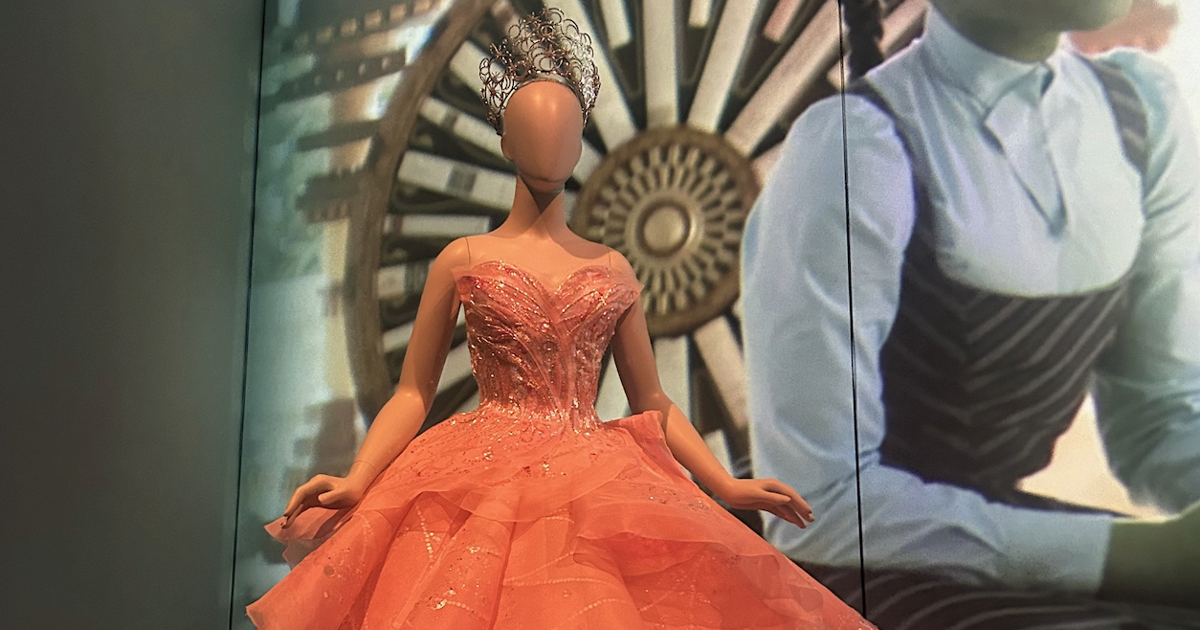
Of course, the exhibition’s biggest draws are the costumes themselves. Glinda’s pink bubble dress, worn by Ariana Grande in “Wicked,” and Elphaba’s Emerald City gown, worn by Cynthia Erivo, are among the show’s highlights. Finished garments are paired with sketches, research materials and design notes, allowing visitors to follow a costume from concept to screen or stage.
“I shape how you see someone before they speak a word…That’s what fascinates me: how simple a fabric can tell us who is a hero and who is wicked,” Tazewell said in a TED talk about his practice.
Garments are designed not only to communicate character but to withstand the practical demands of performance, from rapid costume changes to physically demanding choreography. Elphaba’s black gown, for example, draws inspiration from the flora and fungi of Oz, helping establish her connection to the natural world while setting her apart from the gleaming Emerald City around her. The exhibition also shows how the costume had to function under unusual strain: Cynthia Erivo sang “Defying Gravity” live while suspended in the air on a broomstick, requiring a garment engineered to carry the weight of both the performance and the illusion.
A recurring theme throughout the exhibition is how often Tazewell has worked on stories centered on belonging, exclusion and identity, from “Wicked” and “The Wiz” to “Hamilton” and “West Side Story.”
Discussing his approach to Steven Spielberg’s “West Side Story,” Tazewell explained that he wanted the costumes to communicate the cultural differences between the Jets and the Sharks without reducing either group to a stereotype. His designs draw from working-class New York, Latin American textiles and the distinct visual identities of both communities while emphasizing the larger social forces shaping their conflict.
“For the Jets, I leaned into blue-collar toughness … the uniform for boys rooted in concrete,” Tazewell said in his TED talk. “For the Sharks, I turned to Latin textiles, vibrant florals, colors inspired by sun and sea … I let the colors bleed together because even in conflict, cultures mix — the borders are never as fixed as we pretend.”
As remarkable as the costumes themselves are, what stands out is Tazewell’s unwavering relationship to his identity and glimpses into his creative process.
The question that greets visitors at the beginning of the exhibition — “Who am I?” — lingers throughout the show. By the end, Tazewell’s story invites a broader question: Who are we? “Crafting Character” offers a cache of tools and possibilities, modeled after Tazewell’s ability to draw inspiration from his immediate surroundings. In doing so, it encourages visitors to begin crafting definitions of their own.
“Crafting Character: the Costumes of Paul Tazewell” is on view at the Griffin Museum of Science and Industry through September 7, 2026.
‘ The preceding article may include information circulated by third parties ’
‘ Some details of this article were extracted from the following source hpherald.com ’