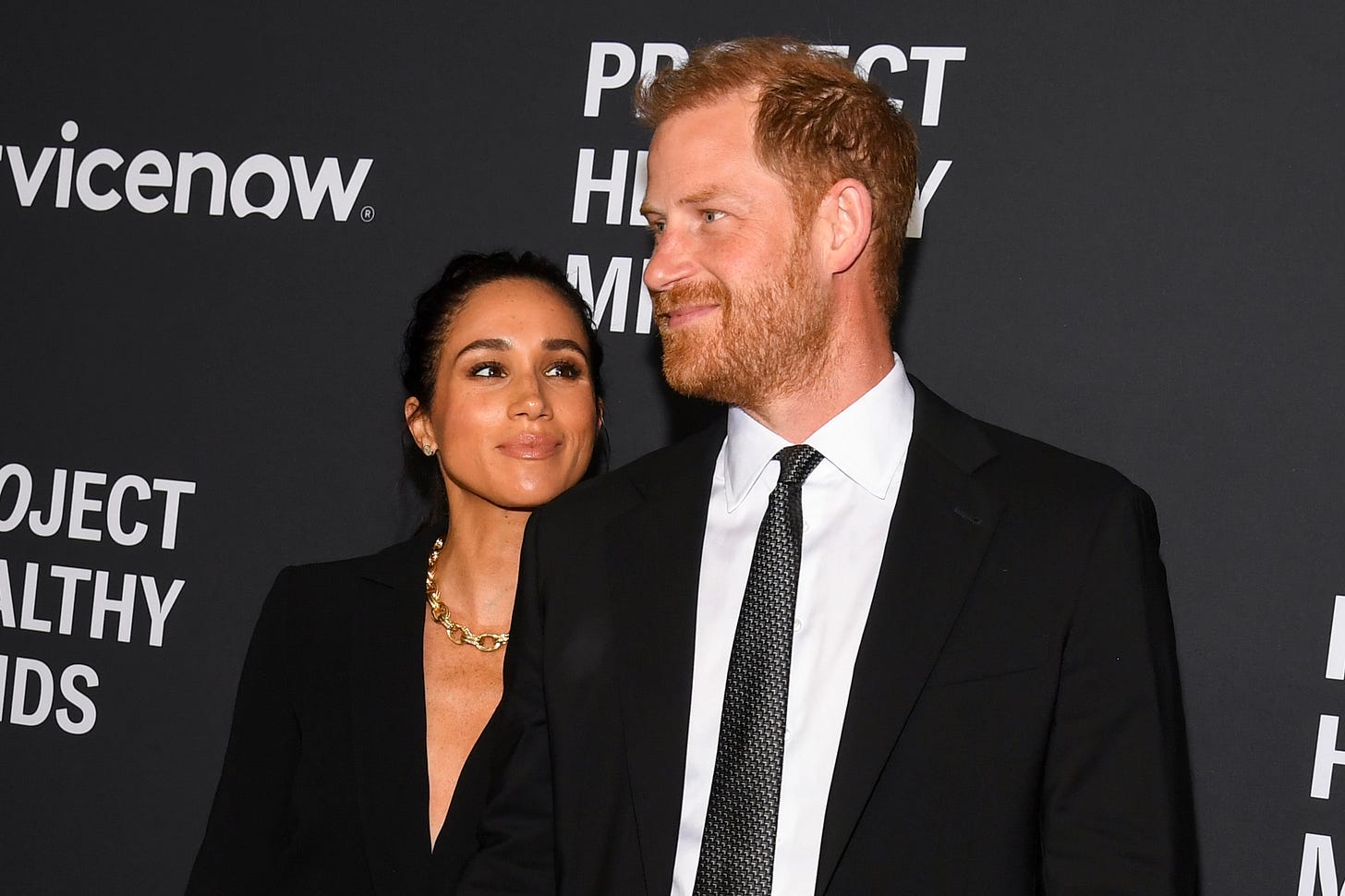
I was very struck today, after listening to Prince Harry’s new podcast with Hasan Minhaj, by how much he must loathe his wife posting endless images of their children on social media.
The prince was 50 minutes into the chat when he said, in a line which has not been picked up by any other media yet (partly, I suspect, because listening to the end of this sycophantic encounter is a trial of patience you really would want to be being paid for): “Parents should be really, really worried, concerned, and cautious about putting photographs of their kids online. Especially now with this surge of unregulated AI. You just don’t know where it’s going to go.”
The juxtaposition of Harry’s interview with the story I broke exclusively yesterday —that Harry and Meghan’s team raced to scrub images of their children’s faces from online platforms after accidentally including them in a Pumpkin Patch video —is striking.
Although the interview was actually recorded three weeks ago and Harry was speaking in generalities—about parents, AI, and online safety—the timing and tone of his remarks on Minhaj’s podcast made them sound perilously close to a domestic sub-tweet. Meghan’s Instagram (which Harry suggested was part of a group of internet companies controlled by “evil” and “wicked” men) has been humming all year with lifestyle clips featuring images of their children, albeit photographed in ways that obscure the details of their faces.
Those close to him say it wasn’t meant as a public rebuke to his wife, more an expression of genuine exasperation at the utter disregard of social media companies for children’s mental welfare, which millions of parents share.
But the reality of a husband urging restraint while the wife uploads content featuring the kids isn’t great for a brand that depends on selling a vision of a harmonious marriage.
Whether he was subconsciously chastising Meghan or not doesn’t really matter; the effect is the same.
His words highlight a fault line in their partnership that they go to great lengths to blur: the clash between Harry’s moral seriousness and Meghan’s marketing instinct. One speaks the language of protection, the other of promotion. Harry is urging the world to keep its children’s images off social media while his wife is doing the opposite.
It was ironic that Minhaj was invoking the specter of Sora, the new generative video software capable of conjuring photorealistic faces from fragments, on YouTube in the very week Harry and Meghan accidentally gave anyone trying to complete the jigsaw the final piece. Archie and Lilibet, and over the years, have been revealed in degrees. We actually don’t even need Sora to fill in the blanks. Followers have pieced together those fragments into an almost complete portrait. The children’s appearance is no mystery.
Instagram is a key marketing tool for Meghan, and her glossy reels are all about domestic idyll. And though she maintains the fiction of privacy by avoiding direct shots of their children’s faces, their presence hovers unmistakably in the frame: little bodies darting through the background, little voices off-camera, the Sussex family’s unspoken star power quietly monetized.
For Harry, who described tech bosses in excoriating terms as killers and fraudsters in the interview, it’s pretty clear that he would rather his kids’ images not be posted online.
One source told me this week, “He’d be quite happy if social media didn’t exist, full stop. He isn’t a fan of it at all—it’s why he isn’t on it. He’s very protective of the kids. He feels it just isn’t a safe space. Like a lot of parents, he worries about the impact it will have on his kids.”
Harry has become a powerful voice in the parents’ networks that campaign for online reform, warning of deepfakes, trolling, and the corrosive mental health impact of always being online. He has spoken movingly about the trauma of seeing his mother hounded by cameras and about the need for “guardrails” in the digital world.
And yet the world has become increasingly accustomed to seeing his own children circulating through that same ecosystem to drive engagement.
The couple’s once-unified message—digital responsibility, compassion online, truth over clickbait—has split down the middle since Meghan relaunched her Insta this year.
I would suggest this is not just a divergence of tone, but of fundamental philosophy. Harry believes in withdrawal, in limiting exposure. Meghan believes in visibility, in shaping the story before others do. His instinct is to shut the door; hers is to stage-manage the room behind it.
Nowhere is the difference more visible than in their respective brands. Harry’s post-royal career has been defined by high-minded seriousness—mental health, veterans, the environment—his voice often somber, his public appearances rare.
Meghan’s is a creature of light: jam jars, golden-hour lighting, California ease.
And yet that golden light keeps exposing cracks. Her so-called “jam incident”—when eagle-eyed followers noticed she was holding a jar lifter upside down in one of her kitchen videos—was more than a meme. It became a metaphor for the fakery at the core of her image: a woman selling authenticity who keeps getting caught performing it.
The same energy animates her new Instagram life. Each polished frame, each sentimental caption, each glimpse of domestic normality only serves to remind cynical viewers how staged the whole operation is.
Harry, I think, grasps that the performative quality undermines the moral seriousness he craves. His activism relies on credibility: if you are warning the world about the dangers of online exposure, you cannot, at the same time, profit from it. Each new post undercuts him. Every time Meghan’s account deploys their children, however blurred their faces, she reopens the question of whether the Sussexes are protecting privacy or packaging it for sale by the ounce.
Hypocrisy is, I believe, at the heart of why Brand Sussex increasingly fails to land.
When they left royal life, the couple promised a transparent media venture rooted in compassion and accountability. Archewell would be the anti-tabloid—a place for truth. Instead, the projects that thrived were the ones that sniped and attacked and trolled the most: the Netflix doc and the Oprah interview.
Now we have the endless re-curated snippets of their private life.
The gap between their rhetoric and their reality is widening. For Meghan, social media is a stage she cannot abandon. Indeed, Meghan hinted the other day that she was shifting her entertaining show into 2-minute social media clips!
But for Harry, it is clearly an arena he cannot tolerate.
At the center of that push-pull lies an authenticity crisis.
Meghan and Harry have made digital responsibility and child protection online one of their signature causes. They have denounced the “toxic effects” of social media on young minds and spoken movingly about the pressures it creates.
Yet she remains an active participant in that same ecosystem—courting engagement, curating content, and, inevitably, monetizing the clicks that come with it.
‘ The preceding article may include information circulated by third parties ’
‘ Some details of this article were extracted from the following source theroyalist.substack.com ’