If you are wondering whether Madison Square Garden Entertainment is still a bargain after its recent run, or if the easy money has already been made, this breakdown is for you.
The stock has climbed 5.7% over the last week, 15.4% over the past month, and 52.6% year to date, with a 64.1% gain over the past year reshaping how the market is viewing its potential.
Investors have been reacting to a stream of venue and live-event related headlines, including ongoing buzz around premium experiences at Madison Square Garden and broader optimism for live entertainment demand. These developments have supported a narrative that MSGE could have more pricing power and monetization levers than the market had previously assumed.
Despite the excitement, our valuation model gives Madison Square Garden Entertainment a 1/6 valuation score, suggesting it only screens as undervalued on one of six checks. Next, we will unpack those methods, before finishing with a more holistic way to think about what the stock might be worth.
Madison Square Garden Entertainment scores just 1/6 on our valuation checks. See what other red flags we found in the full valuation breakdown.
A Discounted Cash Flow model takes the cash Madison Square Garden Entertainment is expected to generate in the future and discounts those projections back to what they are worth in $ today. The idea is to estimate what an investor might be willing to pay now for those future cash flows.
ADVERTISEMENT
MSGE generated around $140.6 Million in free cash flow over the last twelve months, and analysts expect this to grow steadily, reaching about $201 Million by 2028. Beyond the explicit analyst horizon, Simply Wall St extrapolates further growth, with free cash flow projections rising into the mid $200 Million range over the following years as the business scales its venues and premium experiences.
Using a 2 Stage Free Cash Flow to Equity model, these future cash flows are discounted back to an estimated intrinsic value of roughly $62.70 per share. Compared to the current share price, this implies the stock is about 13.1% undervalued, which may indicate a margin of safety for long term investors who have confidence in the cash flow trajectory.
For profitable companies like Madison Square Garden Entertainment, the price to earnings ratio is a useful shorthand for how much investors are willing to pay today for each dollar of current earnings. A higher PE can be justified when a business has strong growth prospects and relatively low perceived risk, while slower growth or higher uncertainty usually calls for a lower, more conservative PE.
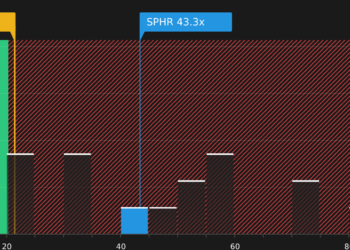
MSGE currently trades on a PE of about 73.3x, well above the Entertainment industry average of roughly 20.1x and higher than its peer group average of around 45.1x. To move beyond simple comparisons, Simply Wall St calculates a proprietary Fair Ratio of 24.5x. This reflects what a reasonable PE might be once factors like MSGE’s earnings growth outlook, profit margins, industry dynamics, market cap and company specific risks are taken into account.
This Fair Ratio framework is more robust than just lining MSGE up against peers because it adjusts for differences in growth and risk rather than assuming all companies deserve similar multiples. With MSGE’s actual PE of 73.3x sitting significantly above the 24.5x Fair Ratio, the stock screens as materially overvalued on this earnings based lens.
Earlier we mentioned that there is an even better way to understand valuation, so let us introduce you to Narratives, a simple framework on Simply Wall St’s Community page that lets you write the story behind the numbers by linking your view of Madison Square Garden Entertainment’s business drivers to a set of revenue, earnings and margin forecasts, converting that into a Fair Value, and then comparing it to today’s Price to decide whether you think the stock is a buy or a sell. The platform dynamically updates your Narrative as new news or earnings arrive, and makes it easy to see, for example, how one investor might build a bullish MSGE Narrative around sustained premium demand, sponsorship momentum and a Fair Value near 52 dollars, while another, more cautious investor could anchor on slower discretionary spending, venue concentration risk and a Fair Value closer to 45 dollars.
This article by Simply Wall St is general in nature. We provide commentary based on historical data and analyst forecasts only using an unbiased methodology and our articles are not intended to be financial advice. It does not constitute a recommendation to buy or sell any stock, and does not take account of your objectives, or your financial situation. We aim to bring you long-term focused analysis driven by fundamental data. Note that our analysis may not factor in the latest price-sensitive company announcements or qualitative material. Simply Wall St has no position in any stocks mentioned.