“The worker can unionize, go out on strike; mothers are divided from each other in homes, tied to their children by compassionate bonds; our wildcat strikes have most often taken the form of physical or mental breakdown,” wrote Adrienne Rich in “Of Woman Born.” Four decades later, I began to write “If I Had Legs I’d Kick You.” Her words ring true for me because I experienced the existential terror of loving my child so fiercely, caring for her so full-bodied, that the only way I could sustain this in the midst of her health crisis was to divide from myself and experience the horror of disappearing. No one’s job was to care for me. No one’s concern was how I could maintain a sense of self in the context of the stakes of a sick child. Of course not. I was the Mother. But didn’t I need to exist as my own person in order to do the job bestowed on me when my daughter exited my body seven years earlier? How else could we both survive?
Does cinema tell — and thus validate — stories of mothers dealing with this very complicated conundrum? The existential imperative of knowing herself as a separate individual, with wants, needs and limits, colliding with the persistently all-encompassing needs of another person, a person who started this world as part of her very body and soul? Not until I sat down to write the script that would provide a space for me to express the taboo, the forbidden, the absurd and the terrifying feelings I knew I wasn’t alone in. Not until I willed this movie into existence.
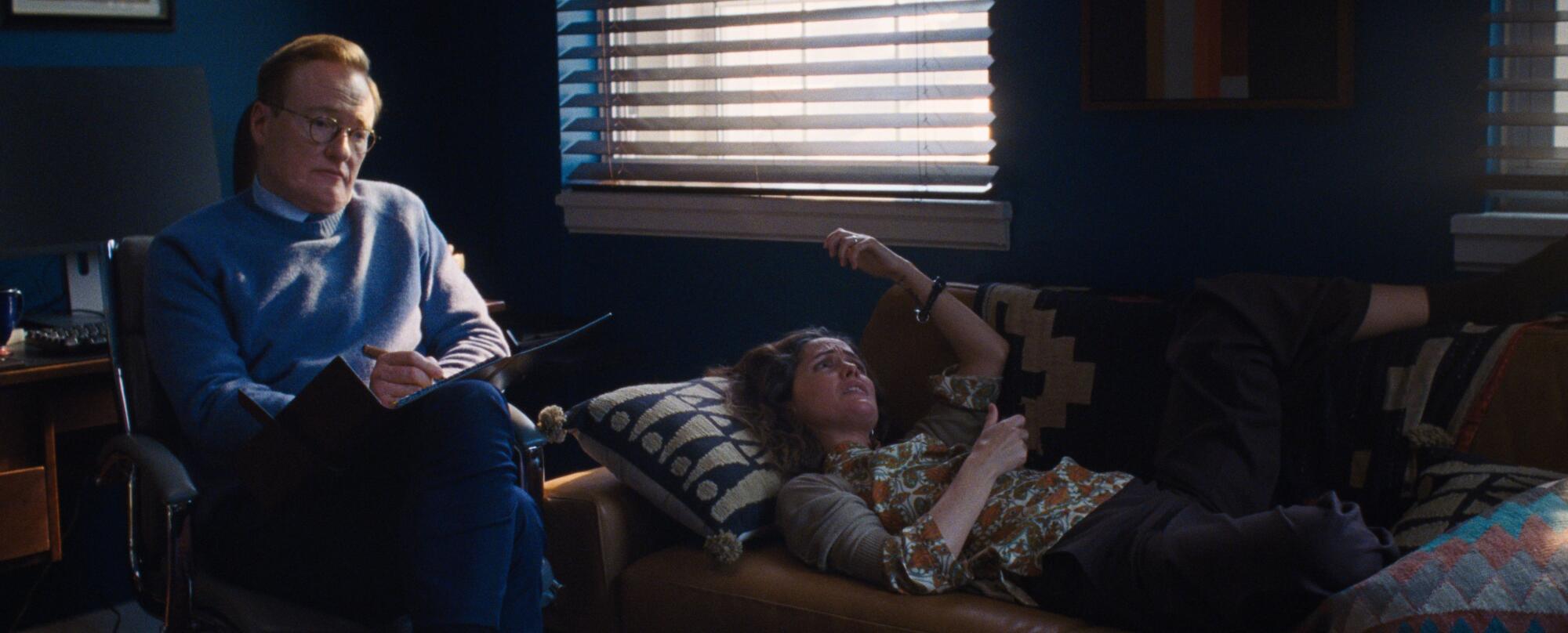
Conan O’Brien and Rose Byrne in “If I Had Legs I’d Kick You.”
(A24)
First I had to dust off and reclaim the title of Artist I had buried underneath frustration and resentment and lay it loudly alongside that of Mother. While writing the script I experienced my daughter recovering but my mother dying. I showed the script to everyone with the unanimous reaction, “This is the best script I’ve ever read,” and yet no one would fund it. Instead I’d get, Maybe if you pulled back on this. Maybe if she wasn’t quite like that. If she had a love affair. You’ll have to cut this scene. We need to see the child! No one uses practical effects like that. No one will like this woman. Have you thought about how to make her more likable? That subplot has commercial potential, have you considered making it a mystery about a missing woman? What about making the whole thing… easier? No. No. No.
Reader, I heard a lot of noes. I said a lot of noes. I didn’t stop. I needed to make this movie. Not wanted. Needed.
If I did not make this movie, a violent void built from complicated trauma would be stuck inside me. I needed people to experience this feeling. I knew people would see themselves for the very first time in this film. I knew my very specific feeling was also somehow universal. I trusted the material, myself, my vision. Someone finally said “Yes.” But then I had only half the money I’d need. I kept going until the other half came. I was given 25 days. I used my director’s fee to buy two more. There would be no time on set for a single mistake or lots of takes. So I created a system by which I could not fail.

Mary Brontstein.
(Guerin Blask / For The Times)
Rehearsal periods started a year before shooting with actors who astonished me with their trust in my vision. In the middle of this, my father died. Now I was a parentless daughter. Then I entered into the biggest venture of the film, forming the character of Linda with Rose Byrne. This took place at my kitchen table months before our production office opened. Through our private work together, she birthed Linda from the page into her body, becoming an emotional avatar for my deepest fears and darkest fantasies. Work with my director of photography Christopher Messina on the visual language, lighting and technical aspects of the film went on for more than a year before shooting. There were not enough days. So the surrealist and experimental elements of the film were shot during postproduction with just me, my DP and lots of trips to the craft store.
The hard-won path of getting “If I Had Legs I’d Kick You” from brain to page to screen is an example of what a filmmaker does when they must make a film. She finds a way. She steals time. She transfers her enthusiasm and vision wholesale to the other artists she is depending on. She cries in secret and has bulletproof confidence in public. It is the same thing that a mother does, even on the brink of a complete breakdown: She can’t strike. She has a mental breakdown and then gets it done.
‘ The preceding article may include information circulated by third parties ’
‘ Some details of this article were extracted from the following source www.latimes.com ’