Reality shows, like almost all television programming, have always thrived on attention currency: the idea that our viewing habits can be commodified into a measure of what’s hot, popular and worthy of our precious time.
At reality TV’s genesis, that looked like network ratings from millions of viewers tuning in for appointment television week after week for, in most cases, the juicy drama they couldn’t get enough of. Nowadays, though, those ratings are more contingent upon onscreen drama sparking discussions, and not just in our homes, group chats and at the office watercooler. Instead, conversations have shifted to places like social media, which are designed to fuel TV gossip discourse (the good and the bad) for a much wider, more engaged, and, dare I say, obsessed audience.
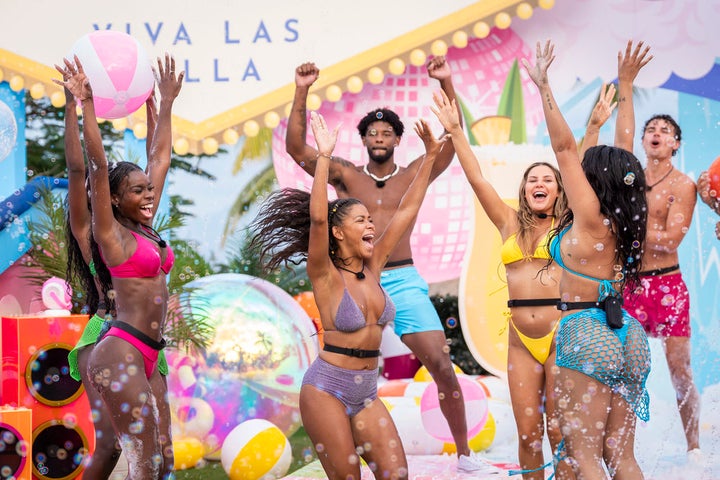
It’s for that reason that many who aren’t avid reality TV watchers may have found their social media timelines hijacked this summer by the annual fixation of Peacock’s “Love Island USA.”
A hit spinoff of the U.K. original, “Love Island USA” has become the most-talked-about reality series in recent memory, largely due to the unprecedented success of Season 6’s breakout cast — whom fans have followed religiously online and in real life since last summer, and even now on their Peacock spinoff, “Love Island: Beyond the Villa.”
But the same can be said of the show’s record-breaking seventh season, which has been the subject of just as much, if not more, internet chatter this summer.
With fan-favorite couples like Nicolandria (Nic Vansteenberghe and Olandria Carthen) and Chellace (Chelley Bissainthe and Ace Greene) gaining devoted followings and sparking their own cultural waves — alongside an increasingly star-studded viewership — “Love Island USA” has solidified its place as a full-blown reality TV obsession.
But amid all that passion, something shifted between Seasons 6 and 7 that took the “Love Island USA” fandom into toxic territory, so much so that the show itself had to intervene.

Ahead of one episode that aired in late June, the Peacock series issued a “friendly reminder” to viewers amid growing negative discourse online about some contestants.
“We appreciate the fans, the passion for the series, and the amazing group of Islanders who are sharing their summer with us,” read the statement. “Please just remember they’re real people — so let’s be kind and spread the love!”
On an episode of “Aftersun,” the “Love Island USA” companion talk show, host Ariana Madix also made a statement to fans, saying directly, “Don’t be contacting people’s families. Don’t be doxxing people. Don’t be going on Islander’s pages and saying rude things.”
This isn’t the first time “Love Island USA” has called out such behavior from viewers. A similar statement was made last year ahead of Season 6’s reunion, which noted, “While we love your passion for [the “Love Island USA” cast], we ask that you always choose to be kind.”
Still, this summer saw viewer conduct reach new lows, with online harassment escalating to rather parasocial levels due to fanbase wars and a hypersurveillance of Islanders once they exited the villa — the latter often taking place in dedicated fan communities that constantly repost Islanders’ day-to-day activities, both on and offline.
In the most extreme cases this season, fans’ toxic behavior turned into outright racism toward Carthen and Bissainthe, the only two dark-skinned Black women of the main cast. The two addressed the harsh backlash they received last month on the “Baby, This Is Keke Palmer” podcast, where they told the actor-host that they felt they needed to “tone down” in the villa to avoid being vilified. Yet, it happened anyway.
During this week’s reunion special, Carthen brought up the matter again when she expressed how hurt she felt that fellow castmate and former friend Huda Mustafa didn’t check her stans over online racism they spewed Carthen’s way, which Carthen said impacted her mentally.
“I truly wish you would’ve prioritized that moment to address the racism and the bullying towards me and Chelley since that was spewed out the most,” Carthen said before tearing up. “Your face was not plastered on fucking George Floyd’s body. Mine was, and I told you that. It was that bad.”
In these cases, it doesn’t help that platforms like X (formerly Twitter), Instagram and TikTok egg on this extremist behavior by giving fans direct access to the people they watch nearly every day of the week. But Uttara Ananthakrishnan, assistant professor of information systems at Carnegie Mellon University, told celebrity.land this is a result of social media and reality TV working in tandem to increase engagement, rather than addressing what’s most concerning.

It’s a two-fold problem, the professor said, that begins with reality TV offering a voyeuristic glimpse into the everyday lives of show contestants, which are technically scripted for entertainment. The juiciest storylines are decided by producers, who then package them into moments designed to spark the most engagement on social media.
“You create this environment where you want [these moments] to go off the TV platform and go into all these other channels where your primary engagement is going to come from,” Ananthakrishnan said. “And the more divisive your main show or your main plot is, the higher the buzz that it creates on a different platform.”
“So, it’s sort of engineered to provoke reactions on what is already a very volatile channel in itself,” she added, “which is social media.”
Essentially, it’s a feedback loop fueled by algorithms that reward outrage by amplifying the most polarizing content. And with groups of passionate viewers pledging their allegiance to their favorites, online commentary has become less about the show itself and more about defending their chosen side, whether they’re right or wrong.
That would explain why some viewer responses often feel so personal — and so extreme — even when directed at contestants they’ve never met. But as Ananthakrishnan pointed out, there’s more at play than just emotional projection.
There’s also the fact that reality shows are structured in a way to give audiences a “mirage of authenticity,” the professor noted, where the degrees of separation are intentionally collapsed to make them feel like they genuinely know the contestants on a personal level.
“Most of the time, the stars of these reality shows go on to these [social media] platforms and interact with their audience as the person that they are portrayed to be on [TV],” the professor added, “which then leads to this perceived authenticity of these characters or the way that this bond has been created.”
But in the case of “Love Island USA,” those blurred lines of reality can also be attributed to the fact that the show gave fans more voting power this past season to decide contestants’ romantic fates. That in itself makes viewers act more entitled because they’re actually invested in the onscreen drama, not as spectators, but as active participants.
And this is where parasocial relationships come into play — this one-sided connection between fans and the person they supported all season long. In pop culture terms, we call those folks “stans” — derived from Eminem’s 2000 song “Stan” — who glorify and defend their favs to no end, to the point where any negative comment, or even the slightest critique, is met with immediate vitriol.
These relationships, of course, aren’t exclusive to reality TV. In today’s era, stan culture primarily exists in the celebrity and entertainment realms (think of Beyoncé, Nicki Minaj and Cardi B’s fanbases, for instance). However, the side of the spectrum devoted to reality TV fandom is just as powerful, in part, because contestants who appear on shows like “Love Island USA” are much more accessible.
“You’re seeing them in a much more immersive way than when you watch a sitcom that is scripted and has this artificialness to it that we don’t see in the same way,” said Maureen Coyle, assistant professor of psychology at Widener University, who also pointed to social media as a factor.
“It blurs that line between this person I know in real life and this person I see across the screen,” she added, “and we treat them as fundamentally the same in our own psyche.”

That’s sort of what reality shows are counting on from their viewers. Despite its name, reality TV, as many know, often fails to paint a full, raw picture of what’s actually happening in real life, since the ultimate goal is to entertain. Hence, you usually hear stars complaining about receiving unfair edits, which sometimes fuel false narratives about them.
But it’s hard for viewers to keep that in mind when a show like “Love Island,” which is filmed and aired in real time, feels like it’s capturing everything we think is happening IRL.
“There’s a false sense that [people are] truly seeing the whole of a complex person and that what you’re seeing on the reality show is all of that person’s dynamics,” said Tracy King, a clinical psychologist with expertise in online behavior.
“I don’t think people like to think that it’s just a screenshot,” she added. “They like to think that that’s what’s there, and they’re getting that insight into [what they’re seeing], so they then feel they have the right to comment on it, too.”
That explains why some “Love Island USA” fans have become especially hostile toward cast members online lately, spawning communities where negativity only grows as more people join in, some under anonymity. As King noted, this groupthink behavior only amplifies users’ worst impulses to say the most hurtful things to and about contestants.
“[Viewers] are not really understanding that what they’re saying is harmful,” King said of fan comments. “They’re just reacting rather than responding to what they see, and because it’s online, they don’t see that it has an impact.”

That’s a critique many “Love Island USA” cast members voiced this past season, especially as fan backlash escalated into vicious cyberbullying, including attacks on contestants’ appearances and behavior. For viewers, that should serve as a stark reminder of just how deeply online hate can cut, especially when it crosses the line from criticism to straight-up dehumanization.
It’s unsettling to see just how toxic fan behavior has become lately. Still, again, both King and Coyle trace it back to how parasocial relationships can often distort boundaries to the point that viewers feel justified in attacking contestants who go against their favs or trigger something within themselves that they think is under attack.
“That is why people could get pushed to saying and doing these more dangerous, aggressive things,” Coyle said, “because they’re seeing it as an attack on their belief system.”
But that’s why the professor says it takes more self-awareness from viewers to decide what does and doesn’t warrant a reaction online, and when it’s time to take a step back from our devices.
“Or as Gen Z says, touch grass,” she added.

It may take time for that mindset to catch on again. These days, online culture thrives on instant reactions, and reality TV, by design, plays right into that. But with “Love Island USA” now behind us (at least until next summer), there’s a chance for the chronically online conversations to slow down, finally.
Maybe during that time, viewers will reflect on where they went wrong with their commentary this season and course-correct for the future. Or better yet, the show itself will take measures to address the toxicity in a way that won’t feed the algorithm machine — that is, if they care enough to really address the issue.
“It’s not an easy problem to solve,” Ananthakrishnan said, adding there’s still a lack of incentives for reality shows to monitor their engagement online.
“They want a lot of toxicity and hate because that there is a lot of attention [for them],” she adds. “But the technology absolutely exists now to [filter] what gets put out on the internet.”
If social media platforms or reality shows won’t take it upon themselves to set healthier boundaries around fan engagement, then perhaps it’s on viewers to take control instead.
“People forget that they do have some control over their algorithms,” Coyle noted. “If we notice that we don’t feel good, that we’re feeling angry or upset, or these toxic dynamics are happening with other people, it could be good to just tell the platform, ‘I want less of this, or I want to pause this for 30 days.’” Like maybe I want to wait until the season’s over before I even engage online with it.”
“I know that can be hard to do,” she added. “But things like that, where we try and communicate to the platform that we want less of that content, it won’t take up so much mental space, and then it might be less likely that we’ll have those visceral reactions to things.”
‘ The preceding article may include information circulated by third parties ’
‘ Some details of this article were extracted from the following source www.celebrity.land ’