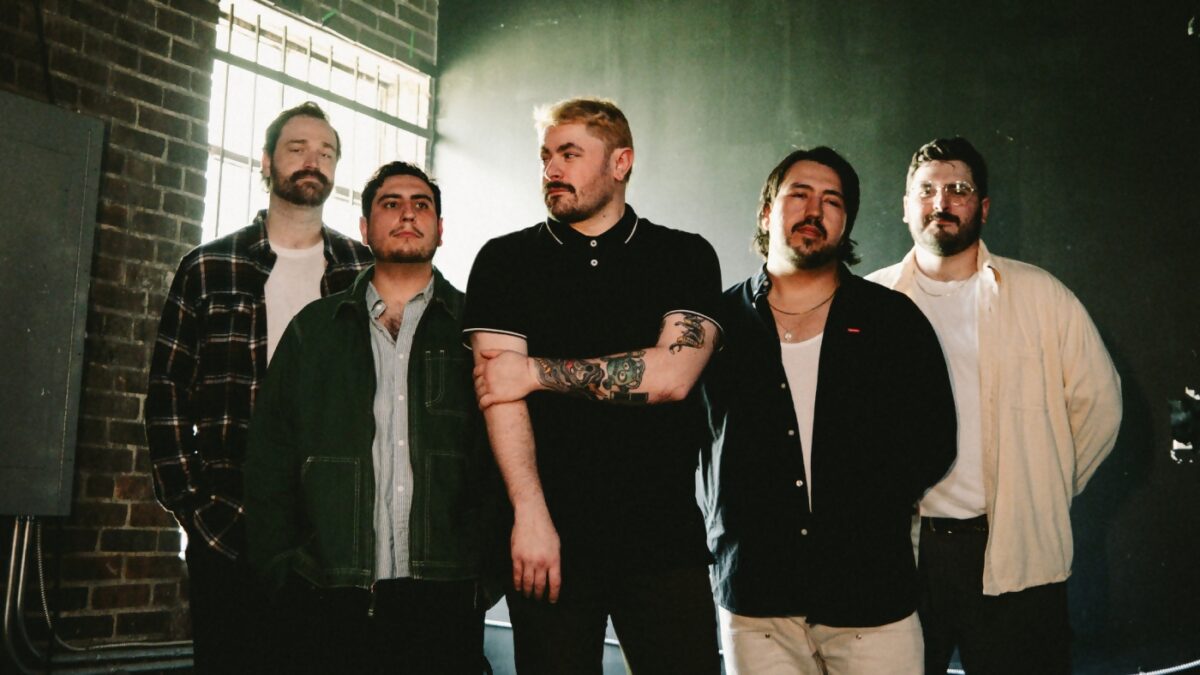
Corey Castro thought he knew exactly what Free Throw’s new era was going to be defined by. Then he got the call that he was going to be a father.
A life-changing moment for anyone, but when you have poured so much of yourself into a set of songs, the context of not just them but who you are as someone who will be revisting those feelings every night when you play them live is completely altered.
A lot of what makes up the band’s latest record ‘Moments Before The Wind’ does actually sit in the grey rather than either black or white. Modern emo brilliance presented within a liminal space where lessons that have been learned are put into practice whilst lessons still waiting to be uncovered have the space to have an effect.
As the band prepare to make their way back to the UK and Europe for a string of shows, including an appearances at Outbreak Fest and 2000trees, Rock Sound catches up with vocalist Cory Castro to delve into what has changed and what has stayed for same for him.
Rock Sound: How did it feel to realise just how much what you had been working on with this new record was immediately changed with the sort of news you received during the making of it?
Cory: The record, outside of the end, was already what it was going to be like in my head. I felt like I didn’t really have a defining moment that really tied it all together. I was writing a lot about the stuff that I’d gone through over the last year and a half, two years, and when I got that call in the studio, that immediately kind of gave me, ‘Oh, this is that moment’. It gave me a new sense of purpose. I was writing a lot of the lyrics with the idea of being stuck in this liminal space in your mind where all the things that are going on in your life seems like oddly familiar because they’ve happened a lot, or you’re also like stuck in a space that you don’t really want to be in. it’s like being in the Backrooms in your head andconstantly being on the threshold, but never crossing the threshold. And that call was the moment that all of a sudden, I saw where the cross of the threshold was. And like, you know, it gave me like this light at the end of the tunnel. I knew that I wasn’t going to be living for myself anymore. That this was going to be a drastic change, and something that I needed.
So now, the record wasn’t just being this collection of songs about the breakup that I went through and then getting back together and all of the issues within that and all the mental health issues of just like the lifestyle that I was definitely leading. That moment gave it a trajectory. I knew immediately where I wanted to go, and it changed how the record is themed and presented.
RS: It’s amazing how you can think you have a handle on something, but then one thing switches, and your whole perspective on who and where you are is in freefall, and you have to figure out who you are in this new reality. Everything flows out at once. And what sort of effect does that have on you as an artist as much as a person?
Cory: It’s like a moment of clarity. I’ve made it such a habit of writing such personal songs and, like, really wearing my heart on my sleeve a lot. Knowing that I’m going to have to go out and play these songs live, you almost have to disassociate sometimes. There are certain songs you know that when you’re performing them, you want to go back to that place to really get that performance and to make it feel as good as you would like it to. But a song like ‘Two Beers In’, I don’t go back to that night anymore. Now that song is a lot more fun for me.
But yeah, it’s definitely like a Pandora’s box without a lid, especially with Free Throw being a band for 13 years and me writing songs about my life for 13 years. Playing those songs, then those songs become popular with people relating to those songs, which actually really helps, especially when you’re really going through it. And there’s nothing better when you’re going through the shit than not feeling alone. I think feeling alone makes things worse.
RS: You mention the songs becoming popular, but what has that been like to witness from inside the band? The growth over the last few years, and the love for songs that you have had for those full 13 years, has been incredible, but how do you feel about that yourself?
Cory: It comes back to being on the threshold. I felt like our band before the pandemic was always the one with our foot in the door, but never really crossing over. A lot of people love ‘Those Days Are Gone’ now, but when it was released, we were still playing people’s living rooms and stuff. It was a short-term kind of thing. But we were finally starting to make that crossover into a wider audience when the pandemic hit, and everything came to a crushing halt.
I honestly thought we were going to have to start over, back at square one, but we got really lucky coming out of the pandemic and landed on some pretty good tours. And from there, it just never stopped going. But now, when you set goals for yourself and eventually achieve them, it never feels like you’re done. I think it’s just human nature to have this insatiable need to keep pushing things further.
The thing about Free Throw is that we have grown up together. We’ve been like this since we were teenagers, basically playing music together, and if not in the same band, in bands that played together. And I think that’s one of the reasons why I don’t think that free throw will ever truly end. I think it’s just kind of one of those things that exists because it is us.
RS: It’s interesting to look back over each era of the band and see just how deep you appeared to be digging. Like, even looking back to 2019’s ‘What’s Past Is Prologue’, that felt like you were going in on a level you hadn’t yet. Yet it’s clear just how much more you still had to share and uncover.
Cory: I definitely thought that at the time. The song ‘What’s Past Is Prologue’ is very real about how I really thought I was figuring myself out. But then life happens, you know. I think it’s the same as with the band. You think you’ve made it, and then oh, there’s something else.
RS: Well, a big thing that feels like it’s changed is that you’re giving yourself a lot more grace these days, being sympathetic to your situation, and allowing reflection to be the predominant emotion.
Cory: That’s actually a really good way to put it. It’s almost like having an out-of-body experience. While I was writing, I was thinking about what happened, but it’s almost like I’m watching myself do it. I think that helps with introspection a lot, and part of it is getting older. The whole thing about being older and wiser is so true. No matter what I said when I was 19, it just is. It’s just life experience. I’m not as angry these days, and I’ve just become more understanding through all this time, I think. And one of the things that’s helped me become a lot more understanding is the outpouring of my emotions and stuff into the records, and then talking to other people who relate to it. Using Free Throw as a sort of therapy.
RS: And part of that is also feeling certain things, even though you don’t actually know or have a reason to feel that way. That can be a scary place to find yourself. But allowing yourself the space to understand it a bit more is the first step towards conquering it.
Cory: Getting older is like a forest. There are so many different ways you can go. And ultimately, you’re never really going to get out of the forest, but when you’re really lost, it is hard to put into words. The best way I found to do it was to write down what was in my mind and, like, use the things I had gone through. And the thing is, up until now, the question that has come from that has been, ‘Did I make the right choices?’ Have I done the right thing? But at the same time, I’m asked all the time what I’m going to do after this, and the truth is, this is all I’ve ever known. But in becoming a dad, I have found a renewed usefulness within the band. I can’t wait to do things again. And, much as I enjoy being home and spending time with my new daughter, I’m very excited about playing shows again. That itch is back.
Free Throw will be playing a string of headline shows across the UK and Europe joined by Saturdays At Your Place, as well as some festival appearances.
Here are the dates:
JUNE
27 – MANCHESTER Outbreak Fest
28 – YSSELSTEYN Jera On Air
29 – COLOGNE Cologne
30 – BERLIN Neue Zukunft
JULY
01 – NUREMBERG Zentralcafe
02 – STUTTGART Juha West
04 – LONDON Electric Ballroom
05 – NORWICH Waterfront
07 – GLASGOW The Garage
08 – NEWCASTLE Newcastle University SU
10 – CHELTENHAM 2000trees Festival
‘ The preceding article may include information circulated by third parties ’
‘ Some details of this article were extracted from the following source rocksound.tv ’