“All my memories are movies,” says the title character of Jay Kelly, Noah Baumbach’s wry dramedy about an A-list actor having an existential crisis. (The Netflix movie hits theaters on Nov. 14 before premiering on the streaming service on Dec. 5, you know the drill.) What’s interesting about this bit of dialogue — and about this purposefully meta portraiture as a whole — is not who’s saying the line, but who’s playing who’s saying the line.
Every movie star carries memories of their best-known roles with them whenever they appear onscreen; audience members don’t just see a famous face familiar from a million magazine covers and red-carpet galleries, but a simultaneous greatest-hits slideshow whizzing by in their mind’s eye. Flash George Clooney’s Mount Rushmore–worthy mug onscreen, and it’s not just another silver fox with a sharp jawline. It’s Michael Clayton, Danny Ocean, Fred Friendly, Major Archie Gates. It’s E.R. MVP Dr. Doug Ross. It’s Batman with nipples.
More from Rolling Stone
That long relationship between him and us is the current running through this look at an artist taking stock of his life. And while we know in our jaded heart of hearts it isn’t explicitly autobiographical, it’s impossible not to merge the fictional and the nonfictional as you watch this semisweet, occasionally syrupy take on the Global Megastar Blues. Regrets? Clooney has likely had a few. As concocted by Baumbach and co-writer Emily Mortimer (yes, the same Emily Mortimer that’s graced everything from Shakespeare flicks to Paddington in Peru), his screen counterpart Jay Kelly’s hauling around a boatload of them. Virtually every character circling the orbit of this Tinseltown royalty got the life they wanted, and now finds themselves wanting the life they didn’t get. Kelly, however, is the epitome of this idea. He’s long been perched at the top of the food chain, beloved by fans and the envy of his peers. So why does he feel so damn empty?
Some of it stems from the usual malaise that happens when a movie shoot is over; Jay is reminded by his longtime manager and perpetual problem-solver Ron Sukenick (Adam Sandler) that he often gets like this at the end of a project. His college-age daughter Daisy (Grace Edwards) is also leaving for the summer to go to Europe during the only time he’s got off, and Jay was looking forward to hanging out with her. His mentor, an elderly filmmaker (Jim Broadbent) on the skids who gave him his big break, just died. And then there’s that chance, or maybe not-so-chance, encounter with an old acting-class pal (Billy Crudup) that leads to a hornet’s nest of resentment and recriminations being stirred up. It’s the perfect storm of extreme circumstances. Time for a long overdue reckoning.
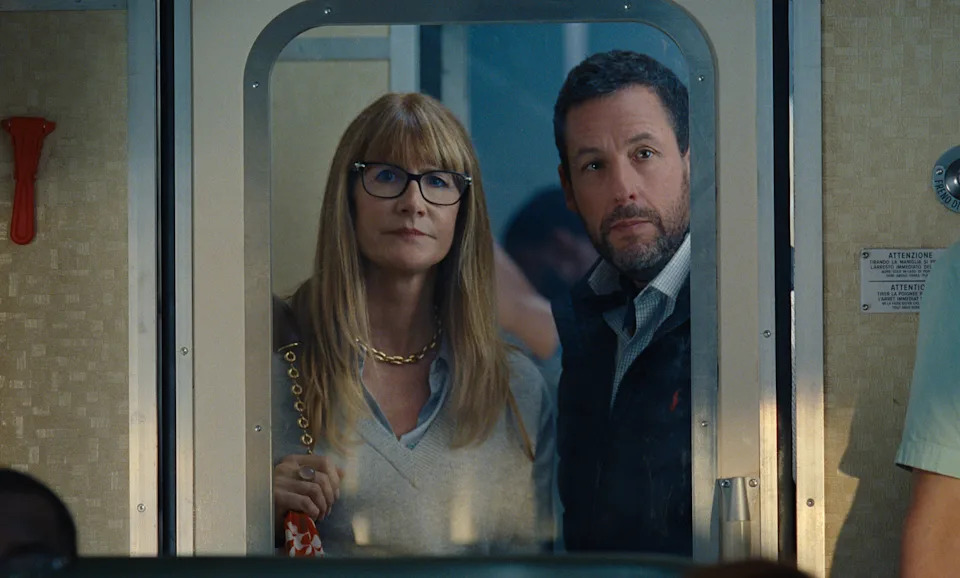
Suddenly, that film-festival tribute in Tuscany, the one that Jay blew off as some sort of ridiculous, symbolic honor? He’s decided to reverse course and attend, dragging Ron, his publicist Liz (Laura Dern), and a retinue of assistants and stylists along with him to Europe. If they leave right away, Jay can intercept his kid in Paris and turn the whole thing into a family trip. It doesn’t occur to him that his daughter maybe wants to simply backpack through the continent with her friends. Or that Ron and Liz have lives outside of their jobs supporting him, and his self-centered pity party is wearing thin. Or that his eldest daughter Jessica (Riley Keough), with whom Jay has been estranged for ages, maybe has a point when she asks him, “Do you know how I know you didn’t wanna spend time with me? Because you didn’t spend time with me.“

What we have is not just a showcase for an Oscar-winner, in other words, but the cinematic equivalent of Harry Chapin’s “Cat’s in the Cradle,” combined with bits of Hollywood Confidential backstage farces and a lot of maudlin reminders that a lack of work-life balance leaves collateral damage in its wake, etc. It’s the sad-dad version of a showbiz valentine, a wobbly knuckleball that thinks its a screwball pitch, the kind of thing that isn’t above goosing moments with overly sentimental orchestrals or letting Clooney/Kelly unleash a charm offensive on a train filled with common-people caricatures. And while it has its share of highlights — a random close-up of Clooney that captures Kelly in mid-thought, a throwaway line delivered with offhand comic timing (“Death is always so surprising, particularly in L.A.”) — there’s a lot of celebrity malaise and hot air masquerading as insight here.
You could make a case that it really isn’t even Clooney’s movie, though he’s in almost every scene, even the cringeworthy flashbacks featuring his younger self; Jay’s lament that he feels like he’s “watching a movie of [his] life” is taken to another level by making him a ghost-like observer as the past plays out like scenes on old sets. Again, he’s doing perfectly fine work with what he’s working with. The stealth lead of Jay Kelly is Sandler, who blooms on the periphery here. His take on the professional star whisperer, ready to drop everything for his client in a nanosecond and able to coax him out of funks via endless distractions, is neither cloyingly affectionate nor barbed. It simply feels beautifully reactive and in-the-moment in way most of the main narrative business doesn’t. His scenes with Dern, always a first-rate scene partner, make you wish for a longer cut of an already long film, where they share more about their storied history. We don’t pay much mind to the cacophony of awards-season chatter, but it’s clear why Sandler is the one generating the buzz.
A colleague recently mentioned how they kept running into three types of movies: the good, the bad, and the simply-wanting-it-to-be-better. Jay Kelly is a solid example of No. 3. “I wish you were the man I thought you were,” one character says about Kelly, and you’ll find yourself wishing this was the superior movie you think it could be. As it is, Baumbach’s addition to the movies-about-movies canon still makes the most of the star power at the center of it. When Kelly’s big tribute finally kicks into gear, the man of hour watches as his life unfolds before his eyes, one zinger and explosion and zoom-in at a time. Every sequence in the tribute reel is an actual scene from an actual Clooney movie. “Can I go again?” Kelly asks at the end of it, looking straight into the camera. And you get the sense that this time, you know which of the movie stars you’ve been observing for the last few hours is the one speaking.
Best of Rolling Stone
Sign up for RollingStone’s Newsletter. For the latest news, follow us on Facebook, Twitter, and Instagram.
‘ The preceding article may include information circulated by third parties ’
‘ Some details of this article were extracted from the following source www.yahoo.com ’
![Robbie Williams Explains What Fell Onto His Microphone During Live TV Broadcast [Video] - 2oceansvibe News](https://celebrity.land/en/wp-content/uploads/2026/07/Robbie-Williams-Explains-What-Fell-Onto-His-Microphone-During-Live-350x250.jpg)