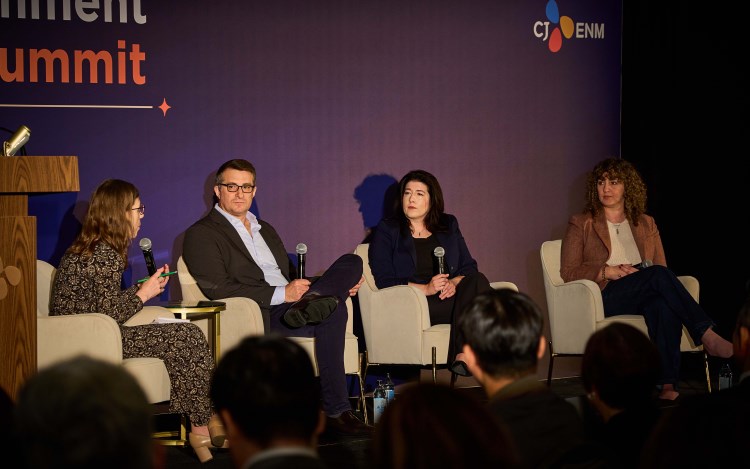
On the audiovisual side, Hyonbae Park, CEO of CJ ENM America (which was also the producer of the event), contextualized the sector’s growth by recalling his arrival in the United States in 1990: ‘I lived in a small town in New Jersey. I was one of the very few Asians there. People came to me and asked, “Where are you from?” And I would say “Korea”, and many people [would] say, “Korea, is that a country?” Fast forward to 2026, no one asks what Korea is anymore’. He added that the commercial message was clear: ‘K-Entertainment is not just a passing trend; they have become an integral part of the daily lives of everyone globally’.
In fact, a central topic of the K-Entertainment Industry Summit was the demographic profile and consumer behavior of the audience. John Kim, Vice President of Marketing and Distribution at UMG/Interscope Records, addressed misconceptions about the sector, explaining, ‘I think people who don’t know what K-pop is, they think it’s a very young niche. But if you look at its reach globally, and [how] it transcended across the globe, you can see that the age range is a bigger gap. I grew up on K-pop right? I think it reaches young teens through the mid-40s and 50s. I grew up on K-pop, my son grows up on K-pop, so it’s generational now’. This transgenerational reach prompted brands to modify their traditional sponsorship strategies.
Michael Traynor, Vice President of Hennessy at Moët Hennessy USA, commented on their collaboration with artist Jackson Wang: ‘We saw extreme diversity, all different demographics, all different ages, and a fandom that again had bought in not just the experience, but they wanted more’. Meanwhile, Tara Klee, Director of Global Touring for AEG Presents, highlighted the business impact of fan communities, stating, ‘My favorite thing about working and touring with artists and management companies is that the fandom, they’re trendsetters ultimately, they have a voice, and it’s really powerful’.
In the television and film sectors, the adaptation of Korean intellectual property influenced production workflows through direct audience feedback analysis. Sera Tabb, Head of Global Television at Webtoon Productions, detailed how they utilized their digital platforms for this purpose: ‘What we noticed is that each individual piece of IP has its own culture, because there’s a comment section on Webtoon. For us, as the adapters…we can track in real time how people are responding to certain character moments’. Similarly, Danielle Kreinik, Senior Vice President of Television at Jerry Bruckheimer Television, agreed on the relevance of these interactions for script development, noting, ‘We want to understand who the fans are and how we can service the fans, but on top of that, bring in a new collection of fans through a new doorway. I spend a lot of time in the comments section…reading, per episode, what people thought’.
Streaming platforms also confirmed their ongoing focus on the Asia-Pacific region for developing original concepts with cross-border distribution potential. Jon Wax, Executive Vice President of International Original Television at Disney Entertainment, explained the company’s programming logic by stating, ‘While travel ability isn’t always something we desire in each one of our shows, certainly as a global streamer, if something tends to travel, that’s attractive to us, even if that’s not the goal for every piece’.
The forum concluded with an analysis of content construction, where James Shin, President of HYBE America Studios, linked commercial viability to cultural authenticity. He concluded, ‘Let’s get rid of the notion that it’s an outlier. And just look at the brass track of what it is. It’s a great piece of storytelling with innovative animation… How did they dial into that, is it the mythology storyline? The details of K-culture? It’s those little details, it’s the beauty and specificity’.
‘ The preceding article may include information circulated by third parties ’
‘ Some details of this article were extracted from the following source www.prensario.net ’