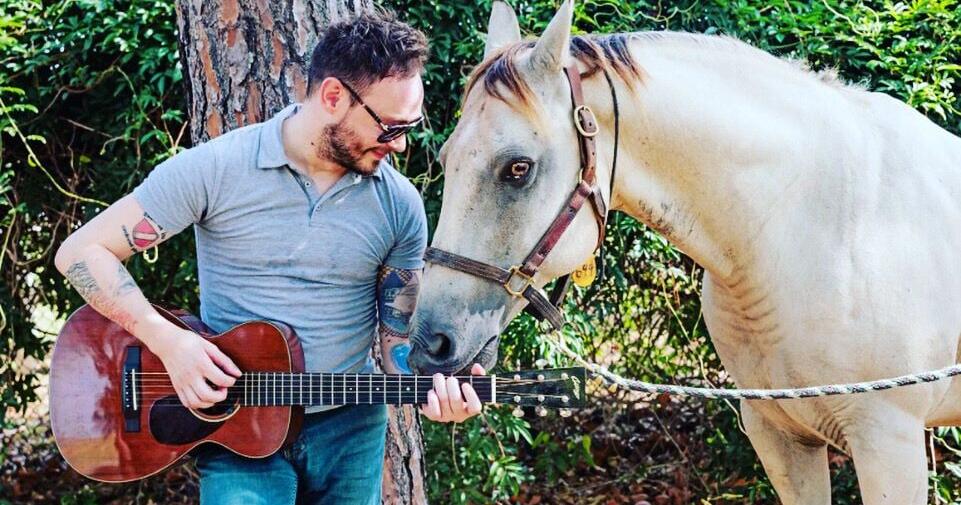
After observing veterinary clinicians and their animal patients, Charlie Rauh channeled his LSU vet school residency into compositions for solo guitar and choir.
The LSU School of Veterinary Medicine was still fresh in Charlie Rauh’s mind when he started writing his book, “simply, patiently, quietly: an approach to creating intentional music.”
He’d spent August 2024 as the school’s artist-in-residence working with faculty, students, staff and animal patients, all of whom inspired his work as a composer.
As a composer, he admits that he was an unusual choice for the school’s residency program, which hosted a visual artist and writer in previous years.

Charlie Rauh was the 2024 artist-in-residence at the LSU School of Veterinary Medicine. The experience was an inspiration for his book, ‘simply, patiently, quietly: an approach to creating intentional music.’
But the match between Rauh and the veterinary school proved to be perfect, and he reflects on that experience in his book.
Released in March
The book, “simply, patiently, quietly,” released in March by String Letter Publishing, is a combination of Rauh’s essays and musical compositions from the residency, complemented by illustrations drawn by his sister, artist and author Christina Rauh Fishburne.
“All of the essays are basically talking about my life experience as a musician and how I think those qualities are important in how somebody approaches being creative,” Rauh said, speaking from his New York home. “So, I talk about a few different things, experiences I’ve had, people I’ve met and a lot of what happened at the residency. The experience was an integral part of making the book happen.”

The cover of Charlie Rauh’s book, ‘simply, patiently, quietly: an approach to creating intentional music.’
Rauh didn’t know what to expect when he first walked into the vet school. That’s not saying he wasn’t familiar with hospitals.
“I spent a lot of time in hospitals when I was a child, and like a lot of people who had early surgeries, I wasn’t very fond of hospitals,” Rauh said. “But I had never spent time in an environment like the veterinary school. I had no idea what they wanted me to do as an artist making music, so I was kind of going into the residency blind in a lot of ways. But I decided to do it.”
All apprehension disappeared the moment Rauh walked into the vet school and stepped into the role of observer.
He often played improvised tunes on his guitar to calm animals before treatments. Other times, he could be found playing for students during a lunch break.

Charlie Rauh’s sister, artist and author Christina Rauh Fishburne, drew the illustrations for Charlie Rauh’s book, ‘simply, patiently, quietly: an approach to creating intentional music.’
He also collaborated on a composition with LSU’s choral program.
“It was an interesting perspective to have,” he said. “That’s something I didn’t really unpack until recently, and that is definitely in the book with how I made the music and how I approached making the music — just having that opportunity to sort of be a specter floating around a hospital. Not many people get that perspective.”
Composing music to translate intention
Rauh also credits literature and travel for inspiring his compositions, and, at one point, explains how he’s combined the influence of Emily Brontë’s poetry with his experience at the vet school in his lullaby compositions.
“I composed these lullabies as a way of translating intention,” he writes. “The subject matter is widely varied: Literature, travels to remote locations, wellness, family — but the core of this music is its intention. From traveling to Djupavik, Iceland, to experiencing the poetry of Emily Brontë for the first time, to examining the intricacies of wellness with the medical staff at LSU Vet Med, I wanted to musically capture the messages that I received.”

Composer Charlie Rauh, artist-in-residence at the LSU School of Veterinary Medicine, plays his guitar outside an examination room in the Stephenson Pet Clinic while Dr. Kielyn Scott and her assistant perform acupuncture on a cocker spaniel.
Rauh still keeps in touch with the school and is in talks of revisiting the school if funding becomes available.
“I’d like to continue the research we were doing to see the impact of intentional music on veterinary medicine and how it can be leveraged,” he said. “We’re still very much talking about it and trying to figure out a way for me to get back down there.”
‘ The preceding article may include information circulated by third parties ’
‘ Some details of this article were extracted from the following source www.nola.com ’