“You’ve got a lot of fans out there, people are posting, marching in the streets,” the prison security guard tells a young inmate with thick eyebrows, handing him a stack of fan mail. “Apparently, there’s even a musical.”
“What kind of sick fucks would buy tickets to something like that?” the prisoner asks, prompting a round of laughter from the audience.
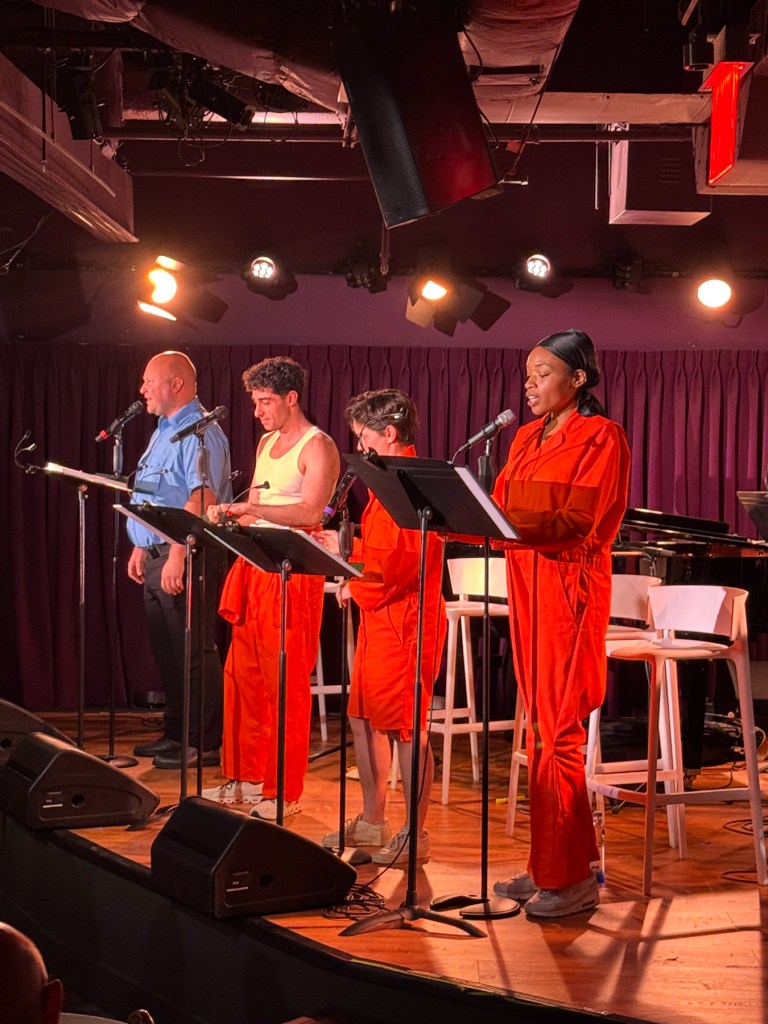
It’s Monday night and Luigi: The Musical has made its New York City debut as a staged reading to a sold-out crowd at the Green Room 42, a cabaret club in Hell’s Kitchen.
Four actors sit on chairs on stage, three are dressed in orange jumpsuits and one wears a prison guard uniform. The three incarcerated characters are meant to represent United Healthcare CEO shooting suspect Luigi Mangione as well as convicted felons Sean “Diddy” Combs and cryptocurrency entrepreneur Sam Bankman-Fried. The musical focuses on an imagined friendship between the three men, who at one point were all being held at Metropolitan Detention Center in Brooklyn. (In reality, Bankman-Fried and Combs were housed in the same high-profile unit but Mangione was assigned to a unit in a different building entirely.)
“These are three men who represent the three pillars of American life that people have lost trust in over the past 15 years,” the musical’s creator Nova Bradford tells me. She’s referring to healthcare, Hollywood, and Big Tech. “Symbolically, we’re telling a story about America’s relationship to these institutions through the story of these three individuals in prison.”
The plot is loosely about the three famous inmates planning a prison escape, but it’s really a critique about society’s relationship with celebrity worship, with commentary about the for-profit healthcare industry woven in. The script hides serious moral and ethical conversations about fame, political violence, and powerful institutions amongst jokes about hashbrowns. It talks about why we, as a culture, venerate certain people, as well as looking at the cultural response to different high-profile criminals and suspects. It does so without taking itself too seriously, marrying commentary with over-the-top satire, including a romantic relationship between Diddy and Bankman-Fried and a running joke where Mangione writes in his diary, singing, “Dear Manifesto.” Just when there are emotional moments of sincerity about healthcare denials causing bankruptcy and even death, the tone shifts with a joke about fan girls sending Mangione their underwear.
Editor’s picks
“It doesn’t matter what you’re famous for, it just matters that you’re famous,” Diddy’s character (played by Chine Ikoro) tells Mangione (played by Mike Cefalo).
“People are addicted to being angry and scared — so if you’re doing something to keep them that way, they’ll make you go viral,” continues fictional Diddy. He advises fictional Mangione to stay famous by feeding the public simple stories they can understand, offering them a hero and a villain. At one point, the musical jokes about President Donald Trump pardoning Diddy and Sam Bankman-Fried (played by co-writer Andre Margatini). (Ironically, this same week Bankman-Fried has signaled he’d like a presidential pardon.)

Luigi: The Musical performers at a stage reading this week in New York City.
Courtesy of Kliffer Entertainment
Bradford said she had been thinking of doing a musical about Diddy and Bankman-Fried incarcerated together, and was further inspired once she saw the polarizing public respond to Mangione’s arrest. “The way the public’s response seemed to be divided didn’t seem to fall across existing political polarization,” Bradford says. “It didn’t seem to be aligning with other fault lines that I am accustomed to looking for. As a satirist, that was an interesting subject that caused me to think, ‘What’s going on here?’”
Related Content
She says a common misconception from people is that the show is celebrating Mangione. “This show is very explicitly neither pro nor anti [Mangione],” Bradford says. “Or it’s perhaps more accurate to say that it’s both pro and anti. We’re engaging with all of the types of responses that the audience might be having, so the goal is that, regardless of someone’s existing opinions on the subject matter, they will see the show and find that their perspective is both reflected and also challenged.”
One of the moments in the musical that caused the most laughter and claps from the audience was the final song, which mocks the idea of using violence as a form of protest rather than joining a movement or focusing on policy.
Mangione’s character takes off his shirt while singing, “The world has a lot of inequality / so I’ll wreak some bloody violence ‘til there’s harmony / Every single human being’s life has worth / that’s why I’ll shoot everybody ‘til there’s peace on Earth.”
The musical is still a work in progress, Bradford and her co-writers and composer hope to eventually turn the play into a full-fledged production in New York City. They’ve done readings in San Francisco, where they are based, and a festival in Scotland, as a way to test interest. The troupe was surprised by the media explosion around the show’s announcement.
Before the musical even opened, it was being discussed by Stephen Colbert and Bill Maher, and they were on the front page of an Icelandic newspaper. “Part of the motivation for wanting to write the show was seeing the media circus that happened around the [Mangione] case and thinking about virality, why this happens, the news cycle’s focus on violence, and then before the show even opened we found ourselves at the center of the very phenomenon we sought to critique.”
Waiting outside of the show this week were supporters of Mangione, holding a large “Free Luigi! Free Us All!!!” banner. These supporters are often regulars at Mangione’s hearing, and handed out stickers advocating for jury nullification as well as a mock playbill with information they’d put together about Mangione’s legal cases. The playbill accused the musical of prejudicing potential future jurors, telling readers, “The musical you are attending tonight is part of the problem.” Outside of the venue there were mock musical posters plastered on the wall, advertising a “This is Not Luigi Musical” which “featured an illegal search and seizure, prejudicial perp walk and leaked evidence.” A note on the bottom of the posters said they were to “raise awareness of the rights violations” involved in Mangione’s case.
Opening night of the New York City-staged reading was two days before Mangione’s state hearing. On Wednesday, Judge Gregory Carro unsealed a notice that had been previously filed by Mangione’s defense team, revealing that they may use a psychiatric defense in the New York state murder case against him. If used, the psychiatric defense would have claimed Mangione acted under “extreme emotional disturbance” in the shooting of Thompson. However, on Thursday, Mangione’s team abruptly withdrew their notice, leaving their plan for his defense unclear.
Bradford hopes that the musical will remind the audience about the relationship between art and politics. “I hope that this can be part of a broader push to demonstrate that art, including musical theater, is still political, still current, and can still be challenging in the way that it entertains and pushes its audience,” she says. “I hope that this is opening people’s minds to the fact that satire is alive and well within the theater world.
“Art and politics have always been intertwined from the very beginning,” adds Cefalo, the actor playing Mangione. “Neither could exist without the other, and I think that this show shines a spotlight on that very sentiment.”
Trending Stories
Cefalo says it was a strange experience playing a real person who the public feels like they know but who hasn’t spoken publicly.
“I’m navigating the fact that audience members are walking into our show with a fully-loaded version already in their minds, coupled with the reality that we have yet to really hear a word from Luigi himself,” Cefalo says. “Part of the job is almost holding all that projection without playing to it … I’m playing a person in a very specific moment before the country decided what he meant. The character in this musical is the guy at the center of the storm, not the outcome of it.”
‘ The preceding article may include information circulated by third parties ’
‘ Some details of this article were extracted from the following source www.rollingstone.com ’