Some spoilers below.
“I’m obsessed with my mother,” says the author Mary H.K. Choi, her deadpan tone projecting both wry self-awareness and utter seriousness. She blinks at me through a Zoom camera, smiling as if to say, It’s just the truth. And it is the truth: As Choi wrote in a 2013 essay published in Aeon, “These days I don’t love money how I used to. My mom though, I’m crazy about. I think about her all the time and can’t stand it.”
Now, on a late afternoon in early May 13 years later, Choi tells me that obsession has proved chronic. “I write about her quite a bit,” Choi continues. “There’s always a very intense, fraught, weighty mother-child relationship in all my books.”
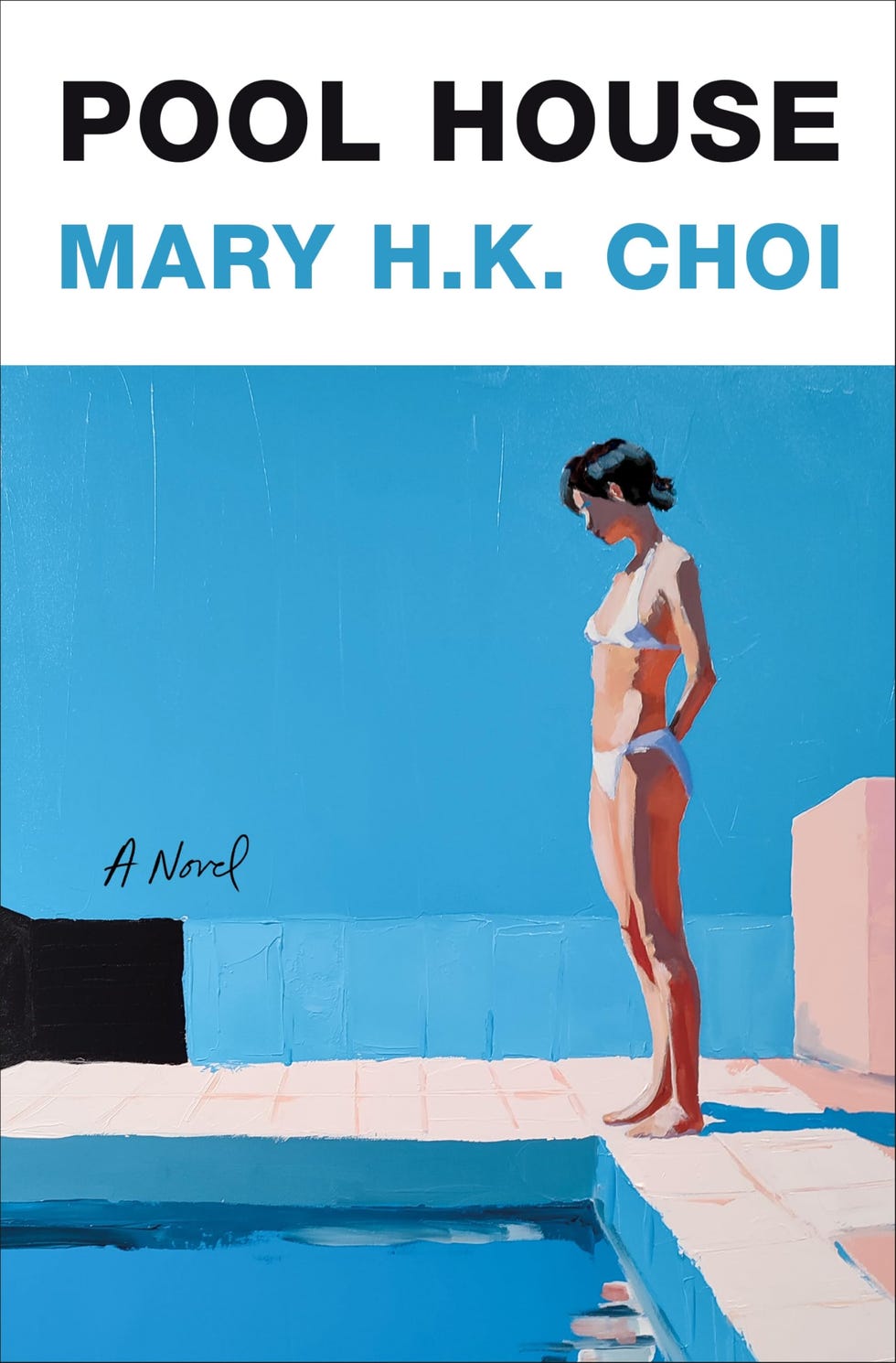
That’s certainly true of Choi’s latest, Pool House—her first adult novel after three young-adult releases, Emergency Contact, Permanent Record, and Yolk—in which the nuclear relationship centers on mother-and-daughter pair Moon and Stevie. Moon is a recovering alcoholic and a former B-list Hollywood star, having come up in the ’90s and enjoyed a period of success on a mid-2010s family sitcom called Wabi-Sabi, named on account of the blended Korean-American military family formed by its main cast. More recently, Moon is “burnishing,” as Choi herself puts it, out of work while Stevie tries to pull herself out of Los Angeles via a promotion at a restaurant chain called Pee Wee’s. But ultimately untethering herself from her mother seems, to Stevie, almost fatally impossible. As Choi was brainstorming ideas for the novel, she realized she wanted to understand what would happen if and when this daughter, “who has never wanted [celebrity], comes into her own in terms of the power of her appearance.” What might that do to her? What would it do to her relationship with her mother?
Stevie’s 20-something coming-of-age becomes a lot more complicated thanks, in part, to the men around them. First, there’s Arthur “Mac” Maclean, Moon’s former sitcom husband and Stevie’s pseudo-father figure; he dies at the beginning of Pool House, sending Moon and Stevie into separate but orbiting portals of grief. Then there’s Adam Dano, Moon’s former sitcom son and Stevie’s old crush. Now based in Hong Kong, he answers when Moon calls, and in the wake of Mac’s death he flies to her and Stevie’s rescue. The two Korean-American women live together in their property’s filthy pool house—they rent out the so-called “Big House” to pay their bills—but by the time Adam arrives, the tenants have vacated the premises, allowing Moon, Stevie, and Adam to move in together and pantomime a healthy family.
It was during the peak of the COVID pandemic that Choi first pitched a rough concept for Pool House to her publishers at Flatiron Books. They were curious if she had an idea for an adult novel; as it turns out, she did have something. Choi has long explored the terrain of a woman’s early twenties in her fiction, in part because it had been “such a ripe time for me,” she says. Born in South Korea and raised in Hong Kong and Texas, she moved to New York in 2002 after graduating from the University of Texas at Austin with a degree in textiles and apparel. “It was that fascinating thing where I was expected to be an adult, and I felt like an adult, and in many ways I looked like an adult,” she says now. “But I was also completely disembodied and disassociated and full of so much fear. There was that schism that I find really interesting at that age.”
In writing Pool House, she knew she wanted to examine that schism again, “that feeling of coming into power, that first blush of feeling ripe for a kind of agency that makes you feel a little dizzy.” But she didn’t only want to explore that dynamic from the vantage point of her 20-something self. “I am a woman of a certain age,” says Choi, who published her first novel in her late thirties and is now in her mid-forties. “There is a whole slew of lighting conditions under which I don’t love my neck.” She wanted to write about that, too.
And she wanted to write about the power of celebrity. Similar to her “obsession” with her mother, Choi has spent years “fixated,” she says, on the allure and ouroboros of celebrity. After college, she became not a fashion designer or retailer but a journalist, flying to New York to chase a lifelong love for magazines. She started as an intern at the Red Hook-based indie publication Mass Appeal, and in the years since has launched and folded her own magazine (the alt Missbehave) and worked for outlets including The Cut, The New York Times, GQ, Wired, Allure, and more. “I’ve profiled everyone from Rihanna to, like, James McAvoy,” Choi says. “I ghostwrote DJ Khaled’s first book, and I also was on Rihanna’s 777 Tour, where she had a plane full of journalists and fans. We went to seven countries to see seven Rihanna shows in seven consecutive days, and we all promptly lost our minds.” She was an early Belieber; she met the up-and-coming Justin Bieber when he was still “an actual child.” To this day, she finds it “astonishing” that someone like him “could feel like he walked into YouTube as a regular kid and walked out of YouTube an absolute pop culture juggernaut.”
Writing of Moon’s aching relationship with her own celebrity status allowed Choi to probe how, as she’d already discovered in her work as a journalist, “the celebrity industrial complex is one thing, but each particular celebrity is a very specific startup fiefdom of their own.” No one seems to recognize this more than Stevie, who oscillates between roles as her mother’s friend, her mother’s caretaker, her mother’s manager, her mother’s nemesis, and her mother’s daughter, especially when she would prefer to not be thinking about her mother at all. Meanwhile, Moon attempts to remain a celebrity: She’s no Oscar winner, it’s true, but she still chafes at her real manager’s pitying looks; she still hopes her collection of vintage clothing—the “canny little suits, wasp-waisted Mugler, Ghesquière shoulders, Stella McCartney satin bustiers”—will “increase in cultural value once her own stock rises.”
Choi has observed enough A-listers in action to recognize that “the way they present to you is either persona the whole time, or they go into character; they’ve decided that the moment they sit across the table from you at the Sunset Marquis or whatever, that they’re on,” she says. “And then, once you stop recording, they turn into a totally different person.” She once shared an elevator with a “very, very famous person,” who, once they’d realized Choi was not there to interview them, “turned their face off. They just switched everything. Powered down.”
This unapologetic performance, coupled with the choreography of stylists and publicists and “headset-ed worker bees” in a celebrity’s immediate vicinity, enraptures Choi even now. She finds it both depressing and delicious, which is perhaps exactly how Moon herself would characterize the charade. “There’s just something about the whole boondoggle of it,” Choi says, “and the way that we’ve collectively decided this is the absolute apex of human existence, that this is a level of importance that sort of borders on deification, is also super fascinating to me. I think about the cost of it a lot, too. I do wonder how you end up remembering your life at the end of it, and if it really will have felt like you touched the face of God.”
She continues, “This relationship we have with celebrity…feels proximal in this really, really seductive way.”
This figurative seduction is threaded throughout Pool House, as is much more literal sex, which further necessitates the book’s adult designation. “It’s a foundationally really horny book, and so that feels adult,” Choi says. It’s not that readers won’t find sex in her young-adult literature—they will—“but I think the desire and the way it plays out [in Pool House] is bizarre in the way that life is so bizarre.”
She adds, “There’s a lot of brutality, I think, in this book. And not that I’ve ever deliberately held punches or felt that I was punching down or anything for younger readers, but I did want everyone [in Pool House] to have total agency. I wanted three people who, ultimately, are trying. Are they successfully doing their best at any point? Maybe not. Is their best even all that good? Is it completely at cross purposes to what another person wants? Yes, absolutely.”

Mary H.K. Choi.
Multiple seminal moments marked the stretch of time Choi spent writing Pool House: She was diagnosed with ADHD; her father died in 2022; then, a year later, at 43, she was also diagnosed with autism. She had not originally written a father-figure character for Pool House, but in the wake of the loss of her own father, Mac appeared in Choi’s drafts. “When my dad died, there was suddenly a dad in this,” she says. “It’s almost like I threw him in to figure out what the hell I was thinking about everything.” Similarly, she was confused about the “grief” and “guilt” she felt knowing that “once I was done with this book, that the sort of biological window for having children—at least for me, without a lot of very extensive medical intervention—was going to close.” She needed to write about the “bifurcation” happening within herself: a before and an after. “I sort of dumped the steaming entrails of all of these thoughts onto the table and started working with the material,” she says. She then compares editing a project like Pool House to moving a futon mattress from room to room by herself: “It’s like the most unwieldy, challenging thing, but that’s the only way I understand how to live this one life, and to even have evidence that I lived it at all.”
I ask if there was ever a point in this process of dumping entrails and rearranging futons when she felt she had landed on the thing itself: that she knew exactly what she felt and thought; knew exactly what she would take away from writing about Stevie, Moon, and Adam; knew exactly what she wanted readers to take away from the book themselves.
Not quite, Choi says. Writing Pool House was a useful tool for emotional processing, yes, “but it’s not that I just use [the book as catharsis] and then discard it and then expect some…feeling to graft onto whoever happens to read it. It’s not like a symbiont suit that then has a new host or anything like that.” (Our conversation is peppered with these superhero-adjacent references, a callback to Choi’s time spent writing for comics.) “It’s more that I do have this really lovely moment, usually in the editing, where [the book] is no longer mine,” she continues. “At that point, yes, I’ve processed things that I wanted to process, and even those things changed. They became this wholly distinct, discreet thing from me that then belongs to the characters. And then the characters also belong to themselves.”
Growing up, Choi wasn’t always convinced she’d become a writer. In her estimation, she “lacked the imagination to ever envision that an author wasn’t always an author.” She thought of writers as if they’d been born that way, fully formed and credentialed, predestined through some sort of literary primogeniture. “It’s like that thing where a kid believes their teacher lives at school,” she explains. “It wasn’t a job that I thought you could ever even earn. I thought it was like royalty where it was sort of handed down, I suppose, and it would always exclude me.” She didn’t particularly enjoy writing as a kid, and she definitely didn’t enjoy the idea of making so little money doing it as an adult. But she was “chatty,” as her schoolteachers put it, and she loved magazines, and eventually she realized she could write in the same way she spoke. She could use that same voice to make sense of the way she saw the world.
She recognizes there’s a dramatic cultural divide taking place over modern storytelling: At the same time that brands such as Miu Miu and Dior are proclaiming books “fashionable,” Choi says, AI and social media are threatening those books from without and within. “It sometimes feels, when I’m in a really negative place, that everyone wants a book from everyone except authors,” she says. A friend of hers recently told Choi that she’d heard a content creator online calling a novel “long-form content.” “And I laughed so hard,” Choi says now. “Because, you know what? Fair enough.”
But none of this change threatens how Choi feels about the craft itself. Becoming a writer over the decades since she graduated from college has given Choi more than just a career; it’s given her companionship. If Stevie, Moon, and Adam can be whittled down to any unified characteristic, it might be their shared loneliness; their desperate need for one another is as deep as their need to escape one another. Choi knows the feeling well.
“It hurts my feelings that I am a person,” she says. “I would so much rather be completely attached to someone else. Just going solo in this life is really hard. And I love writing because writing has always kept me company. If I’m not populating some sort of Sims alternate universe or Animal Crossing of a book, I don’t know what I’d be doing with my brain.”
Like Choi herself, Stevie, Moon, and Adam are each preoccupied with thoughts of their mothers; it would be fair to say they’re “obsessed” with their mothers, women who are depicted as sharp-edged, often performative, perhaps unreachable in some fundamental way. But that does not stop their children from reaching, or the mothers themselves from attempting to shoulder the weight of that reach. Stevie, Moon, and Adam aren’t particularly likable characters. In fact, there’s much about Pool House that is purposefully ugly, even painful, written as if poking a wound to see if it oozes. Choi’s characters bear mother-sized wounds they cannot resist reopening. And yet, keeping their company for the duration of the novel is a powerful thing. By the final page, I felt an unexpected tenderness toward them. This, too, is a feeling Choi knows well.
“It’s like a spiritual practice,” Choi says of writing these characters. “It puts me in a position of finding so much affection toward everyone else in the world.” She concludes, “It really does speak to some sort of divine design, in some way.”
‘ The preceding article may include information circulated by third parties ’
‘ Some details of this article were extracted from the following source www.elle.com ’