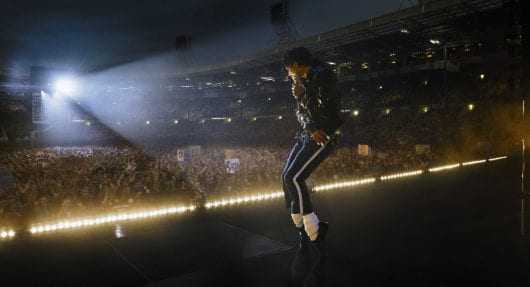
Jaafar Jackson as Michael Jackson in “Michael.” Credit: Lionsgate via TNS
In the sea of late music superstar biopics, the newest of the bunch, “Michael,” might not be beating any stereotypes, but it’s a damn good watch nonetheless.
Directed by Antoine Fuqua, the film follows the infamous Michael Jackson for the majority of his music career, beginning in the 1960s with the Jackson 5 and ending in 1988 after Michael’s final departure from the family business.
Viewers get to watch Michael grow up in the music industry, the creation of his first three solo albums — “Off The Wall,” “Thriller” and “Bad” — before ending at his sold-out performance at Wembley Stadium in London.
The film is meant to provide more of an inside look into Michael’s childhood, notably the abuse he suffered from his father, Joseph Jackson. While fans wouldn’t want to watch two hours of physical abuse, there’s something to be said about how little is included.
There is a singular scene where Joseph gets physical with Michael, and then the rest of their one-on-one moments are more of a highlight of Michael’s anxiety surrounding his dad. Past that, it’s an underlying theme throughout the movie, but it would only resurface when Joseph was planning for another tour or brand deal. Again, no one wants to watch a beloved musician going through that with his family, but it felt like it was being pushed under the rug.
There’s a similar lack of expansion for the ending point. Michael’s story extends far beyond 1988: he released three more albums before his unexpected death in 2009, went on two more world tours and continued to remain a relevant face in the music scene.
But on the other side, the movie is meant to be a highlight of Jackson’s life, and it becomes a lot more depressing when his sexual abuse scandals are included.
According to a Rolling Stone article, the reason the darker parts of Jackson’s life were left on the editors’ cutting room floor was because of a legality found in post-production, prohibiting Fuqua from portraying the accusations made by Jordan Chandler. Chandler accused Jackson of molesting him in 1993, though Jackson settled with the family for $20 million.
Even with the discrepancies in the timeline, Fuqua addresses Jackson’s early struggles quite well, especially his personality developing in the least childhood-like way, the effects the music industry had on his social life and his introduction to pain medications after an incident filming a Pepsi commercial in 1984.
Speaking cinematically, the movie was extremely well-produced. Jayden Harville and Jaafar Jackson, son of Jermaine Jackson, play Michael and give solid performances throughout. Though Harville was only in the childhood scenes, he still captured that infectious energy that a young boy on the cusp of his big break would have.
Jaafar seemingly mastered Michael’s recognizable voice, making it hard to determine who was speaking when. His performance and energy are nothing short of memorable, with an added level of respect coming from the family ties to the project.
Say what you want about nepotism or pulling strings to involve the Jackson family, Jaafar’s portrayal of his uncle at his peak made viewers feel like they were in the studio and stadiums themselves.
Two things stand out — the AI-generated animals and the off-putting energy in the latter concert scenes.
Jackson was known to have a wide variety of pets, including a llama, giraffe and his chimpanzee, Bubbles. All of the furry friends featured were obviously AI-generated, which really threw off the ‘70s and ‘80s vibes. Personally speaking, AI doesn’t really have much of a place in the media I like to consume, which is why it stood out to me so clearly.
Secondly, the crowd’s energy in large stadium scenes was just… off. It was clear that production teams announced that they needed a packed stadium full of extras for a concert scene, which lent itself to the featured extras looking a little like time travelers. A lot of close-up shots had people wearing sweaters from last spring, the clean-girl makeup aesthetic and lack of the larger-than-life hairstyles from the era. It sounds crazy, but it felt very obvious that people were pulled from the street to fill the spaces and not prepped for the 1980s.
Outside of the large stadium scene, the costume department was on point, replicating some of Jackson’s iconic wardrobe pieces in a way that didn’t feel forced. With someone as popular as Jackson, it only makes sense that the costuming visionaries had lots of inspiration.
To save the best for last: the music. The soundtrack largely relies on original studio recordings of Jackson’s music, though in studio recording scenes, the audio is a mix of Michael and Jaafar. There are also mixed audios in tracks with the Jackson 5. With someone like Michael, it makes sense to use original tracks, especially since it eliminates the risk of angering diehard fans if the music isn’t the same.
Again, speaking personally, I grew up listening to Michael Jackson, and the music was the cherry on top of the film. Using big hits like “Thriller,” “Billie Jean” and “Human Nature” was smart, knowing both fans and casual listeners would know the selections, while also adding to the movie.
Overall, “Michael” does a well-thought-out job of depicting Michael’s life, without making the film too depressing. The casting, costumes, soundtrack and general feel of the film might not be truly ‘70s and ‘80s, but it comes pretty close. Above all, it gives a pop superstar, even close to 20 years after his death, a more human-like perspective, not just the ethereal “King of Pop.”
Rating: 4.5/5
‘ The preceding article may include information circulated by third parties ’
‘ Some details of this article were extracted from the following source www.thelantern.com ’