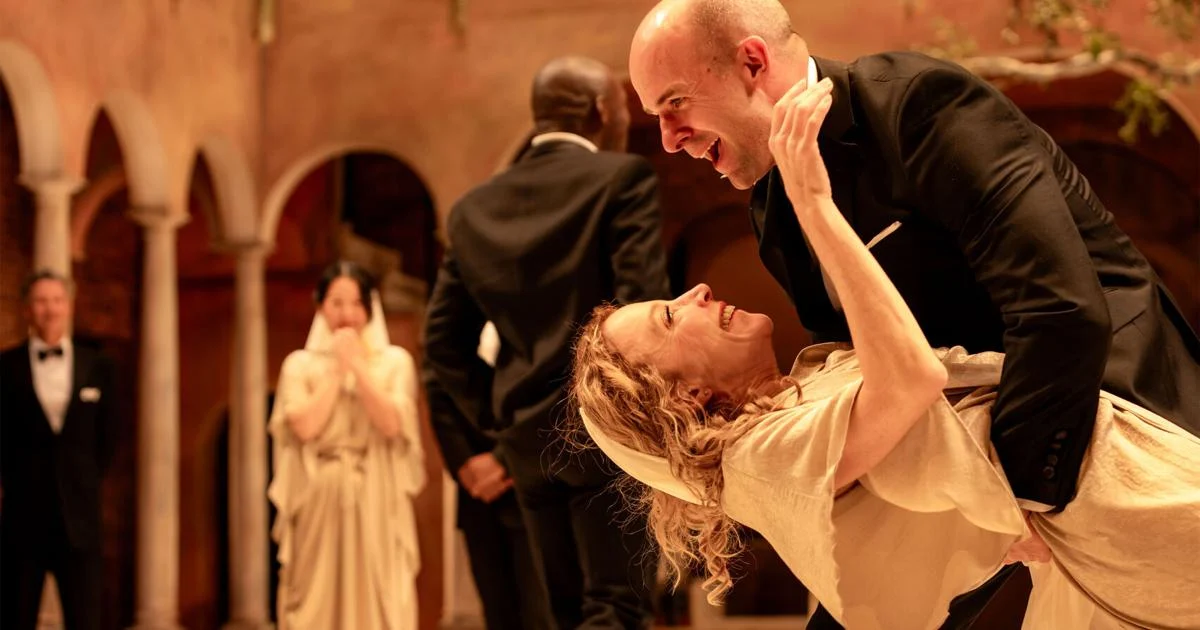
Artifice permeates every aspect of the entertaining production of “Much Ado About Nothing” in Chicago Shakespeare’s Courtyard Theater. From the moment actors amble on stage and one signals for the lights to go down, to the closing song with cast members playing various instruments, including the malicious Don John (Erik Hellman), who returns from having fled Messina and performs a banjo solo, we are always conscious that we’re in a make-believe world.
That world is controlled by British actress-turned-director Selina Cadell, who also directed Suzy Eddie Izzard’s one-person “Hamlet” last year. Her vision combines conventional elements, such as the super-clear presentation of Shakespeare’s language and a clutter-free setting, to quirky innovations that provide a lot of the humor, among them the approach to audience involvement.
Most of the action takes place at the Sicilian villa of Leonato (Kevin Gudahl), governor of Messina. Tom Piper’s scenic design, suffused with the Mediterranean sunlight of Jason Lynch’s lighting, features a courtyard surrounded on three sides by two-story arched porticos. A swing hangs from a large tree on one side, and chairs are the main props. Nicholas Pope’s sound design shows off Eliza Thompson’s original music and the singing to good effect.
Piper’s modern-day costumes bring together resort wear for the daytime and formal wear at night, though the soldiers also have simple pale-blue uniforms, except for Don John, who wears black most of the time (natch). Others are dressed like peasants or to suit their station.
“Much Ado” is often hailed as the original rom-com, and Cadell leans into that description with her screwball comedy treatment of the verbal sparring between a slightly ungainly Beatrice (Deborah Hay) and a bald Benedick (Mark Bedard), both of whom here are full-fledged adults rather than ingenues.
Most of the first half of the play is devoted to their friends tricking them into thinking they are in love with each other, which ultimately makes it so. Leonato, nobleman and military commander Don Pedro (Debo Balogun), and his right-hand man Claudio (Samuel B. Jackson) conspire to discuss Beatrice’s devotion to Benedick in the courtyard, while they know that he is eavesdropping, even though he earlier swore he’d never marry with a shake of an audience member’s hand.
In a parallel scene, Hero (Mi Kang) and Ursula (Felicia Oduh) talk about Benedick’s love for Beatrice and her disdain for him, and she, overhearing, vows to love him back. The acting is fine all-around, but what makes these encounters funniest is Cadell’s direction. Hay’s Beatrice scoots all around the stage to catch every word and avoid being seen, even sitting next to an audience member and hiding under a program or coat to avoid being found out. Bedard’s Benedick contorts himself in the tree with the same goal.
The play’s other comic long suit is Dogberry (Sean Fortunato) who, with his fellow officers of the law, ultimately foils Don John’s plot and brings the bad guys to justice, almost by accident. Fortunato gives a brilliant performance, using every inch of his lanky frame and spouting enough malapropisms to make Mrs. Malaprop blush, but I have to confess, it’s just not my type of humor.
“Much Ado” also has a potentially tragic plot and what struck me — maybe because I was seeing it so soon after Court Theatre’s “The Taming of the Shrew” — is its profound misogyny. Not only does Don John’s plan to make Claudio think Hero has been unfaithful with Borachio (Yona Moises Olivares) — by having his girlfriend Margaret (Tiffany Scott) dress in Hero’s clothes and meet him at the window — cause Claudio, Don Pedro and Leonato to vehemently denounce Hero, there are signs of trouble even before that.
When Claudio and Hero first fall in love, and Don Pedro offers to woo Hero for himself, then give her to Claudio, Claudio at one point gets jealous and thinks Don Pedro really wants Hero for himself. The way the near-saintly Hero is treated like property with no mind of her own left a bad taste in my mouth and increased my respect for Beatrice for standing up for herself and for Benedick because he takes her side.
Although the comic and near-tragic story lines don’t quite fit together, we know from Don John’s first appearance that the tragedy is going to be averted. Hellman is naturally funny in the role because he doesn’t seem to be taking himself too seriously as he explains why he’s going to be the villain. His performance and other deft details like the ways the actors break the fourth wall are among the many reasons this “Much Ado About Nothing” is worth seeing.
‘ The preceding article may include information circulated by third parties ’
‘ Some details of this article were extracted from the following source www.hpherald.com ’