Note: There’s so much happening on the royal beat that my usual Catching up with the Royals post will land in your inboxes after this post.
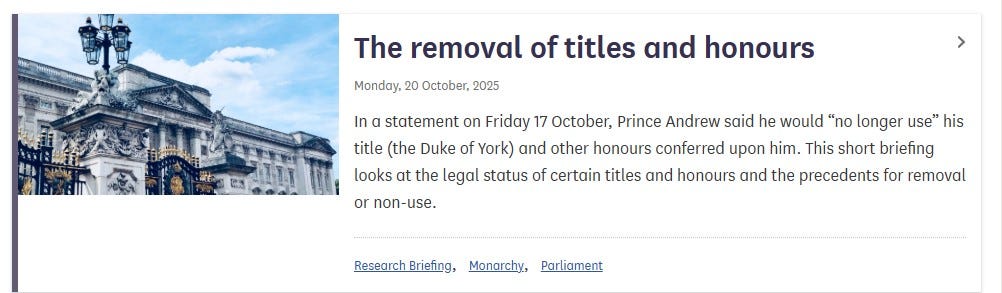
In the aftermath of Prince Andrew’s decision not to use his Duke of York title as well as honours conferred on him, I thought it a good time to game out some likely scenarios regarding the future of those titles, etc., as well as what the announcement means for the royal family as a whole. I was already working on this post when David Torrance, a researcher for the House of Commons in London, published a rather handy research briefing: “The removal of titles and honours,” which tracked with much of my thinking.
Now that King Charles III has slimmed down who qualifies as a working royal, all signs point to the monarch and/or his successor, William, dramatically curtailing who is eligible for the HRH style, title of Prince/ss, and hereditary peerages, including removing them from members of the royal family who currently enjoy them.
As one expert told me, “If you can add, you can take away.”
A STATEMENT BY PRINCE ANDREW
In discussion with The King, and my immediate and wider family, we
have concluded the continued accusations about me distract from the
work of His Majesty and the Royal Family. I have decided, as I always
have, to put my duty to my family and country first. I stand by my
decision five years ago to stand back from public life.
With His Majesty’s agreement, we feel I must now go a step further. I
will therefore no longer use my title or the honours which have been
conferred upon me. As I have said previously, I vigorously deny the
accusations against me.
What we know:
The Duke of York title, like his “His Royal Highness” style will not be used but are still technically his.
His ex-wife, Sarah, will use her maiden name of Sarah Ferguson, not Sarah, Duchess of York.
His title of Prince Andrew (as well as his daughter’s titles of Princess Beatrice and Princess Eugenie) continue under the Letters Patent of 1917.
My posts from Friday include my analysis piece issued just before the announcement was released, in which I theorize that Prince Andrew’s fate would be a template for Prince Harry, as well as my update after the announcement.
It’s that template that I explore more thoroughly here.
Right now, there are 10 working royals: the King, Queen, Prince and Princess of Wales, Duke and Duchess of Edinburgh, Princess Royal; Duke and Duchess of Gloucester, and the Duke of Kent. Of those 10, only two are under the age of 60 (William and Kate), while two are in their 60s (Edward and Sophie), while the rest range from 75 (Anne) to 90 (the Duke of Kent).
Within a decade, basic math leads me to assume that the number of working royals will drop to five or six.
In 15 years, if William is then on the throne and keeps to the slimmed down model of working royal life, there may be just two or three full-time working royals. Many of the current stalwarts, such as Princess Anne and the Duke of Gloucester, will have retired or dramatically scaled back their workloads, while William and Kate’s children would likely still be in the educational phase of their lives and thus not handling full royal workloads.
Yet, by that time, there could still be a lot of Windsors holding a lot of royal styles and titles, including:
HM King William and Queen Catherine
HM Queen Camilla
HRH Prince George
HRH Princess Charlotte
HRH Prince Louis
Prince Harry, Duke of Sussex (The Sussexes were not use the HRH style per the 2020 agreement with the Queen though Harry and Meghan have used it “privately.”)
Meghan, Duchess of Sussex
Prince Archie of Sussex
Princess Lilibet of Sussex
Prince Andrew (the HRH style and Duke of York title are not used; his ex-wife, Sarah agreed not to use Duchess of York)
HRH Princess Beatrice
HRH Princess Eugenie
HRH Prince Edward, Duke of Edinburgh
HRH Duchess of Edinburgh (The Edinburghs’ children, Louise and James, are entitled to use HRH Prince/ss styles and titles as grandchildren of a monarch through a male like but have never used them)
HRH Princess Anne, Princess Royal
(Plus any surviving Gloucesters and Kents, who would then be in their mid 90s or older.)
Just as there’s no sign of any desire to temporary bolster of the ranks of working royals, I think that such slimmed down option will likely extend to other parts of royal life, especially who has royal titles and styles.
Charles III has already started that process when he made the Dukedom of Edinburgh a life peerage instead of a hereditary one when he conferred it on his youngest brother, Edward, in March 2023. (James will not inherit it but will retain the hereditary titles of Earl of Wessex and Forfar, which Elizabeth II had conferred on Edward). And in 2022, Charles III asked Parliament for legislation to add Princess Anne and Prince Edward to the list of Counsellors of State, while making it clear that only working royals would use those powers (effectively bypassing non-working royal counsellors, such as Harry, Andrew, and Beatrice.)
And that brings us to the Letters Patent of 1917, which streamlined who got royal styles and titles at a time when so many grandchildren and great-grandchildren of Queen Victoria were princes and princesses that it was almost impossible to keep track of them. As David Torrance explains:
Under 1917 Letters Patent, the style of “Royal Highness” and the title Prince or Princess was restricted to the children of a Monarch, the children of the sons of a Monarch and the eldest living son of the eldest son of the Prince of Wales. This meant some members of the then Royal Family lost their titles, including the three-year-old Prince Alastair of Connaught, a great-grandson of Queen Victoria. Further Letters Patent from 2012 extended the 1917 provisions to all the children of the eldest son of the then Prince of Wales.
What is important is not only that the Letters Patent codified who was entitled to such styles and titles but that some lost their existing titles (Prince Alastair of Connaught). That may not have happened a few years earlier but times can change change quickly. And that’s what happened in Britain. In the middle of the First World War as revolution toppled thrones and sparked scandals, King George V restricted who gets the top titles in Britain.
The Letters Patent has been amended several times since 1917, usually to restrict usage (the Duchess of Windsor never got an HRH, while divorced wives lost the same style), which means it can be changed now and in the future. As Torrance writes, “The title of Prince or Princess can be removed by statute or under the prerogative, although the latter would likely require ministerial advice.”
‘ The preceding article may include information circulated by third parties ’
‘ Some details of this article were extracted from the following source writeroyalty.substack.com ’