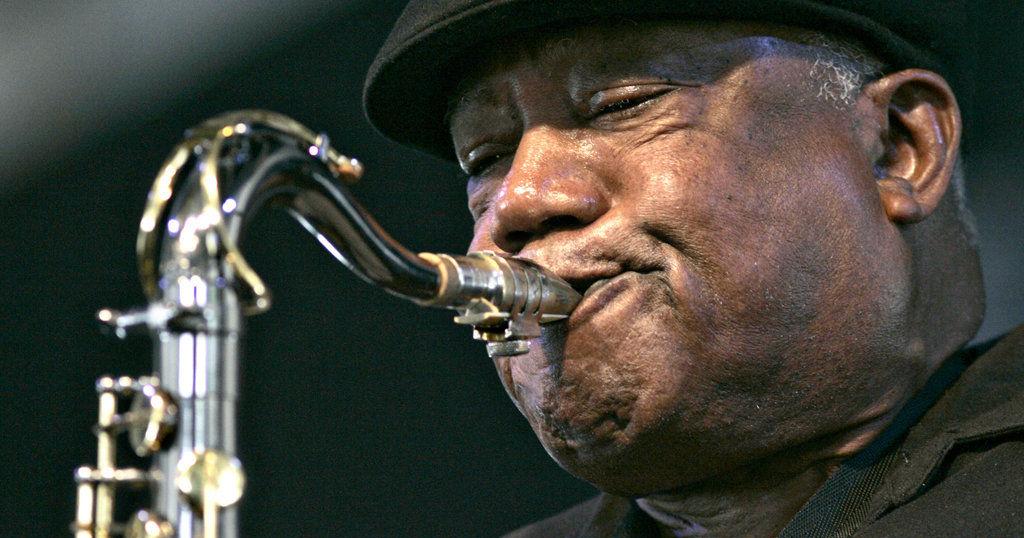
James Rivers, a multi-instrumentalist fixture of New Orleans nightclubs who was fluent on everything from saxophone and clarinet to bagpipes, died July 5. He was 89.
His saxophone was featured on such classic New Orleans R&B recordings as Al Johnson’s “Carnival Time” and Frankie Ford’s “Sea Cruise.”
His jazz band, the James Rivers Movement, logged countless gigs everywhere from Tyler’s Beer Garden on Magazine Street to Mel’s Lounge in Faubourg Marigny to annual appearances at the New Orleans Jazz & Heritage Festival.
His fans included director and actor Clint Eastwood. Rivers performed on the soundtracks of several Eastwood films, including the New Orleans-shot 1984 thriller “Tightrope” and 1988’s “Bird,” the biography of jazz musician Charlie Parker.
James Rivers Movement performs on the Jazz Playhouse at the Royal Sonesta New Orleans stage during French Quarter Fest in New Orleans, Saturday, April 13, 2024. (Photo by Sophia Germer, The Times-Picayune)
Rivers also appeared onscreen in Eastwood’s “The Bridges of Madison County” in 1995.
Born in the Treme neighborhood on April 18, 1937, Rivers grew up in a close-knit family of six siblings. He first started playing music at age 8.
He attended Walter L. Cohen High School and graduated from Booker T. Washington High School.
Determined to be a professional musician, he studied at the Houston School of Music. He toured as a backing musician with the Impressions, Jerry Butler and the New Orleans R&B band Huey Smith & the Clowns.
While on tour with the Clowns, he was badly injured in a car accident. After being hospitalized, he formed the James Rivers Movement.
In the book “Up from the Cradle of Jazz: New Orleans Music Since World War II,” Rivers recounted to co-author Jason Berry an unconventional musical inspiration.

James Rivers, right, performs during a press conference where the New Orleans Jazz and Heritage Festival lineup was released at the George and Joyce Wein Jazz and Heritage Center in New Orleans on Tuesday, January 15, 2019.
“Sometimes I used to practice and go out at night to Lake Pontchartrain, in contemplative moments, where it would be quiet and listen at the waves and the water,” Rivers said. “Just to be alone, like to hear the different sounds of the water beating against the seawall, and I could meditate. You’d be surprised at the things you can work out.”
His repertoire of instruments included the tenor, soprano and alto saxophones, clarinet, flute, harmonica, piano, organ and guitar.
A school band’s performance during a televised football game first piqued his interest in bagpipes. He ordered one from the music store Werlein’s and taught himself how to play from listening to bagpipe records.
During an interview with Berry at the 2017 Jazz Fest, Rivers clarified, “I am not really a bagpiper, but a musician who learned how to play one.”
Rivers was a regular at Tyler’s Beer Garden, which opened on Magazine Street in the 1970s and burned in 1990. That was reportedly where Eastwood first heard him.

The cover of New Orleans multi-instrumentalist James Rivers’ 1981 funk-jazz album ‘Thrill Me.’
A favorite at jazz brunches, he also had a standing gig at Fat Harry’s on St. Charles Avenue. His robust bagpipe rendition of “Amazing Grace” inspired drinkers to sing along with the religious standard.
Beyond the many recordings by other artists to which he contributed, Rivers’ own discography includes the 1978 album “Olé” and 1981’s jazz-funk collection “Thrill Me.” Recorded at Allen Toussaint’s Sea-Saint studio in Gentilly and released on J.B.’s Records, “Thrill Me” consisted mostly of songs written by producer Senator Jones.
He also issued 45 rpm singles for J.B.’s Records and other labels, including 1976’s “Disco Lady.” His 1996 CD “I’m the Man” included “Amazing Grace,” “Ave Maria,” “Cherokee” and “All These Things.”
Berry, a friend for more than 50 years, recalled the spontaneous energy of Rivers’ 1970s gigs at the Freret Street club Sylvia’s.
“He sometimes led patrons out of Sylvia’s, second lining down the street,” Berry said. “Once he got on the Freret bus, serenaded the driver for a few blocks, got off at Napoleon Avenue and met his dancing tribe on the way back.
“He was a showman of seamless ease. Off stage he was an easy-going gentleman, a delight to hang with.”
Funeral arrangements are incomplete.
‘ The preceding article may include information circulated by third parties ’
‘ Some details of this article were extracted from the following source www.nola.com ’