New Orleanian Craig Klein is a Grammy-winning trombonist, educator and composer. His influence spans over 200 recordings with legends like Dr. John and the Neville Brothers, and he actively performs with top brass ensembles. Klein has championed brass band music on international stages and through media like the radio station WWOZ. His advocacy for musicians’ health has also encouraged more open conversations and resources around artist care.
Klein struggled with focal dystonia, making trombone playing difficult, but he remains dedicated. In addition to playing weekly at Preservation Hall in New Orleans, he hosts jazz shows on WWOZ and advocates for the station.
Tell me about yourself and your life in music in New Orleans.
I grew up in Metairie. My inspiration comes from my uncle, who is my mom’s younger brother, Jerry. He is seven years older than me and plays trombone. I came up watching him, admiring him, and I wanted to be just like him. We still play together in a brass band called The Storyville Stompers since 1981.
Jerry Dallman, left, and his nephew Craig Klein, both trombonists for the Storyville Stompers.
As I was growing up in the suburbs in the 1970s, we would go to the French Quarter as 15- and 16-year-old kids because Bourbon Street had good music going. It was jazz and blues.
I specifically remember coming out of Pat O’Brien’s with my friends, and Preservation Hall is right next to Pat O’s. In those days, they would open up the shutters so you could look through the old New Orleans-style glass windows and see what was going on.
I can still see it like it was yesterday. It was just so mesmerizing and magical. The window sits right behind the drums and the trombone player. When I looked in, I thought it was a dream. I’d never really heard the music like that before, and so I left my friends. I stayed there and listened.
Every time we would go back to the corner, I would go to that window and hear as many songs as I possibly could. And then sometimes, if I had an extra $3, I would pay the cover charge and go in and stand along that back wall. I thought it would be cool to play there.
When Storyville Stompers started in ’81, that’s when I started really chasing New Orleans music, after the Olympia brass band.
What is it like to play Preservation Hall?

Trombonist Craig Klein, left, at Preservation Hall.
It’s a dream come true. Preservation Hall started in 1961, and it’s still the best place in the world to hear traditional jazz.
It’s an honor and a privilege and an obligation to keep this music going for the elders.
Can you tell me about your experience with focal dystonia?
Focal dystonia only affects maybe 2% or 3% of musicians, and normally it’s a muscle movement disorder. Have you heard of the term, “the yips” in sports? It’s like that, but with musical instruments.
The neurons in your brain become tangled, and the wiring becomes unwired. It happened after Hurricane Katrina. We had to move to Baton Rouge, and I started coming back to New Orleans to help musicians rebuild houses.
There was so much stress. The stress affects different people in different ways. For me, I started noticing I couldn’t start a note.

Craig Klein and Kevin Louis recorded a tribute to Lucien Barbarin.
I felt like something was happening. Then I started noticing more and more, “Man, something’s wrong on my chops. I can’t start this note, this passage. I’m really suddenly not so good.”
I knew I could play, but it just felt like my playing disappeared.
It was the hardest thing I’ve ever dealt with. I had never been more depressed in my life.
At some point, I went online, and focal dystonia pops up and it lists all of the symptoms. I’m going, check, check, check.
It affects different musicians. For instance, like clarinetists or pianists, they get it in their fingers. Guitar players will sometimes get it in their fingers. It only shows up when you have your instrument. So for me, whenever I put the horn on my face, my chops would lock up.
I didn’t tell anybody except for my fellow trombone players, so they knew I had this. I was able to hide behind them in the band.

Advocate staff photo by MATTHEW HINTON–Greg Hicks, left, Craig Klein, and Mark Mullins of Bonerama perform on the Gentilly Stage on the second Friday of Jazz Fest in New Orleans, La. Friday, April 29, 2016.
How did you eventually get help?
I started finding people. I reached out to another horn player, Dion Tucker, in New York, and he helped me get some help.
One way to come out of this is you have to retrain your mind. We already know we know how to play the instrument. We have to rewire our brain. Neuroplasticity is what it is. So I had to almost relearn everything. I’m thinking I’m probably about 75% there.
I took sessions with specialists over Zoom. They have taken me to a level that I never even thought I would even get to at some point. I work on it every single day.
Has this condition changed your relationship to music and performing?
I always appreciated (music) because I love it, but (focal dystonia) made me appreciate it even more.
You just have to be able to play and to contribute to what this culture is.
When you lose something, and you love it, man, and when you have a chance to get it back, you appreciate it more than you can ever imagine.
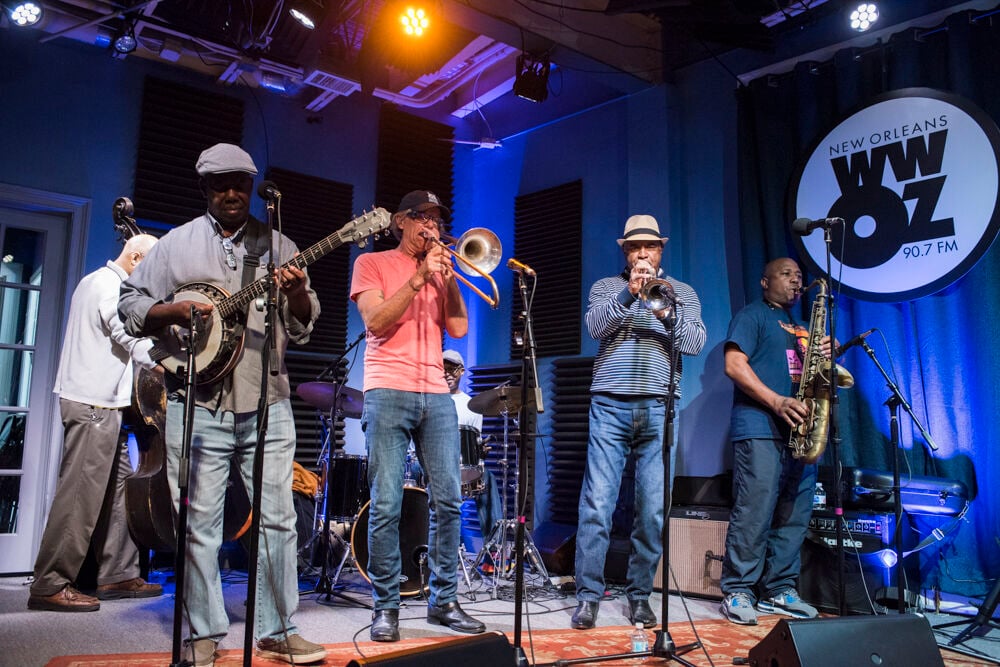
The Syncopated Percolators, featuring Detroit Brooks on banjo, Wendell Brunious on trumpet, Roderick Paulin on sax, Craig Klein on trombone, Herlin Riley on drums and Carey Lewis on bass, perform inside WWOZ’s studio during the community radio station’s spring pledge drive on March 21, 2018.
What is your relationship to WWOZ, and what does the jazz station mean to New Orleans?
Growing up, I didn’t own a lot of the records they were playing. On Saturday, Big Mama Rankin had the traditional jazz show, and I would put her on the radio. I would get my horn out, and I would play along. And that’s how I learned a lot of music, by playing along with it.
In my beginning years, WWOZ played that important part of my career, teaching me the music. I wasn’t going to be able to go out and buy all of those records. It just couldn’t possibly be done. It’s a very important resource for musicians.
I wanted to do a show on OZ. It was always on my bucket list. So, I started sitting in on the other DJ shows and watching and learning. And then they started calling me to sub.
The next thing you know, a Saturday morning slot is open. To now be a part of the OZ family, and to play music that I love, it’s just a special thing for me. I feel like it’s almost full circle.
‘ The preceding article may include information circulated by third parties ’
‘ Some details of this article were extracted from the following source www.nola.com ’