“Cinema of the mind.” This is how composer Nathan Henninger describes his music – theatrical, emotional, motivated, scenic. The musical landscape is paced like drama: scenes of exposition, conflict and resolution. Even without imagery, “there’s a certain shorthand – of rhetoric and gestures – that whether one is trained in music or not, there can be a kind of cultural recognition on a broad scale.”
Nathan Henninger
© Viktor Szende | NateChet Music
Henninger’s music might well be representative of a broader set of trends occurring across contemporary classical music in North America. Taking influence from film scoring as well as orchestral and operatic classics of the 19th and 20th centuries, he fits alongside other composers since the 1990s who have been looking for emotional directness, recognisability and theatricality in their music. In particular, Henninger gravitates to the influence of French music, which itself left a lasting impact on North American composers of the 20th century, especially those who studied with Nadia Boulanger in Paris.
“It’s like we’re hearing a magical 1950s radio, hearing Edith Piaf or jazz from the Umbrellas of Cherbourg,” Henninger says, describing his recent piece Romanza for piano and orchestra. “When we think of love – or Paris… certainly elements of 50s jazz and Hollywood are playing a role in Romanza.”
Nathan Henninger conducts Romanza with the Budapest Scoring Orchestra and pianist Marouan Benabdallah.
Henninger’s father, Richard Henninger, was a composer too: a Professor of Composition at the University of Toronto. Frequently involved with the music department’s electronic music studio, his music of the late 1960s was atonal and structuralist, and he later transitioned to software development after studying in Stanford University.
“I was born well after that,” Nathan recalls. “The father that I know is a bit different from my father, the composer. I grew up with a guy who was all about opera and Bach, choir and theatre – he loved Gilbert and Sullivan. I think the music that he would write today is probably very different from the music that he wrote then.” While there is a stylistic break between the elder and younger Henningers’ musics, his father nonetheless continues to leave an impression. “I learned so much – not only from his understanding of the orchestra, but the ideas and conversations about what music can do.”
Born in Toronto, Henninger was immersed in music from an early age and studied piano and french horn. Majoring in music composition at Pomona College, he later pursued further studies at Juilliard. The influence of his psychologist mother was also strong, and Henninger’s interest in psychological and communicative aspects of music might be indebted to her. “I think it underlies language – it predates language,” he says. “Music has a real power to bring us into memory, and those hard-to-articulate parts of our brain, the way we process our experiences.”
Nathan Henninger with audio producer Anton Langer
© Viktor Szende | NateChet Music
After moving to New York City to study at Juilliard, Henninger took up an unusual position: communications work at the United Nations. As well as working with professional and collegiate choirs, and studying piano with Taka Kigawa, Henninger was working in the private office of UN Secretary-General Ban Ki-moon.
“I played the Brahms Intermezzo in A major, Op.118 at a party back in 2008. [Ban’s] special assistant, Mr Yoon, cornered me in front of the elevator and said, ‘Nathan, Mr Piano Man, will you play at the staff party this Christmas?’ I didn’t think it would be too bad, but it ended up being at the Secretary-General’s residence: palatial, hardwood floors, chandeliers, and every single member of staff had to come.”
The experience with diplomacy and communication at UN might have left their impression too. Henninger describes music as social and psychological, as well as communicative. “Music can play a role in society, where people are coming to concerts, or supporting orchestras, because they’re feeling a vital sense of what music can do for them. Music is, in a way, acting as a healing force.”
After a foray into photography, during the Coronavirus pandemic, Henninger found himself returning to composition in earnest. He received guidance and encouragement from composers and arrangers including Nan Schwartz and Conrad Pope. Five Scenes for Orchestra, essentially his first large-scale composition, emerged from this period of reflection and study.
Nathan Henninger’s Five Scenes for Orchestra recorded by the Scoring Berlin Orchestra.
“I felt that really, for the first time in my life, everything was brought together. That all my other compositions, the things I’d been working on – everything came together. That this felt like a world that I wanted to explore,” Henninger says.
With sections contrasting in dramatic character, swift changes, mixtures of harmonic language and texture – including, in Scene Four, dissonance and harshness – Henninger’s Scenes owe much to the theatrical and dramatic lineage he’s adopted. Schwartz and Pope, a couple, both write their own music for film, but are also part of the wider film scoring community, orchestrating for John Williams, James Horner and Howard Shore, among others.
“Now I’m working on my first symphony – it’s much in the same language, but trying to go deeper and longer, exploring things more,” Henninger says.
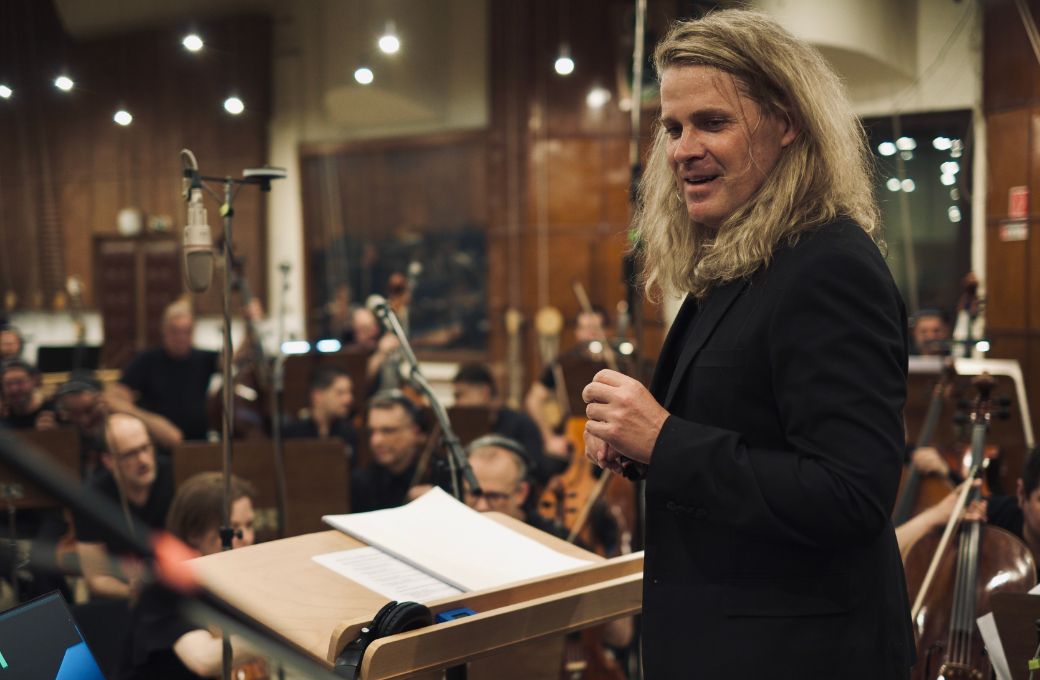
Nathan Henninger conducting in Budapest
© Viktor Szende | NateChet Music
Film and theatre music are also an influence on Romanza, which harks back to Morricone as well as Gershwin – and Puccini too. “I think when you hear those old scratchy RCA Victor recordings, there’s a kind of sense memory of people going to the opera, and really taking in the melodies of these operas. When we hear the music of that era, from the early 1900s to the 1930s, there’s a sense of a lost world,” Henninger says.
“It’s almost like there’s something in the collective consciousness where, when you hear a Puccini opera, you can’t ignore the fact of the sheer quantity of human beings that have listened to it, through the development of recording technology… Think of a grandmother in a kitchen with an old radio in the 1930s, listening to La bohème, or the beginning of Act 3 of Turandot… I think music is about this kind of shared human experience. That’s what I’m really interested in.”
Taking a theatrical and communicative approach to musical expression seems to come naturally to Henninger. “I remember doing theatre exercises in college once where people would be doing Shakespeare, and the teachers would say: Okay, now I want part of the class to mime around the actors doing speeches. I think music can do a similar thing. A flute might be playing a melody, and other instruments are making a wordless comment or observation. Or when something horrible or harsh happens, there might be something very soft, an observation which follows it. And I think this observation, this echo, it can teach us. It teaches us how to feel.”
Budapest Scoring Orchestra recording Romanza
© Viktor Szende | NateChet Music
“If you’re telling a story, it can also be a kind of reflection of an internal state,” Henninger says, speaking again about Romanza. “You have this kind of churning feeling of: I’m so afraid I’m going to lose you. And if that’s the case, then I’m just going to give my all, because I’m going to lose everything. It’s a dramatic moment, but is it because of something happening in the physical world, or is it a more internal kind of anxiety? That anxiety building is what leads to action.”
Even the melodic shapes in the work are interpreted with a certain amount of theatre. “The opening gesture, going down and then reaching up, and suspending and not knowing what to do. And finally being met with the melody completing by dropping down. When you drop down it’s like there’s a soft landing.”
Henninger’s experiences with opera and music theatre, both in youth and later as a professional, were clearly formative. In Lake Arrowhead, California, he was involved leading community musical theatre, in a programme involving over 200 people. “We were putting on musicals, doing pit orchestra and weekend rehearsals – every show would have around eight performances. I did really feel of all my experiences there were critical: I learned how to deal with every kind of problem you can have working with musicians. Now I have a certain relaxed confidence about it – I have a sense memory, working countless hours with kids, adults, teenagers, dealing with every sort of problem under the sun!”
For those outside of North America, curious about a contemporary classical music scene with its own set of particularities, the theatricality and sincerity of Henninger’s music is a window onto a world.
Romanza is out now on CD and available to stream and download.
This article was sponsored by NCH Records.
‘ The preceding article may include information circulated by third parties ’
‘ Some details of this article were extracted from the following source bachtrack.com ’