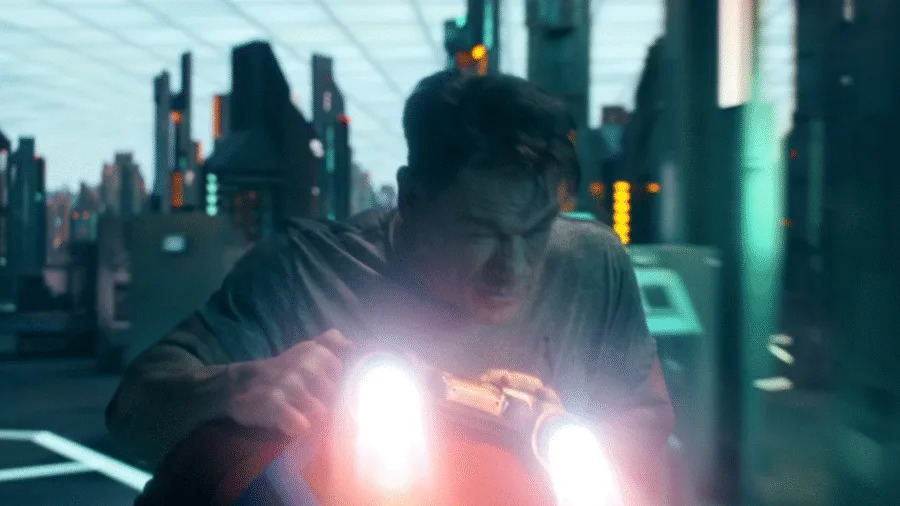
The DCU show Peacemaker has a reputation as a comedy, and that’s well-deserved: after all, this show packs plenty of violent, vulgar punchlines into each of its modestly sized episodes. This season, though, I was struck by the revelation that this over-the-top comedy is the only comics show to treat its audiences seriously. And that’s because it forces audiences to think for themselves about the titular main character and his murky morality.
Before I go any further, a word of warning: I’m going to be touching on several major spoilers for Peacemaker’s second season. If you haven’t watched, I wouldn’t be offended if you bailed right now so you can enjoy every major twist and turn of this John Cena classic. Otherwise, keep reading as I take you into the most unexpected dimension of all, one where the silliest show in superhero history is the only one to treat its viewers like adults.
Peacemaker: What A (Serious) Joke
While James Gunn’s Peacemaker has always been a violent show, this season took things to the next level by having our hero kill a version of himself from another dimension. He claims self-defense, which is fair; the other version of Chris Smith would definitely have murdered our hero if he hadn’t defended himself with lethal force. Of course, the fact that the other Peacemaker caught the “good” version in his house made some viewers debate the morality of what went down (for example, many of us live in states where you would be legally justified in killing an intruder who had seemingly broken into our home).
Peacemaker on Peacemaker violence
What happens next, though, is that our Peacemaker takes over his duplicate’s life, lured over by what he keeps calling the “best dimension ever!” This is a parallel world where his brother and father are both alive and where he has a chance to make a relationship with Harcourt; in his own dimension, his family was dead by his hands, and he had already blown his one chance with the love of his life. While Peacemaker’s temptation is understandable, his impersonation of his other self is one ongoing consent violation because everyone he encounters in the other dimension has no idea he’s a different person.
What Happens In Earth X Stays In Earth X
Speaking of consent violations, our Peacemaker ultimately has sex with the alternate universe Harcourt; while the American justice system doesn’t have to deal with other dimensions (that’s why we don’t have a Law and Order: Multiverse Victims Unit show), what our hero does here would be considered rape by deception. Again, even though this Harcourt is evil (we find out later in the season that this is a literal Nazi dimension), we still watched the title hero of the first live-action DCU show effectively rape someone. Someone with the face of one of our favorite characters, no less!

Our Chris and the other Harcourt
All of this adds up to a crunchy question: Is Peacemaker a bad guy? Certainly, he has killed other characters for transgressions milder than his own. But all of those transgressions have extenuating circumstances, and that makes it hard for the average viewer to tell whether Peacemaker is really a hero or just another villain in a goofy costume.
That’s the point, of course. Peacemaker as a show has always focused on how the troubled leading character is still growing and learning, both as a hero and as a man. Therefore, it makes perfect sense that he will make plenty of mistakes (including some fairly huge ones) while trying to save his country. But what is refreshing about this TV series is how it refuses to give us any firm answers about Peacemaker’s morality, trusting the audience to make its own decision.
Move Over, Marvel
This is the polar opposite of Marvel shows, of course, which rarely leaves room for any moral ambiguity regarding its characters. Remember the Flag Smashers from Falcon and the Winter Soldier? Initially, they were villains that most viewers could empathize with, so (like Killmonger before them), they were turned into cartoonish murderers so we’d know they were bad.

The otherwise great WandaVision was retroactively ruined by Doctor Strange and the Multiverse of Madness. That muddled movie transformed Scarlet Witch into a one-dimensional villain as a result of what went down in her TV show. For viewers, it would have been far more rewarding to let us question the morality of her decisions (you know, the whole “mind controlling an entire town” thing) rather than transforming her into a cartoonish villain just so Doctor Strange could have someone to fight.
Oh, and Loki, the ancient mass murderer who unleashed the equivalent of several cosmic 9/11s on New York? Well, the Loki show gave us exactly one awkward conversation with Mobius, where Thor’s brother admitted he felt guilty, and that was it. How much more interesting would it have been if Loki continued to do both moral and immoral acts, forcing us to decide for ourselves whether he had redeemed himself or not?
There Is No Spoon
Peacemaker is not a perfect show, but the best part about this vulgar series is that it lets audiences make their own judgments about the title hero’s morality. We are consistently shown a flawed character who does both great good and great evil, and we must decide for ourselves if he is a hero or a villain.

That’s how James Gunn’s quirky comedy did the one thing other comic shows refuse to do: treat its audience like adults rather than children whose every story needs clear morals and whose every lesson must be spoon-fed to us, one speech at a time.
‘ The preceding article may include information circulated by third parties ’
‘ Some details of this article were extracted from the following source www.yahoo.com ’