Phil Mulloy, who has died aged 76, was frequently dubbed the “enfant terrible” of animation on account of his intentionally crude and uncompromisingly dark films: he once described his own work as “animation as punk rock”.
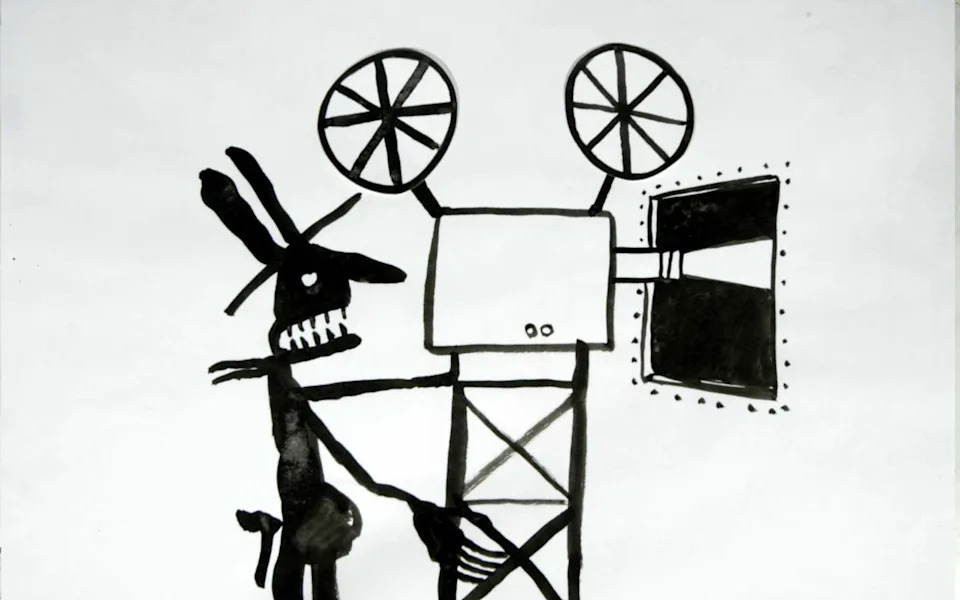
Pushing the limits of what could be shown on screen, Mulloy’s films invariably set out to challenge the viewer. His characters – rendered in black ink – had skeletal frames, bulging eyes and distorted limbs. Through them, Mulloy conjured a skewed world shorn of moral accountability.
His breakthrough series Cowboys (1991) included scenes of bestiality, group sex and horses having their hooves sawn off. The Ten Commandments trilogy (1994-96) had God being kicked down to Hell, while Mulloy’s cult triptych Intolerance (2000-04) depicted a war between humanity and a race of aliens with genitals where their heads should be. “If Disney represents the heart of animation, then Mulloy is its bowels,” wrote Chris Robinson, the artistic director of the Ottawa International Animation Festival.
Mulloy approached filmmaking as a one-man endeavour. He did not write scripts, preferring to see where the process took him without having to think about the audience’s reaction. While he took the work seriously, he sought to inject his films with a scratchy urgency, which made him resistant to the innovations that digital technology allowed. When he progressed to using a computer, he made sure to work as quickly as possible. He lost none of his capacity to shock, and his films continued to divide critical opinion. “Recently I was called ‘brilliant’ and ‘rubbish’ for the same film,” he told an interviewer in 2011. “Perfect.”
Phil Mulloy was born in Wallasey, on the Wirral, on August 29 1948 to an Irish father and an English mother. Brought up Catholic, he attended St Anselm’s College, where the strict discipline of the Irish Christian Brothers left its mark. “Anything that beats you into submission, you question forever,” he later observed.
A still from Mulloy’s film ‘Outrage’
His early artistic approach was shaped by Disney, but he soon moved towards a less comfortable aesthetic, inspired by the raw Picasso woodcuts he had seen on a trip to Paris. After Wallasey Art College he attended the Royal College of Art, where he created his first animated short, Allow Me (1970). But he found the process off-puttingly laborious and spent the next two decades as a freelance television writer and director, returning to animation in 1989.
Working from a converted cowshed in west Wales, he acquired an antiquated 35mm rostrum camera, which he soon found suited his half-finished aesthetic. The result was Eye of the Storm (1989), the story of a child coming to terms with human brutality. Making films that only lasted a few minutes allowed Mulloy to get to the heart of what interested him: the social norms that instruct behaviour, and the ways in which these can be subverted. “If two of my characters were going to have sex with one another, I would tend to cut the getting-to-know-you bit and go straight to the sex,” he said.

A still from ‘Intolerance III’
Later works included The Chain (1997), The Sexlife of a Chair (1998) and The Christies (2006-13). Over time the films became longer and Mulloy’s outlook became bleaker, his style more stripped down. His final film, Once Upon a Time on Earth (2023), was notably devoid of his usual sardonic humour, a meditation on survival set against a post-apocalyptic landscape. Chris Robinson pronounced it “a devastating, poignant, yet cautiously hopeful speculation on the future that awaits us if we don’t get our s–t together”.
Mulloy’s work was screened on Channel Four, the BBC and MTV, and he was nominated for various awards, winning Best New British Animation (for 1993’s The Sound of Music) at the Edinburgh International Film Festival. In 2024 he received a Lifetime Achievement Award at the World Festival of Animated Film Zagreb.
Phil Mulloy is survived by his wife, Vera Neubauer, and by their daughter and son.
Phil Mulloy, born August 29 1948, died July 10 2025
‘ The preceding article may include information circulated by third parties ’
‘ Some details of this article were extracted from the following source www.yahoo.com ’