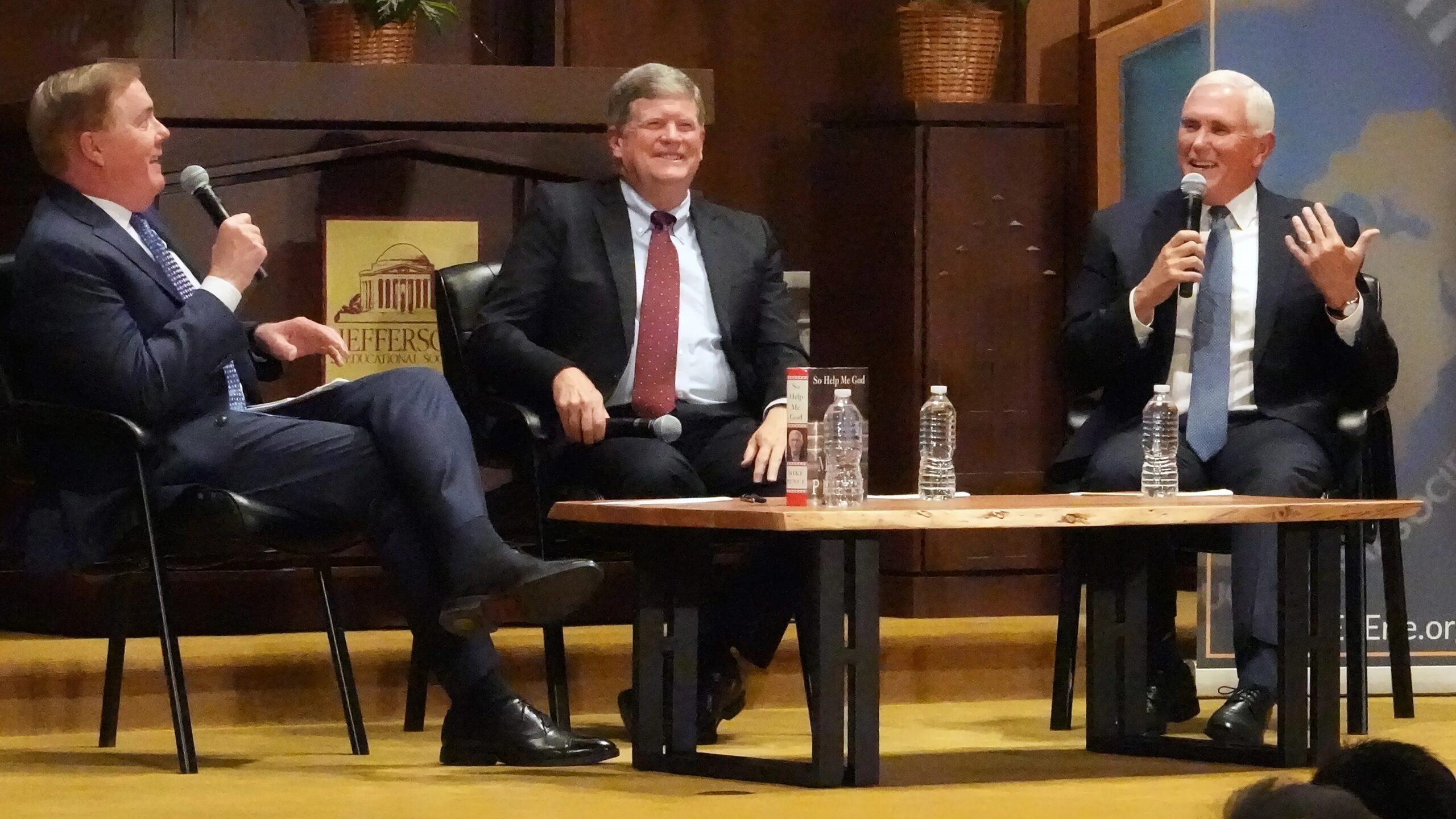

Mike Pence in Erie recounts Donald Trump and the events of Jan. 6
Erie native Steve Scully led the discussion with former U.S. Vice President Mike Pence and Paul McNulty, former U.S. deputy Attorney General.
- The album is set to arrive on the fifth anniversary of an angry mob storming the Capitol in Washington D.C.
- “Violence” is Playboy Manbaby’s first album since 2018.
- The Phoenix rockers started work on “Violence” in 2023.
“Violence is coming January 6th.”
Those are the first words out of Robbie Pfeffer’s mouth in a video shared on social media announcing Playboy Manbaby’s first album since 2018, a satirical masterstroke of darkly comic dystopian art-punk titled “Violence.”
The album is set to arrive on the fifth anniversary of an angry mob storming the Capitol in Washington D.C. as U.S. lawmakers were preparing to certify the election of President Joe Biden.
“We’re in this constant loop of denying history, and I think it’s important to not let that happen,” Pfeffer says.
“To put something out on January 6th, when the current president tried to overthrow the United States government and has now pardoned all those people, and everyone dances as quickly as they can to ignore what actually happened, it seems pretty fitting for an album that’s about a world that’s basically ignoring what’s happening to it.”
The Phoenix rockers started work on “Violence” in 2023 and started over, re-recording everything they’d done so far, when Zac Carper of FIDLAR agreed to produce — a move that led to their most fully realized effort yet.
People warned against releasing ‘Violence’ on Jan. 6
When the singer realized it was possible to get the album done in time to have it be released on Jan. 6, “It felt very much like a thing we would do,” Pfeffer says, with a laugh.
“When I told people about the idea initially, people were like ‘Ooh, you shouldn’t do that.’ And anytime anyone tells me, ‘Ooh, you shouldn’t do that,’ I know I’m getting close to the right thing to do. It’s like, ‘Alright, that’s where I want to be with this.’”
There are no songs on “Violence” that mention Donald Trump by name — “He’s already got his name on enough stuff,” Pfeffer says — or speak directly to the storming of the U.S. Capitol that day. But there are several songs addressing the political environment that made that sort of violence in many ways inevitable.
Playboy Manbaby album was designed to be ‘uncomfortable’
Take the opening track, titled “(Expletive)show,” in which Pfeffer compares this moment in our history to “a dumpster fire burning bright” before summing it up with a gleefully sarcastic, “Thank God we can say retarded again because that was the problem that really needed solving as the fabric of society is completely dissolving.”
That’s all in the first 60 seconds of “Violence,” which inspired a friend of Pfeffer’s to respond, “I wasn’t sure how committed to upsetting people you were until I heard ‘(Expletive)show.’”
And to be clear, that’s by design.
This album “should be uncomfortable,” Pfeffer says. “The marketing of it, the time it comes out. All of it should feel like how things feel right now, which is very, very uncomfortable. When I listen to this record, it feels like what’s happening right now.”
Playboy Manbaby album ends with a message of hope
There are exceptions to that rule.
On “Good Times,” Pfeffer turns reflective, setting the tone with “I wish the people I love would stop moving away/ And I don’t want the people I love to die or decay” on his way to a singalong chorus of “It’s hard to know it’s the good times when it’s the good times.”
It’s a surprisingly heartfelt departure.
“Sincerity is not really our stock in trade,” Pfeffer allows, with a laugh. “And that is a deeply sincere song.”
After making their way through an album whose lyrical highlights range from “I am a veteran of the culture war/ Zero to zero was always the score” to “My offspring is a receptacle for all my bad ideas” and “My family lives in fear because I live in regret,” “Violence” ends with a message of hope.
They hadn’t planned to do so, very nearly ending with “Obituary,” on which Pfeffer sets the scene with “It’s the American Dream of dying (expletive) your 20-year-old secretary/ Go towards the light, it’s not scary.”
As Pfeffer explains, “We were gonna end it with ‘Obituary’ and it was just too (expletive) dark. When we finally had all the songs, I listened through and I’m like, ‘Man, that’s just too much.’ We decided to end with ‘Hope’ just so it wouldn’t be so bleak.”
To Pfeffer, it’s a far more satisfying ending.
“Now it seems like it always should have been the move, because it really does end on what I would actually tell another person,” Pfeffer says.
“‘You’ve got all the hope you need. Don’t ever stop.’ It’s a basic sentiment, but it’s just like, ‘That’s all we’ve got,’ you know? And I think it’s really important. As opposed to ending on a thing where it’s like, ‘Nothing has consequences’ and ‘be as bad as you possibly can, because no one will care.’ That’s a much darker ending.”
‘This is an album that talks about a lot of bad, scary things’
As “a person who detests violence,” Pfeffer was drawn to “Violence” as a title for this album, he says, because “it’s just this thing that’s pretty universally recognized as a bad, scary thing. And this is an album that talks about a lot of bad, scary things.”
He understands that there are people who may not appreciate his take on these bad, scary times.
“But I didn’t pick the game,” he says.
“If you look at the ascent of all these horrifying ghouls, they all understood the same thing. The Andrew Tate business model is to piss off as many people as you can. So there’s something to be learned there. That is the model of the internet. It’s either you’re incredibly traditionally attractive, or you make people angry. Is that wildly toxic? And a horrifying thing? Yes. But if they’re using it, so should we.”
The album art was also chosen to reflect the essence of an album designed to reflect (and critique) these uncomfortable times — a jarring photo of two topless women in masks that look like a demented Mickey Mouse with a naked man standing behind them, his body painted red and a Mickey Mouse mask strategically placed to cover certain details.
The image was inspired by “The Holy Mountain,” a surrealistic art film from the early ‘70s by Alejandro Jodorowsky.
“The whole movie is very jarring, but it has a strange opening scene, and that image has kind of stuck in my mind for more than a decade,” Pfeffer says.
“It’s based on a mix of that and a scene in ‘The Shining’ where there’s a guy in a bear mask. Both of those scenes really struck me as, ‘What the (expletive) does that mean?’ and ‘That’s really uncomfortable.’” I think that’s a great starting point for the album. You should be asking, ‘What is that? Why is that? Why are you doing that? What does it mean?’ I want you to have more questions.”
Playboy Manbaby set out to be loud, funny and ugly
Even the band name was meant to leave you wondering “What the (expletive) does that mean?,” Pfeffer says.
“It’s a one-off line from a cartoon. And the thing that I feel needs to be contextually understood is that there weren’t really fun bands and there weren’t really intense bands at the time that we started.”
That was in 2012. And as Pfeffer recalls, “It was very much, like, peak Mumford & Sons. Everyone was in a folk band with a kind of Urban Outfitters aesthetic, trying to be as quiet and as pretty as could be. And I’ve never been any of that. So I was just like, ‘I want to reject all of that.’ And I would argue that if we’ve done anything, we have definitely rejected all of that. We wanted to be loud and we wanted to be funny and we wanted to be ugly. And that’s Playboy Manbaby.”
It certainly made them stand out on the scene.
“If you show up to a party with nine other bands all headed by attractive men in these kind of perfect Coachella outfits, and you’re us,” Pfeffer says, with a laugh, “everybody’s gonna be like, ‘OK, they’re doing something different.’ And that’s what we wanted to do.”
It was, as he says, “an incredibly bad time to start a weird art rock band,” which only added to the added to appeal for Pfeffer.
“I think we’re DEVO,” he says. “We’re trying to build our own world that is both colorful and fun, but also, like, pretty directly dystopian. That’s DEVO. DEVO is literally de-evolution. And I’ve always been a DEVO fan. There’s bands that are pretty apocalyptic, but they’re very serious about it. A lot of metal bands are incredibly dark, but they’re very serious about it. And then there’s bands that are fun and colorful, but they’re not talking about really dark stuff. To do both, you kind of have to be DEVO.”
They’re also a punk band “for sure,” Pfeffer says. “But in the way that DEVO is a punk band, with a lower-case P. Like, I would feel utterly ridiculous in a battle jacket or any of the aesthetic qualities of punk. And we’ve never once had a song that really has the proper drum beat or guitar tone of punk for the last 20 years or whatever.”
Robbie Pfeffer hopes ‘Violence’ will ‘break through all the noise’
It’s Pfeffer’s hope that “Violence” can cut through the noise and help listeners resist the temptation to respond to all the ugliness that’s going on right now with apathy.
“The whole deafening chorus of everything is intended to make you feel like there’s nothing you can do about it,” Pfeffer says.
“If for even 10 seconds a day you can feel like there’s someone else who sees what’s happening and you can realize how much actual community and hope that there is for the future, that this isn’t normal and just because it’s the reality now doesn’t mean it’s gonna be the reality forever, where it’s like ‘You’re not insane. You’re not alone. This is messed up. This is wrong. Just because they repeat the same thing over and over again doesn’t make it true,’ to break through all that noise for just one second? That’s what I’m going for.”
And there are reasons to be hopeful, Pfeffer says, if you study American history.
“At the same time you had the start of modern American conservatism, you also had the strongest middle class, the highest tax rate on the wealthy, the strengthening of unions, the development of public education, the Civil Rights Act,” Pfeffer says.
“So there’s always gonna be people pushing against the idea that the powerful should have everything. There’s always gonna be both. They’re never gonna stop. And neither are we. So just acknowledging that it’s a broader struggle and an endless struggle is important. Because it’s not about making the Kennedy Center not have the name Trump on it. That doesn’t matter at all. It’s about making sure we can continue to exist after this generation. It’s putting things forward where you can have a world that doesn’t eat itself.”
Get the latest music news with our weekly newsletter.
Ed has covered pop music for The Republic since 2007, reviewing festivals and concerts, interviewing legends, covering the local scene and more. He did the same in Pittsburgh for more than a decade. Follow him on X and Instagram @edmasley and on Facebook as Ed Masley. Email him at [email protected].
‘ The preceding article may include information circulated by third parties ’
‘ Some details of this article were extracted from the following source www.azcentral.com ’