“God bless you, darling Mama. You remain forever in our hearts and prayers,” said King Charles III in a video address Tuesday to mark the centennial of the birth of Queen Elizabeth II on April 21, 1926.
It was that kind of day in London, with personal tributes and park dedications and palace gatherings to celebrate what would have been Her Late Majesty’s 100th birthday. Given that Queen Elizabeth The Queen Mother died at 102 years old, the Windsors suffered a minor shock with the premature death of Elizabeth II at age 96. The doctors were realistic in 2022, listing the cause of death as simply “old age.”
The Royal Family invited others born the same day as the Queen to a reception at Buckingham Palace. No grand staircase climbing or walks in the expansive corridors for this group! The King and Queen Camilla came to them, personally handing out the birthday cards the sovereign sends to all centenarians. They had a slab cake with a “100” in icing, as if someone had picked it up at Marks and Spencer. The Princess of Wales cheerfully asked the guests if they had “anything special” planned for the milestone birthday, endearingly oblivious that being invited to the palace to chat with the royals was precisely the something special.
It was lovely, in a week when the world needed some loveliness. The late Queen was good at providing that.
The official family portrait was expanded to include a few geriatric royals rarely featured on occasions when the main players are present — the now-obscure Duke and Duchess of Gloucester and Princess Alexandra, cousins of the late Queen. The main point evidently was that even the most minor of minor royals were more welcome than the Andrew-formerly-known-as-Prince, as the tabloids call him, and Harry and Meghan, all of whom were happily absent.
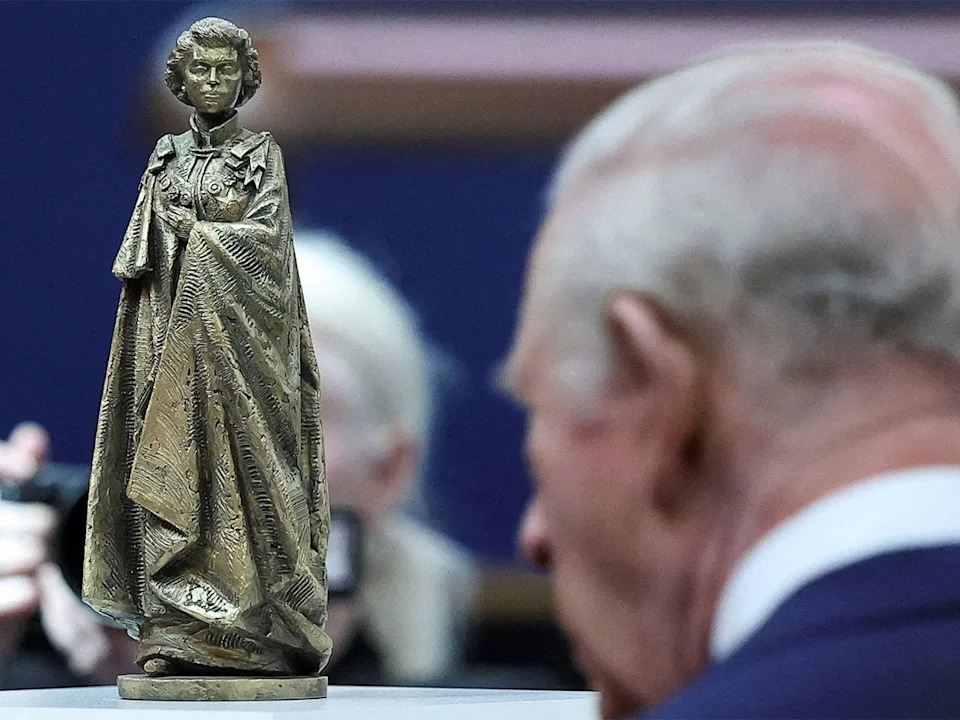
There was a bit of formal business to do. The plans for the official memorial were unveiled on Tuesday, with architect Norman Foster showing his designs to the King and Queen at the British Museum. The plans for the bronze statue depict the Queen in her younger years, wearing the robes of the Order of the Garter. Prince Philip will have his own statue nearby.
King Charles III views a scaled model of a statue of Queen Elizabeth by sculptor Martin Jennings, during a visit to the British Museum in central London on April 21, 2026. The statue will be part of a memorial to the late monarch.
The occasion highlighted a key difference between British memorials and American memorials, with the latter getting greater attention in this year of the semiquincentennial of the 1776 Declaration of Independence. British memorials highlight the personage, with perhaps the name and dates added. The plinth upon which stands the statue of Sir Winston Churchill at the mother of all parliaments has inscribed upon it one word: “Churchill.”
American memorials, in contrast, are verbose things. Mount Rushmore is the exception — four effigies, though suitably super-sized to American tastes. Otherwise, it is the inscriptions that get attention.
The Lincoln Memorial has the Gettysburg Address and the Second Inaugural inscribed, while the Jefferson Memorial has excerpts from the 1776 Declaration and from the Virginia Act of Religious Freedom in 1779. The FDR memorial has his Four Freedoms, and the Martin Luther King memorial has some 16 different texts.
It’s getting a bit out of hand; the newest memorial on the Mall, for Dwight D. Eisenhower, includes windy passages spread over a city block, including a massive wall featuring 200 words from the “military-industrial complex” speech — a text from which only those three words are ever remembered.
It was the late chief rabbi of Great Britain, Lord Jonathan Sacks, from whom I first learned of the difference in memorial styles. The British constitution is a personal one, rooted in the Crown-in-Parliament, rather than a written one. Americans, from Washington to Lincoln, consider themselves an “almost chosen people” and therefore need their own “sacred scriptures,” from the Declaration of Independence to the constitution to the great presidential addresses.

King Charles and Queen Camilla, with architect Norman Foster, attend a presentation at the British Museum for the final design for the Queen Elizabeth Memorial, on the 100th anniversary of the birth of the late monarch.
There was no greater public man of letters than Churchill — he won the 1953 Nobel Prize for literature, not peace — yet none of this is featured in his memorial. Just the visage, the stoop and cane of a man who stood taller than most in the crucial hours of history.
Churchill was already an old man when Elizabeth acceded to the throne, and it was he who offered the prospect of a new Elizabethan age inaugurated by a new, twentysomething Queen. That moment is the subject of perhaps the greatest sequence in the history of filmmaking, from The Crown, where the dowager Queen Mary, preceded by the Queen Mother, pays obeisance to her granddaughter, narrated by Churchillian oratory.
London will soon have the young Queen a short walk from the aged prime minister, her first, as they set out together into the triumphs and travails of the time, shaping it as great figures, worthy of remembrance.
National Post
‘ The preceding article may include information circulated by third parties ’
‘ Some details of this article were extracted from the following source ca.news.yahoo.com ’