REVIEW: Shakespeare in Music Festival, Various venues, 20-23 April
By Peter Buckroyd
The Shakespeare in Music Festival has quickly established itself as Stratford’s musical event of the year. It consisted of seven daytime concerts, (one of which was cancelled because of illness), four other daytime events and four evening events held in Holy Trinity Church.
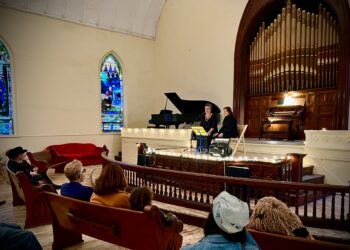
I attended six of the daytime concerts, five of them in the United Reformed Church and the other in the Guild Chapel.

I was reminded that when you went to the theatre in Shakespeare’s day you didn’t say that you had seen a play as we do now, but that you had heard a play. You didn’t go to find about the story but in the vast majority of cases you were familiar with the plot but went to hear what this particular writer had done with it. This festival offered the possibility of doing a similar thing with music because we heard several different performances of the same thing, interpreted by different artists. For example, I heard four performances of Thomas Morley’s ‘O Mistress Mine’. Countertenor Benjamin Irvine-Capel gave a splendid straightforward rendering of the song, beautifully phrased and with a lovely pure sound. Oxford’s Arcadian Singers opened their concert with a choral a capella version. The Bloomsbury Baroque Ensemble treated us to a delightful version for bass viol, renaissance violin, renaissance flute, harpsichord and soprano. The Painted Fall gave us an instrumental version from 1599 for harp and viola. Same tune. Very different versions.
Each of the groups also had their own specific focus. Benjamin Irvine-Capel’s Songs for Countertenor (the star of the festival for me) was a recital entirely of period songs most of them to words by Shakespeare ably accompanied by Kristiina Watt on the lute. He has a lovely pure sound and beautifully phrased performances. I was particularly struck by the gentle pace, splendid variations of tempo and gradual rallentando contributing to a surprising range of emotion in Robert Johnson’s ‘Full Fathom Five’. It was interesting to hear that Johnson was the only composer known to have composed for Shakespeare’s company, The King’s Men. Irvine-Chapel transported us to the Elizabethan court where clearly the quiet, calm and reflective nature of the music must have been a remarkable contrast with and respite from the often tempestuous turmoil of its political manoeuvrings.
The delivery of Dowland Factory’s programme could hardly have been more different. In their Facets of Time programme. Daniel Thomson sang quietly but painted every word and phrase. In his performance of Dowland’s ‘Clear or Cloudy’, for example, he placed great emphasis on the syncopations, creating a series of surges. It was unfortunate that his and Sami Brown’s performances of the five sonnets and the extract from Macbeth were so quiet that they were unfathomable. It was a lovely idea, however, to have the lute playing gently as the audience arrived.
The Bloomsbury Baroque Ensemble’s programme Shakespearean Music for ‘Broken Consort’ was a delight from beginning to end. Philippa Hyde’s crystal-clear soprano worked perfectly with William Summers’s renaissance flute, Ibrahim Aziz’s bass viol, Diane Moore’s renaissance violin and Yeo Yat-Soon’s harpsichord. Yat-Soon’s introductions to the pieces were informative and unusually audible. This perfectly balanced group of musicians was able, in ‘O Mistress Mine’, for example, to create a quintet rather than a voice with accompaniment. It was also a delight to hear how several of the songs featured a duet for voice and flute, each perfectly poised. There was a huge range of musical effects in this programme, none more striking than the splendid staccato vocal opening of Robert Johnson’s ‘Hark, hark the lark’ with the harpsichord. Voice and instruments in perfect harmony.
I didn’t feel quite the same about The Painted Fall’s programme. I found it hard to become acclimatised to the for me unfamiliar combination of harp, viola and two voices. Their programme, Shakespeare Songs, Ancient and Modern, was interesting and imaginatively compiled and it introduced me to twentieth century composer Madeleine Dring whose work I had not come across before. Her ‘Come Away Death’ was written in 1949 for elegiac voice and harp and ‘Take O Take Those Lips Away’ had a similarly plaintive mood, both elegiac and lyrical. The two voices singing in harmony were particularly effective in Taylor Swift’s ‘Love Story’. It was thought provoking to have the programme end with two versions of Sonnet 29 written a hundred and fifty years apart, one by Hubert Parry and the other by Rufus Wainwright.
The most exciting sound of the festival came in the Elizabethan and Jacobean Madrigals from Oxford’s a capella Arcadian Singers, ably conducted by Gerard Lim. It took a while for the ear to become attuned to the number of parts in each song, because these varied. This thirteen voice choir produced an accomplished sound and considerable variety of pace, intonation and shaping. It soon became clear that they were listening attentively to each other, both between and within parts. I loved the variation of volume in Thomas Morley’s ‘Sing We and Chant It’, the depth of sound created by the basses in Gastoldi’s ‘L’innamorato’, the sustained lines, placed and poised discords and beautiful pianissimo singing in Lindberg’s ‘Shall I Compare Thee’, the perfect rhythm and movement from flirtatiousness to deeper passion in ‘Come Again’ and the elegant way in which the religious/sexual metaphor and ambiguity in Campion’s ‘Never Weather-beaten Sail was shown.’ The ensemble was complemented by two splendid soloists – a tenor and a soprano.
The last of the concerts which particularly interested me was All Fancy Sick I Am From Love, a second recital from the Bloomsbury Baroque Ensemble, showing what happened a century after the Elizabethan and Jacobean compositions. It was fascinating to listen to what happened to rhymical variation, tonalities, interplay between voice and instruments, repetitions, decorations, harmonies and occasional dissonances from the previous age. I particularly enjoyed the extracts from The Fairies by John Christopher Smith, the music copyist, we were told, for Handel when he went blind and those from Pyramus and Thisbe, a mock opera by John Frederick Lampe. I didn’t know about Thomas Chilcot based in Bath in the mid eighteenth century. His ‘Orpheus with his lute’ featured William Summers’s flute with pizzicato strings and Philippa Hyde’s soprano as her melodies were echoed by the flute. Uniquely in this concert there was no harpsichord, perhaps pointing forward to the next age when the harpsichord was used less and less.
All in all this was a series of wonderful events. An hour was the perfect duration for this kind of recital. Audience members were provided with invaluable free programmes and the idea of having the performers introduce their numbers was excellent. The United Reformed Church and Guild Chapel are great venues for music of this kind, but their rather cavernous acoustics are very unkind to the spoken voice. Perhaps in future years there will be some amplification for speech.
‘ The preceding article may include information circulated by third parties ’
‘ Some details of this article were extracted from the following source www.stratford-herald.com ’