Rick Bragg says that he’s already eaten his way through Acadiana once — boudin from a gas station and cracklins in a parking lot. He says he stood there popping them like M&Ms. When he made the reverse of the “Oh! Susanna” trip and returned to Alabama, he brought his mother some cracklins.
Through the years, he has bought her two houses — and she was never happier about anything than she was about those cracklins.
He’s excited to be coming back to Acadiana.
Rick Bragg
On April 11, the 1996 Pulitzer Prize-winner will appear at Books Along the Teche Literary Festival in New Iberia. I’ll be the one sitting across from him, attempting to interview him on stage.
I’ve spent considerable time lately trying to figure out what to ask a man who readily admits that he’s already said everything worth saying.
Talking to him in advance doesn’t make that easier.
Not so much about the fancy folk
For anyone who has read “All Over but the Shoutin'” or “Ava’s Man” — and for anyone who hasn’t, my mother would say, “God bless you. You have something wonderful ahead.” — this book festival is worth the drive.

Rick Bragg and his mom, Margaret Bragg, “The Best Cook in the World.”
In fact, my mother would nominate herself to be president of the Rick Bragg Fan Club.
There are parts of his life and perspective that she understands and parts that are foreign to her, but she loves the way the man can turn a phrase and crack open all the feelings long buried in a heart.
Bragg grew up in Calhoun County, Alabama, in the foothills of the Appalachian Mountain chain, among pulp wood haulers, coal miners and farmers. He says that he’s spent his career writing about people who live on the edge of things. He notes he has a deep reverence for both William Faulkner and Tennessee Williams, but he writes about the people who don’t appear in their aristocracy.
Bragg still grades student papers at the University of Alabama, but he doesn’t go far for book talks anymore.
“I turned down that wonderful literary festival they have in Pebble Beach, California,” he said. “I pick my battles. I do a lot of stuff around the South. I’m comfortable with that. They send somebody to get me.”

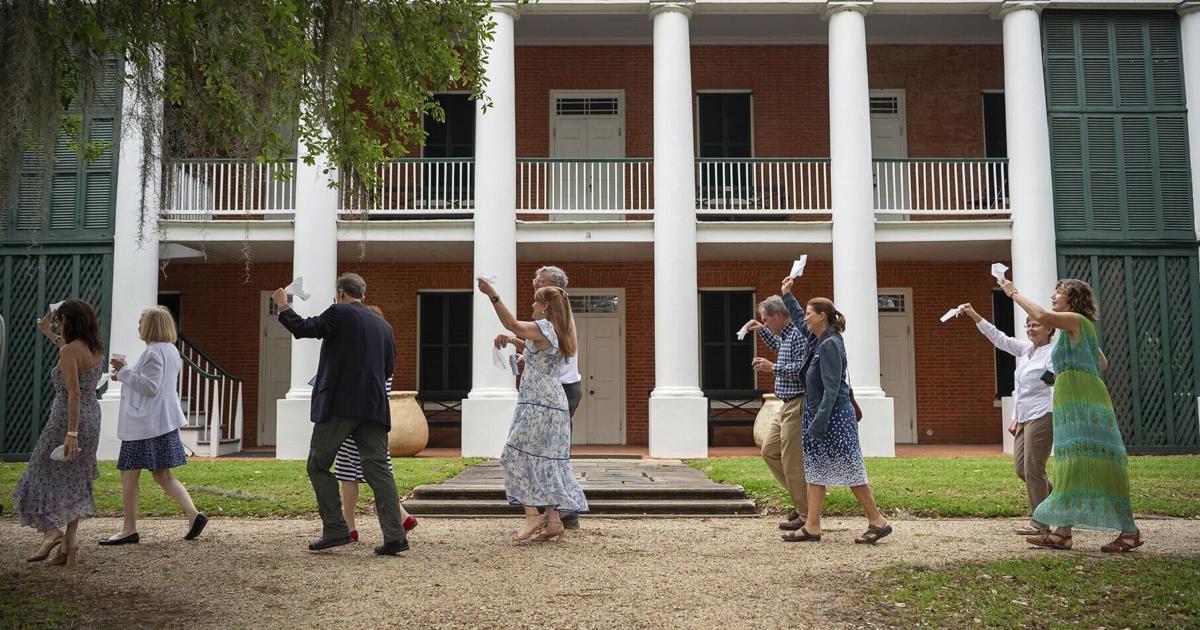
The Books Along The Teche Literary Festival was held on April 4 to 6, 2025 at various locations in the Historic District of New Iberia, La. The event celebrates great southern writers and Dave Robicheaux’s hometown. Books Along The Teche, The Atchafalaya National Heritage Area, Iberia Preservation Alliance and Main Street New Iberia sponsor the event.
Which is exactly what the festival organizers in New Iberia are doing.
He goes because of the people.
“If you write nonfiction books and you don’t want to see the people who read them, then I think there’s something terribly wrong with you,” he said. “I’ll go do a book talk and come home from it wore out, but the first thing I want to do the next morning is write.”
Regrets of a mountain man
A conversation with Bragg makes it clear that he’s been thinking a lot lately about the passage of time. At 66, he admits there are some things he would do differently. Mainly, he says he would have been kinder — not in a big philosophical sense, but in specific moments.
I asked him if he could give me an example, and he told me about how his brother Sam loved a show called “Mountain Men” on the History Channel. One day, they were watching it together, and Bragg told him that the sequence about one of the men taking a horse to town was staged for the show.
Bragg says that Sam took the comment as a slight. Sam thought his worldly, Pulitzer Prize-winning brother was saying that his brother back home in Alabama wasn’t smart. Bragg has carried that feeling ever since, asking himself, “Why didn’t I just stay quiet and enjoy the show with him?”

My Southern Journey: True Stories from the Heart of the South, by Rick Bragg (Oxmoor House, $27.99)
Bragg says he loved Sam like he loved no one else except his mother.
That story has stayed with me. I even shared it with the journalism class I’m teaching at LSU, because it’s such a great example of showing and not telling when it comes to writing. It’s a reminder that it’s not the grand gesture, but the small wrong that sits with us all.
Alligator, honky-tonks and a broken heart
Bragg has been to New Iberia only once before — the first time was shortly after a Cajun woman had done him wrong.
“I went to that part of the world and tried to eat my way out of a broken heart,” he said. “I had a chef in Lafayette who tried to convince me that gator was food. I still disagree with that.”
He went to a honky-tonk where a young man was on stage with an accordion doing zydeco, and there were long tables covered in crawfish shells.
I asked him if he joined in the dancing.
“This will be sad to people in that part of the world, but I just don’t dance, but I’ve always envied people who could just throw off any inhibitions and just throw down,” he said. “So, I just kind of stood to one side and thought, ‘Wouldn’t it be good to be Cajun for one day?’”
He still thinks that.
What Bragg does best, on the page and in conversation, is describe a thing as it is happening — as it is being lived. He says that he’s tried to teach this to students for years with limited success. They, instead, want to be philosophical and write in abstraction.

James Lee Burke’s Dave Robicheaux series are best sellers at Books Along the Teche Book Store, in New Iberia.
As it happens, Bragg keeps a New Iberia presence in his writing room — a passage from James Lee Burke pinned to his wall. It’s one of Burke’s descriptions of a juke joint. It blazes with color, noise and cursing during the night and disappears entirely in the daylight.
He keeps Burke’s writing close at hand to remind himself of the distance between good writing and bad.
“Don’t tell me the moon is shining,” goes the old Chekhov line Bragg lives by. “Show me the glint of light on broken glass.”
A love letter to Acadiana
Today, Bragg still thinks about that honky-tonk. And he has kind remarks about Acadiana.
“Lafayette, Breaux Bridge — what a beautiful, striking, remarkable place,” Bragg said. “You can go all over this country and find a Chili’s anywhere, but there are few places left that are entirely their own places. New Iberia is that kind of place.”
My mom has sent me a few questions to ask Bragg, but I’m still working on the rest. You’re welcome to help me think of more by sending suggestions to [email protected].
Books Along the Teche Literary Festival takes place April 10-12 in New Iberia. The Rick Bragg Great Southern Writer event will be at 11 a.m. April 11 in the Doc Voorhies’ Wing of the Bayou Teche Museum, 131 E. Main St., New Iberia. For a complete schedule and more information about the event, visit booksalongthetecheliteraryfestival.com.
‘ The preceding article may include information circulated by third parties ’
‘ Some details of this article were extracted from the following source www.nola.com ’