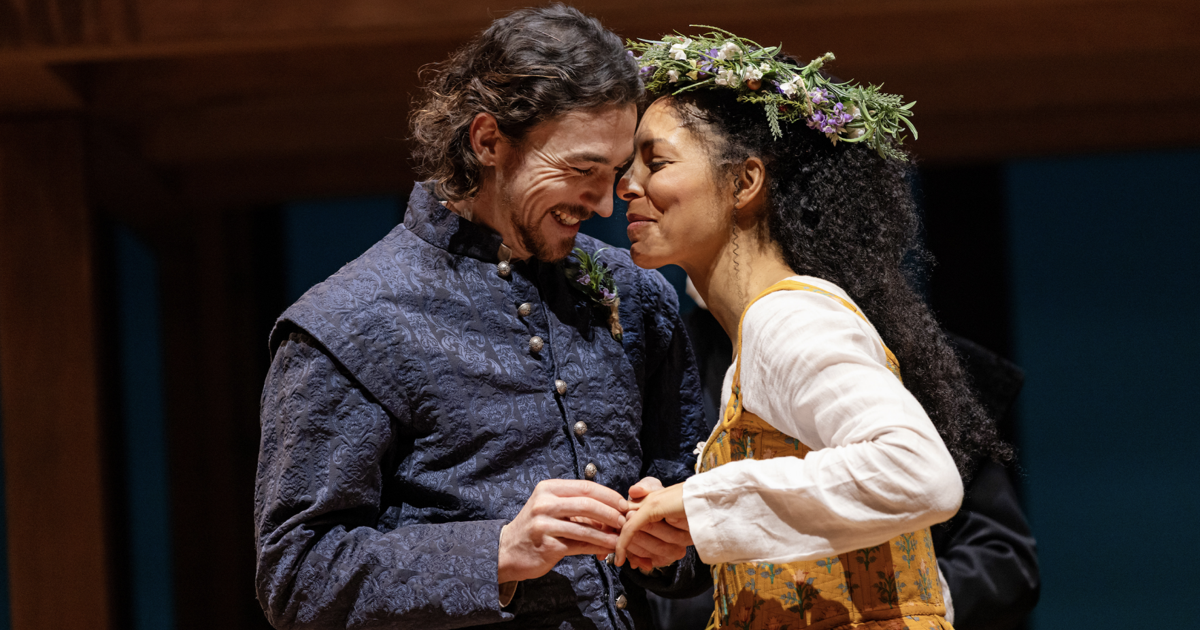
I’ve been thinking about my reactions to the Royal Shakespeare Company and Neal Street Productions’ “Hamnet” ever since Lolita Chakrabarti’s adaptation of Maggie O’Farrell’s 2020 historical novel had its North American premiere at The Yard at Chicago Shakespeare on February 13.
I haven’t read the book or seen director Chloé Zhao’s Oscar-nominated film, co-written by her and O’Farrell and starring Jessie Buckley and Paul Mescal, but the stage version intermittently conveys the heart-breaking grief of losing a child and captures what life might have been like for middle-class people in the late 1500s.
The stagecraft is compelling, too. Tom Piper’s mostly wood-and-rope set morphs from an A-frame attic annex in Stratford formed by two long moving ladders and a platform to a semblance of London’s Globe Theatre, allowing the action directed by Erica Whyman to flow smoothly among locations. His period costumes are in suitable muted colors. Prema Mehta’s lighting enhances the forest, bedroom and stage with equal aplomb, as does Oguz Kaplangi’s music.
Simon Baker’s sound design is intriguing, but the repeated use of long breaths being exhaled to suggest otherworldly mysteries is a bit much. Another distraction is the closed-captioned dialogue on either side of the stage, though it does help our understanding of what’s happening.
The main premise of the play is that William Shakespeare’s life experiences showed up in his work. This is kind of an obvious assumption for any artist, but the centerpiece here is a direct correlation between the death of his son, Hamnet, at age 11, attributed to plague, and scenes in arguably his most famous play, “Hamlet” (the names were interchangeable) written a few years later.
Also, William (Rory Alexander) isn’t the star of the story. That honor goes to Agnes (Kemi-Bo Jacobs), his wife, more commonly known to us as Anne Hathaway, who was eight years his senior.
Except for spectral children, Hamnet (Anjani Cabey) and his twin sister Judith (Saffron Dey), wandering around, the tale unfolds more or less chronologically and feels rather disjointed. The first section is devoted to William and Agnes’ courtship. They meet-cute when she, a free-spirited young woman thought by some to be a witch, is in the forest gathering herbs and flying her kestrel, and he, a Latin tutor, is on his way to or from seeing a client.
The script unfortunately gets bogged down in parental objections on both sides, probably meant to suggest characters who show up later in the Bard’s plays. His father, John (Nigel Barrett), a glove-maker, is an abusive jerk who thinks his son is a good-for-nothing. Agnes’ mother, Joan (Nicki Hobday), has nothing better to do than criticize and scold her. Only her brother Bartholomew (Troy Alexander) shows sympathy.
Before we’ve had time to appreciate the romantic passion between William and Agnes, which isn’t as strong as it should be, they’ve gotten married and, six months later, their daughter, Susanna (Ava Hinds-Jones), is born. After William goes off to London to make a living (initially by selling his father’s gloves), Agnes keeps house and has the twins, transformed from her freer self into a matron, whose friends are other women like Jude (Matilda McCarthy).
Agnes, something of a seer, has predicted that she would only have two children, setting us up for the death of Hamnet who, when Judith gets sick, climbs into bed with her and asks God to take him instead. This is the dark twin of an earlier scene in which the pair dress up in each other’s clothes to fool their parents. They’re also meant to conjure up the separated twins mistaken for each other in many of Shakespeare’s plays, among them “The Comedy of Errors” and “All’s Well That Ends Well.”
What I find most disturbing is that William and Agnes (who has gone through considerable trauma giving birth, by the way) end up trying to process their grief over the loss of Hamnet separately. Rather than being brought closer together, she seems to resent the life he has made in London, while he can’t communicate what he’s feeling.
In the end, she goes to London and we see her watching the scene in “Hamlet” where the Prince of Denmark, played by Cabey’s Hamnet, confronts the ghost of Hamlet’s father, played by Alexander’s William. I think she’s supposed to have an epiphany about how her husband has been suffering, but it wasn’t as clear to me as it should have been.
While “Hamnet” has been a hit with most viewers, I must confess a certain skepticism about the fictionalization of famous people from history. The little voice at the back of my head keeps screaming: “If this wasn’t supposed to be about Shakespeare and his family, would I care about them at all?”
‘ The preceding article may include information circulated by third parties ’
‘ Some details of this article were extracted from the following source www.hpherald.com ’