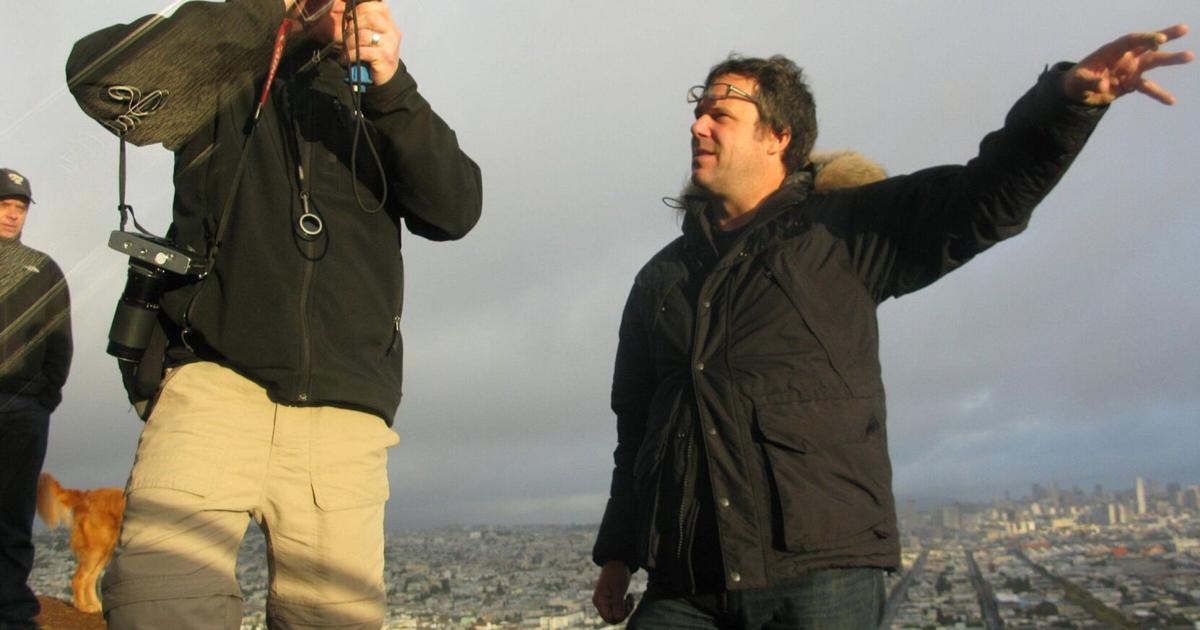
Robinson Devor, the longtime Seattle filmmaker behind local classics such as “Police Beat” and “Zoo,” has had a presidential assassination attempt on his mind for more than 15 years.
The result: “Suburban Fury,” Devor’s new documentary about Sara Jane Moore, who attempted to assassinate U.S. President Gerald Ford in 1975. The film, which opens Friday at SIFF Film Center, is an inventive, illuminating portrait of Moore and the tumultuous political era she was shaped by. Relying largely on extended interviews with Moore (who died in September), it eschews the typical documentary convention of cutting to various talking heads to instead spend long stretches with her at places of note from her past.
Getting Moore, who had just gotten out of prison when Devor approached her in the late 2000s, to participate was something he said was helped by his past work. Specifically, he credits “Zoo,” a documentary in part about the death of Kenneth Pinyan, a Washington man who died from internal injuries sustained after engaging in a sexual act with a horse.
“‘Zoo’ has been a great asset in terms of demonstrating our sympathy for individuals who are perhaps misunderstood or mischaracterized by the media. That was a good calling card, oddly enough, for a 70-year-old woman,” Devor said. “We basically, using that as an example, we said, ‘We would like you to tell your story.’ I think that was very attractive to her.”
Devor and his collaborator, fellow Seattle filmmaker Charles Mudede, who is credited as a co-writer on the film, had originally completed their filming with Moore more than a decade ago. However, Devor said the industry got more unstable, and years went by with them contemplating different ways of how the film could evolve. This included reshaping it into a hybrid film of sorts with actors reenacting parts of Moore’s life. Devor said there was even a meeting with actor Jennifer Jason Leigh, who had wanted to play Moore. However, Devor said financiers said no to her, and there were other big names in the mix like Olivia Colman before it returned to being a doc.
“As the (COVID-19) pandemic was starting, Charles was encouraging me and the project to get back to its formal documentary roots with no re-creations, just use the interviews and really lean in on archival. It was intimidating because it was, like, ‘Can we really make this film with the spine of interviews and just archival?’ That’s what took us another two or three years working on that,” Devor said. “It became what it became, and I think that’s the film it needed to become.”
What the film became is often more slippery, with Devor describing Moore as being a frequently “unreliable” narrator of her own life, but that he wanted to create interesting scenarios in how he explored this. This meant filming her in striking ways, such as speaking alone in a car as if she were an FBI informant (which Moore says she was) providing information to shadowy agents.
“I always say, ‘Hey, I’m essentially a frustrated fiction filmmaker, right?’ So I get a couple setups, I’m going to want to make them as cinematic as possible and not just do talking-heads work. We tried to imagine interesting scenarios and had to work with Sara Jane,” Devor said. “She was very game — she trained to be an actress — and I think she thought it was all fascinating. We are always influenced by (filmmaker) Errol Morris; we used the Interrotron, when somebody can see the interviewer in the lens and speak right into the lens. So in the car, we used a walkie-talkie and she was looking right at us in the lens outside of the car.”
This was all part of what Devor said was trying to get to “ground zero” in Moore’s life. He said that, while he feels he didn’t quite get there, his complex, late subject largely opened up to them.
“I think that Sara Jane was trying to be vulnerable and honest a great amount of the time. I think there were also ingrained narratives that were difficult for her to break free from and the friction would come if those were challenged,” Devor said. “But I think her duality, her ability to be both an arch conservative and a violent revolutionary from the left, they were clashing and living legitimately inside of her. I don’t think she could admit how conservative she really was.”
As for the next narrative Devor is looking to delve into, he’s announced he’s making a doc that will center on Richard Russell, the man dubbed “Sky King,” who stole a plane from Seattle-Tacoma International Airport in 2018 and flew it for more than an hour before fatally crashing on Ketron Island.
“It’s an incredible Seattle story. The fact that he was aloft for 75 minutes, which is the length of a film, at dusk, in summer, flying around Mount Rainier and across the Puget Sound over towards the Olympics while a Pearl Jam concert is starting and F-15s are in the sky, I think it just has all the elements. It’s both a very specific incident, but it’s so open for interpretation and for cinema that it’s exciting,” Devor said. “We’re in the process of talking to people and I believe in Charles’ imagination. We’ve done this enough that we’re going to have something special, I know.”
‘ The preceding article may include information circulated by third parties ’
‘ Some details of this article were extracted from the following source www.yakimaherald.com ’