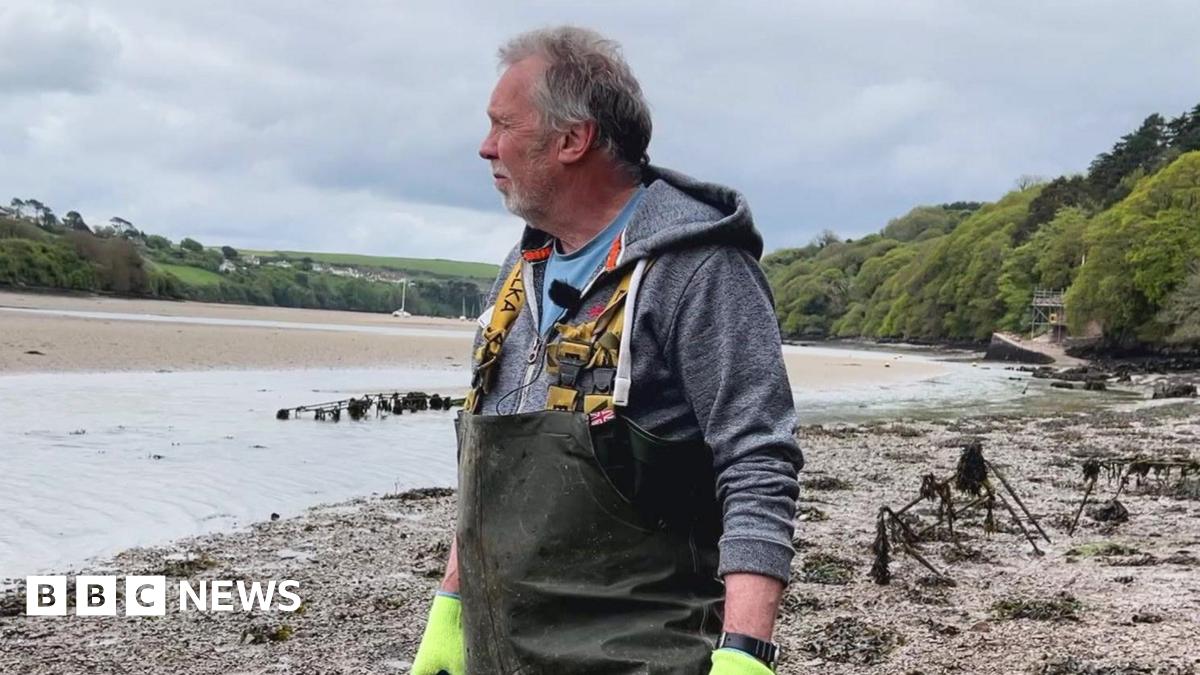
“We are clearing the site,” says Edwards as he hauls trestles from the river to be cut up.
“There’s been a farm here for 50-odd years. We’ve now been required to leave, which is a bit of a pill to swallow.”
Edwards runs a small Pacific oyster farm on the muddy banks of the Avon as it nears the sea at Bantham. He has worked the site full-time for almost a decade.
Now the operation is being shut down after pressure from the Duchy of Cornwall, the estate that owns the riverbed.
It does not want Pacific oysters, classed as invasive, farmed on its land, saying, after talks with conservation groups, it would only support native oyster farming.
Pacific oysters, also known as rock oysters, are not native to the UK. That label has become central to the dispute.
The duchy, which Edwards says is not renewing his lease, argues they are an invasive species, but he says that does not match the reality he sees every day on the river.
“As far as I can see, the scientific consensus is that they’re broadly beneficial,” said Edwards, a former fish farmer in Scotland.
He says his stock is triploid, external, meaning functionally sterile, so it cannot breed in the wild. A habitat regulation assessment found no adverse environmental impact.
“It’s beyond any reasonable scientific doubt that we’re not having any adverse impact on the environment,” he said.
‘ The preceding article may include information circulated by third parties ’
‘ Some details of this article were extracted from the following source www.bbc.co.uk ’