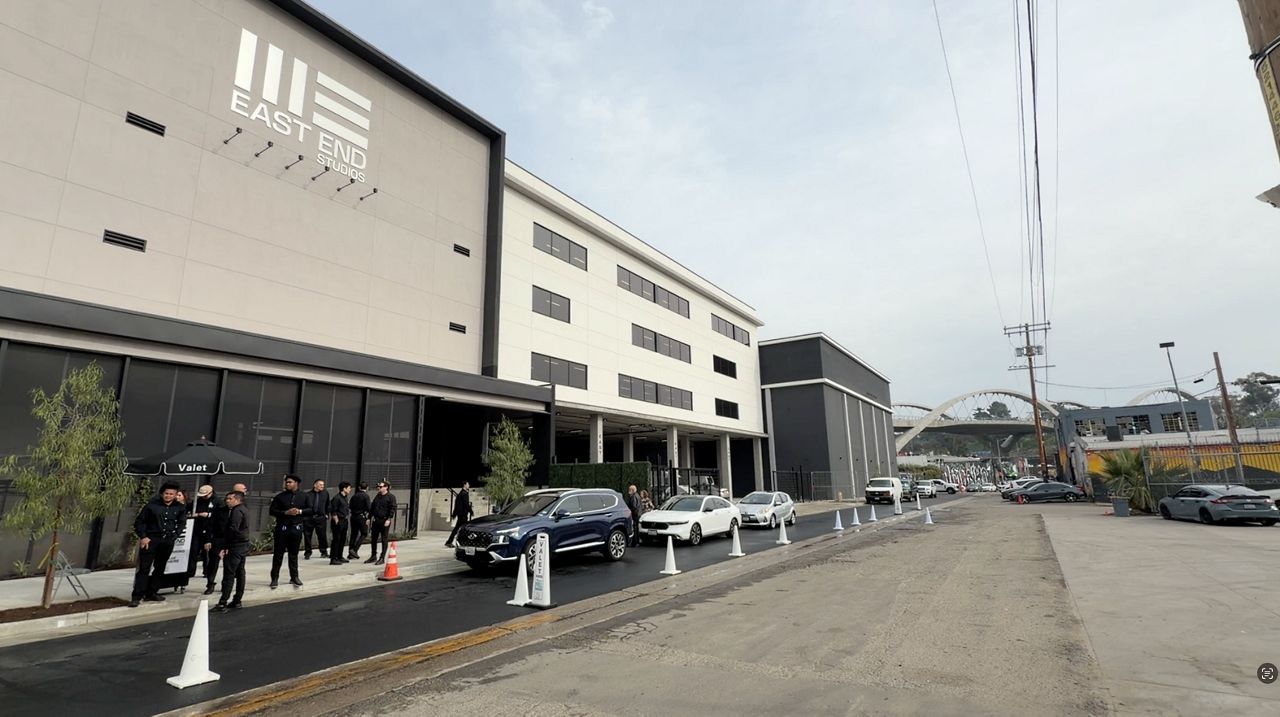
LOS ANGELES — The ribbon-cutting at East End Studios’ newest production facility in downtown Los Angeles offered a sense of hope for an industry that struggled through one of its weakest years in recent memory.
For location manager and scout Alexandra Gibson, the event was a vote of confidence.
“I think that there’s still a lot of business here in LA,” she said, pointing to fully booked stages and ongoing chatter among crews. Her optimism reflects a growing belief among some professionals that 2026 could mark a turnaround.
But last year presented hard realities.
According to FilmLA’s year-end report, Los Angeles recorded just 19,694 film and television shoot days in 2025, a decline of more than 16% compared to 2024 and the lowest total since the pandemic disrupted production.
The contraction echoed in the real estate side of Hollywood too: historic Radford Studio Center, long a hub for major television and film shoots, recently defaulted on approximately $1.1 billion in debt and is being returned to lenders, underscoring financial stress in the sector.
Amid that downturn, infrastructure investments like East End Studios’ new Mission Campus highlight a strategic bet on the future. Partner Shep Wainwright emphasized the versatility of the new facility, designed to handle a wide range of production needs from episodic television to big-screen work.
The campus is a 255,000 square foot facility complete with expansive office space and five-full service sound stages.
In total, the campus created 1,500 construction jobs and is expected to spur an additional 750 permanent jobs for Angelenos. City leadership also channeled optimism.
“LA is the creative capital of the world, with our entertainment industry being core to this city’s history and the backbone of our economy,” said Los Angeles Mayor Karen Bass. “When we invest in our signature industry, we are creating good-paying union jobs, expanding creative outlets and spurring new economic opportunities. I want to congratulate East End Studios on this milestone and look forward to continuing our partnership to deliver for Angelenos.”
Economic incentives are another piece of the puzzle.
California significantly expanded its Film & TV Tax Credit Program in 2025, increasing the total budget and broadening eligibility.
Industry analyst Jason Fisher, CEO of StageRunner, a soundstage marketplace and production news hub, noted that while 2025 saw slow activity, Radford’s default shouldn’t be interpreted as an industry-wide signal.
“I think the studios that have healthy balance sheets, with their banks, with their lenders, with their financial situations, they should be fine. But it’s a good lesson to all,” said Fisher.
Fisher also said the impact of tax incentives at the end of 2025 changed the tone.
“We started to see a number of new projects starting to get green-lit for California. And those haven’t yet come through the system, but we’re starting to see those projects starting to prep,” Fisher said.
Despite the challenges of the past few years, including labor disruptions, Fisher believes the fundamentals of California’s industry remain strong.
“It’s important to remember that California is still the most popular place to film around the world,” he said. “So while it all feels like a lot of doom and gloom, California is still the entertainment capital of the world. And I do think that in 2026, we’re going to see a significant rebound.”
For Gibson, that rebound is feeling real.
“The calls are starting to come in and there’s a certain energy that happens,” she said. “I do think that it’s really having a comeback.”
‘ The preceding article may include information circulated by third parties ’
‘ Some details of this article were extracted from the following source spectrumnews1.com ’