Nashville isn’t just Music City anymore. The whole entertainment sector is growing. The profitable film and TV scene, in particular, is turning Nashville into the new “Y’ally-wood.”
Longtime community fixtures Reese Witherspoon and Nicole Kidman have continually vouched for Nashville as a film hot spot, saying they want to bring more opportunities to the area.
“There is so much room here for production,” Kidman said at the 2025 Nashville Film Festival.
“The crews are fantastic and the actors, and the people … I feel that it’s taking off and will continue to take off, so off we go,” she continued. “Come on, Tennessee, we’ve got this.”
And Kidman is right – off we go. MTSU in Murfreesboro is responding to the increase in local TV and film production jobs with a new graduate program, launching this fall, for students seeking television-oriented careers.
Here’s what to know about the city’s growing film and TV industry.
Are more movies filming in Nashville?
Over the past decade, actors, actresses, filmmakers and writers have all continued to establish home bases in Nashville.
Musical theater legend Kristin Chenoweth, “Modern Family” actress Ariel Winter, and ’90s sitcom star Melissa Joan Hart are among the entertainers who now call Tennessee home. Other additions to the city include “General Hospital” actress Kirsten Storms, “One Tree Hill” star Jana Kramer, “Twilight” actor Kellan Lutz and “Orange Is the New Black” star Laura Prepon.
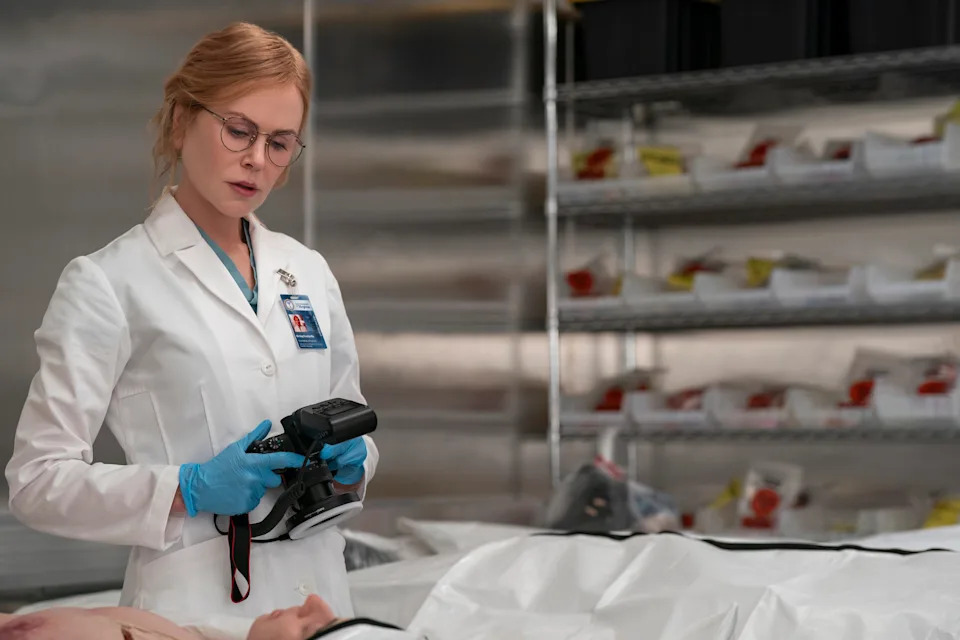
Recent projects filmed in Tennessee include “9-1-1: Nashville,” “Scarpetta” starring Kidman and Jamie Lee Curtis, Netflix’s “Heartland,” and yet another Kidman project, “Holland, MI.”
More: ‘Scarpetta’ stars Nicole Kidman, Jamie Lee Curtis ponder life and death

Kay Scarpetta (Nicole Kidman) in “Scarpetta.”
As of 2026, the Tennessee Entertainment Commission estimates the film industry is generating $365 million in state tax revenues and $6.4 billion in entertainment sector gross domestic product. That’s a dramatic increase considering the commission estimated production projects had a cumulative impact of $445,724,896 in economic output from 2007 to 2022. From 2014 to 2022, Tennessee employment in motion picture and video production grew 82%.
The commission reports Tennessee now ranks fifth in the nation for employment in the motion picture and video sector.
For example, the procedural “9-1-1: Nashville” has created more than 600 jobs and generated an estimated $50 million in economic impact statewide since filming began in June 2025, the commission reported.
“Nashville is a character, and Nashville itself carries a lot of weight,” Commission Executive Director Bob Raines said in an interview with WKRN. “It’s a city that audiences recognize, and it brings authenticity to a show like this.”
More: ‘9-1-1 Nashville’ filming in Music City showcases booming Tennessee film scene

A scene for the ABC show “9-1-1: Nashville” involving an Airstream trailer stuck on the top of a bridge due to a tornado is filmed on the Korean Veterans Bridge on Sunday, July 13, 2025.
But seeing the Volunteer State on the silver screen isn’t a new trend.
Tennessee had its glory days in the film industry with major blockbuster movies filming in town in the ’80s and ’90s after the creation of the Tennessee Film, Tape, and Music Commission in 1983 (now known as the Entertainment Commission), which was part of a government push to attract Hollywood productions.
Movies filmed in Tennessee in 1984 included Mark Rydell’s “The River,” which starred Sissy Spacek, Mel Gibson and Scott Glenn, the Sylvester Stallone and Dolly Parton romance “Rhinestone,” and Jane Fonda and Leon Helm’s “The Dollmaker.”
There was also the sci-fi movie “Star Man” (1984), which starred Jeff Bridges and Karen Allen. In the flick, Tennessee offers diverse terrain depicted as parts of Minnesota, the Midwest, and also the desert of Arizona.
More than a decade later came Tom Hanks’ “The Green Mile” (1999), which was filmed at the old Tennessee State Prison in Nashville. The penitentiary has had a starring role in multiple productions over the years.
As the years went by, Georgia’s tax incentives attracted more productions away from the Nashville area, and the Peach State became the nation’s unrivaled Southern production hub. Atlanta is widely considered the Hollywood of the South and has also been called Y’allywood, gaining momentum after the introduction of film tax credits in the 2000s.
But, as of 2026, Tennessee’s pull is growing, and Nashville is now establishing itself as a player on the scene.
Drew Maynard, a filmmaker and photographer born and raised in Nashville, thinks the city has the foundation to succeed.
Maynard’s films have screened at festivals across the country, including SXSW, the Nashville Film Festival and the Virginia Film Festival. His debut feature film, “Shine Service,” is a documentary about Nashville’s legendary shoe shiner Robert “Percy” Person. It is currently available to stream on Amazon.
“With great organizations like the Nashville Film Festival, Defy Film Festival, the Nashville Filmmakers Guild, Nashville Production Week, the Nash Film Club, Salute Your Shorts Night, and more, the Nashville indie film community is more vibrant and united than ever,” Maynard said.
“In order to sustain our momentum, it’s important for the state to offer competitive incentives for larger out-of-state productions that provide steady work for our local filmmakers, actors, and crew,” Maynard continued.
“Nashville has so much talent on all sides of the camera, we really should be one of the nation’s major film production hubs.”
Tennessee’s current financial incentives include a 25% grant rebate and a production credit that can be used to offset up to 50% of franchise and excise tax liability, which includes music scoring and animation.
Unlike many states, Tennessee often has no per-project cap, making it attractive for large productions. Plus, compared to California, local residents don’t have to pay a state income tax.
Even so, Georgia, California, New Mexico and New York all offer some of the most competitive financial filming incentives, with Georgia leading the pack with its high, uncapped transferable credits.
Why are more actors moving to Nashville?
Leah and Phillip Abraham, who run the media company Philea Media, moved to Nashville from Los Angeles in 2024 after COVID-19 caused much of the film industry go remote. That was the final push they needed to relocate.
“People are making choices based off of where they want to live,” Phillip Abraham said.
“And that means that Nashville, and amazing cities that are centrally located for the Southeast, are just the perfect spot for filmmakers,” he said, pointing out Nashville’s proximity to Georgia and Ohio, two other major filming locations.
The Abrahams produce cinematic social media shorts, have written on major motion pictures, and create music together.
Nashville’s affordability in comparison to Los Angeles was also enticing for them. In Tennessee, the Abrahams can afford a house, as opposed to their 700-square foot L.A. apartment. Now, they even have the financial stability to start a family.

Leah and Philip Abraham, who run the media company Philea Media, moved to Nashville from L.A. in 2024.
“Nashville specifically feels really exciting because you’re at the ground-up, whereas in L.A., the culture is long-standing,” Leah Abraham said. “Nashville is this new energy. All of our friends are collaborating, shooting sizzles and writing pilots. There’s more inclusion and creativity.”
The couple recently filmed a pilot on the property of a man who provided the venue free of charge, which the couple described as an example of Southern hospitality. The property owner even cooked the entire film crew tri-tip steak fresh off the grill for lunch and never billed them. “I can’t stress enough how that would never happen in L.A.,” the couple said.
“Here the soil is fertile,” Philip Abraham added. “We’re having a lot of fun seeing that roots can grow down.”
On the other hand, new territory means that talent will have to protect their rights as industry players learn the ropes.
“Nashville has a lot of room to grow. I’ve experienced as an actor here that people don’t know the film industry in the same way, so you have to really fight for certain protections,” Leah Abraham said, recalling how she has been asked to work unreasonable hours or carry out responsibilities not included in her contract.
“I’m excited to be an advocate for good rights, protecting people and cultivating something that, in my opinion, can be different than L.A. in a really positive way.”
And there’s much to come on the horizon.
What will film in Nashville next?
“9-1-1: Nashville” has been renewed for a second season and is expected to air in fall 2026.
In March, Netflix and Warner Music Group (WMG) struck a multiyear deal to produce documentary series and films about the lives, music and legacies of the label’s artist roster.
WMG artists include Nashville’s Kenny Chesney and Blake Shelton, among many others.

Country music star Lainey Wilson is seen in the documentary “Lainey Wilson: Keepin’ Country Cool,” directed by Oklahoma native Amy Scott.
Separate from the new deal, Netflix will release the documentary “Lainey Wilson: Keepin’ Country Cool,” which was filmed in Louisiana and Nashville, on April 22.
Film lovers can expect to see much more of the Volunteer State on their screens of all sizes in years to come.
Audrey Gibbs is a music journalist at The Tennessean. You can reach her at [email protected].
Curious what The Tennessean’s music team has been listening to lately? Check out our playlist below, featuring all local artists.
This article originally appeared on Nashville Tennessean: Why Nashville’s film and TV industry is growing so quickly
‘ The preceding article may include information circulated by third parties ’
‘ Some details of this article were extracted from the following source www.yahoo.com ’