It takes a lot of chutzpah to write a play that’s little more than two-and-a-half hours of people arguing about a hot topic. But that’s just what Itamar Moses does with “The Ally,” his 2025 Pulitzer Prize finalist that’s now enjoying a well-acted Midwest premiere directed by Jeremy Wechsler at Theater Wit.
Set in September 2023 at “a prestigious American university in a struggling American city” (the program tells us), “The Ally” looks at many sides of the Israeli-Palestinian conflict, as well as how it relates to U.S. racism. It premiered off-Broadway at the Public Theater in February 2024, so it predates Hamas’ October 7 attack and everything that’s happened since.
On the one hand, this specificity instantly dates the play, given all the destruction it fails to address. On the other, the darkly funny debate seems incredibly timely because … well, the more things change, the more they stay the same.
Unlike Moses’ book for “The Band’s Visit,” which reveals the underlying humanity that can bring people with very different beliefs together, “The Ally” exposes the preoccupations, prejudices and political positions that push them apart, often irrevocably, into opposing corners.
Asaf Sternheim (Jordan Lane Shappell) is a 40-something playwright and part-time professor — he teaches one course a semester that meets once a week — who is trying to hold to the middle ground. Like Moses himself, he’s a Berkeley-raised son of Israeli immigrants, and he’s moved from New York to the small town because his wife, Gwen Kim (K. Chinthana Sotakoun), has gotten an administrative job at the university selling growth plans to a predominantly Black community burned by a previous expansion.
When a favorite former student, Baron Prince (Devaughn Asante Loman), asks Asaf to sign a manifesto condemning police brutality after his cousin, Deronte, was wrongly accused of stealing cars and killed by cops, Asaf is initially all in, even though he hasn’t paid much attention to the case or seen the video, which went viral. Gwen thinks her husband’s support of the Black community will help her in her job, even though she’s skeptical because Baron is working with activist lawyer Nakia Clark (Sharyon Culberson), who is Asaf’s former girlfriend.
After reading the manifesto, Asaf has doubts, especially about the use of loaded language — terms like apartheid and genocide — tying the U.S. treatment of communities of color to the Israeli treatment of Palestinians. He also questions why Israel is the only country besides the U.S. to be called out for its oppression of others. But he signs anyway, and the situation escalates from there.
A bit reluctantly, Asaf agrees to become the faculty sponsor of a new Jewish-Palestinian student group created by American Jewish student Rachel Klein (Mira Kessler), a descendant of Holocaust survivors, and Farid El Masry (Eliyah Ghaeini), a Palestinian who was born in Gaza and who still has family in Palestine. Their first priority is hosting a talk by an Israeli historian, who is highly critical of Israel and whose appearance was opposed by the existing Jewish campus group to which Rachel previously belonged.
Asaf, who describes himself as an atheist adhering to an “acoustic-guitar-based variety of Judaism,” sees supporting the speaker as a free speech issue, but he’s immediately confronted by a Jewish grad student, Reuven Fisher (Evan Ozer), who accuses him of self-hatred and offering “a performance of virtue for the goyim.”
Things go from bad to worse after the historian’s speech, when Baron comes on stage and calls for total divestment and sanctions against Israel, blindsiding Asaf. Practically every character gets a monologue — the most passionate is Ghaeini’s as Farid — and they all have much to say. But they also betray an inability (or unwillingness) to offer each other credit or compassion. And they don’t see the contradictions and pitfalls in their own positions.
Feeling pressure from all sides, Asaf is left not knowing what to do. So, naturally, he goes to see the rabbi (Culberson). She offers some insights into the mind-body (or head-heart) conundrum but no concrete answers — naturally.
A harsh critic might say that “The Ally” rehashes arguments we’ve all heard before, but I found it thoroughly engrossing, even if in need of some trimming. I wish the characters and their relationships had been developed more, so they didn’t come across merely as mouthpieces for various positions. Occasionally they teeter on the edge of caricature, but Wechsler’s direction helps keep that impulse in check.
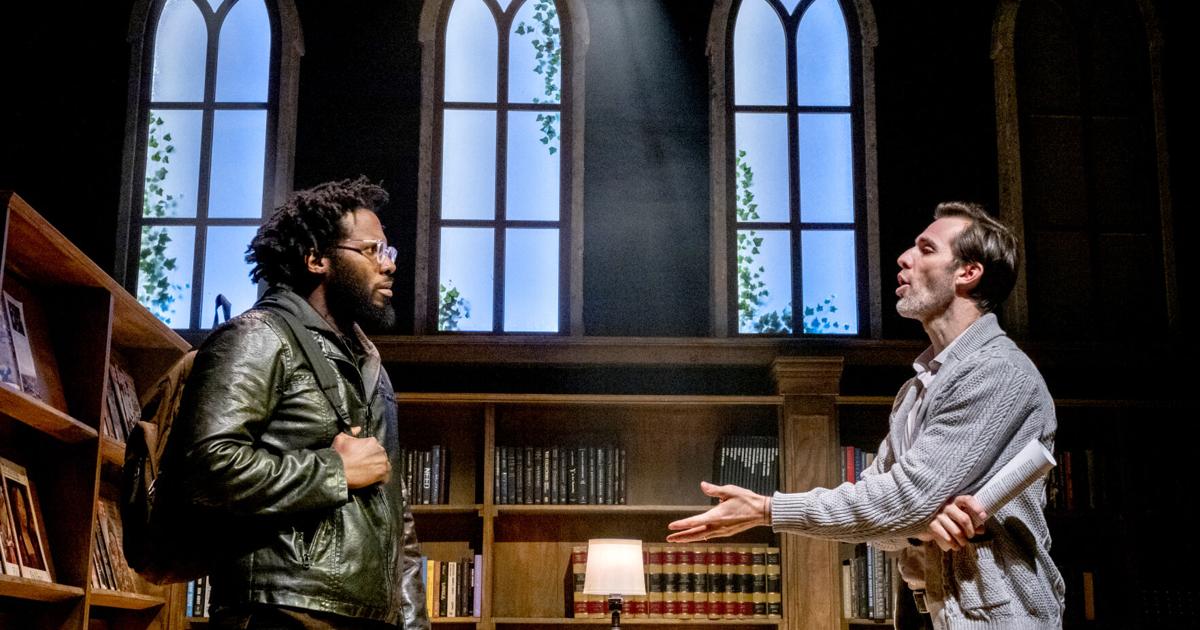
Technically, the production is everything it should be, and special credit goes to Joe Schermoly’s scenic design. I could easily spend a day or two or three studying in his library with its book-filled shelves and soaring ceiling.
‘ The preceding article may include information circulated by third parties ’
‘ Some details of this article were extracted from the following source www.hpherald.com ’