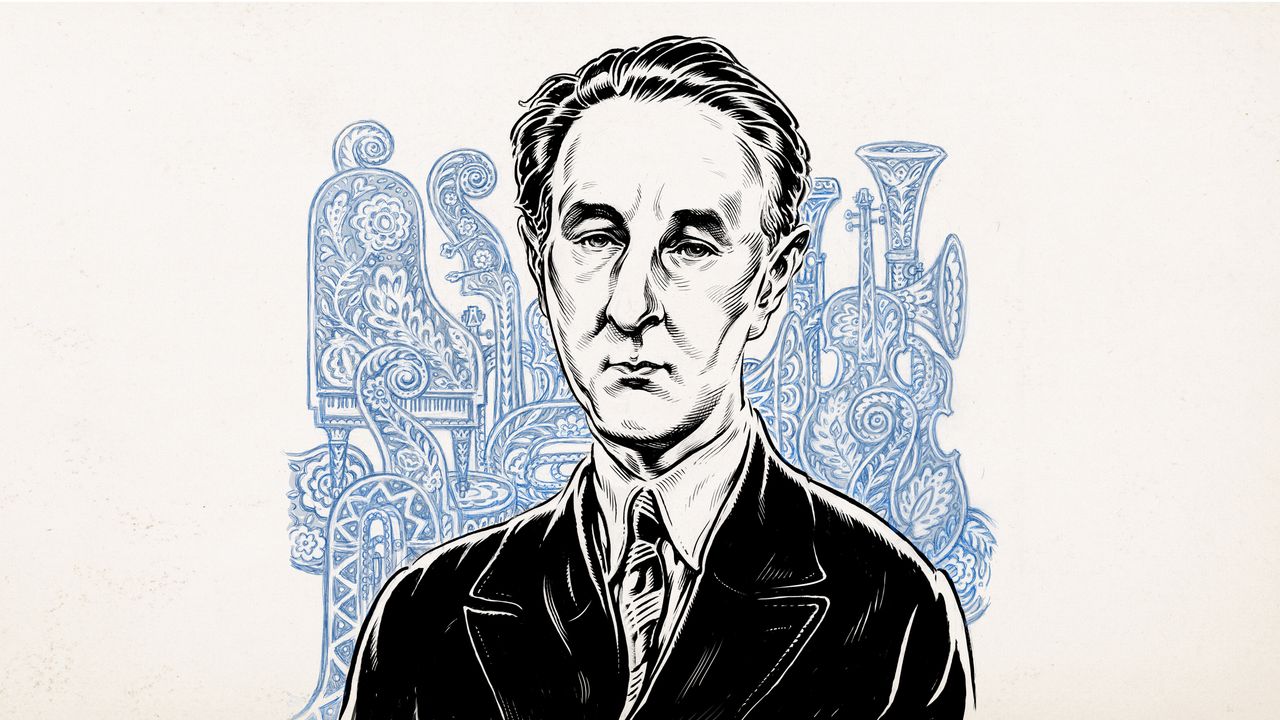
How does a singular musical personality emerge from an agglomeration of pitches? The characteristic quirks of major composers are easily identified: Beethoven’s hammering three- or four-note motives, Schubert’s juxtapositions of heavenly melodies and harmonic abysses, Brahms’s pensive parallel sixths, Mahler’s agonized four-note turns. Even in the case of many-sided figures such as Monteverdi or Stravinsky, who hover between eras and assume various guises, you can pick out the face behind the mask. But it’s not enough to develop a set of mannerisms. What matters is how these signatures interact with the more abstract mechanisms that go into the making of large-scale forms. When that happens, we experience a portion of a life unfolding in sound.
The Czech composer Bohuslav Martinů, the focus of this summer’s Bard Music Festival, at Bard College, had one of those voices which reveal themselves in a matter of seconds. Take the opening of his Second Symphony, from 1943, which the Orchestra Now performed on the festival’s first weekend, under the direction of Leon Botstein, Bard’s president and chief musical curator. The first violins unfurl a lilting, lightly bopping tune in D minor. Ascending patterns elsewhere in the strings blur the outlines of that governing idea. The real Martinů giveaway is an underlying buzz of activity in the piano and the harp—D-minor triads mixed with C-sharp-minor, B-flat-major, and E-flat-major ones, suggesting a rickety machinery behind the lyrical action. These and a few other basic elements recur throughout Martinů’s œuvre: curt themes, darting rhythms, tangy harmonies, glittering textures.
Although Martinů’s music is lavishly documented on recordings, it is not so often heard live. One problem is that there is too much of it. His catalogue runs to about four hundred scores, including sixteen operas, fifteen ballets, thirty or so concertante pieces, and chamber works for every conceivable instrumental combination. (If you have a group consisting of a clarinet, a horn, a cello, and a snare drum, you’re in luck.) History tends not to favor hyper-prolific composers, who are suspected of producing music by the yard. Yet, even when Martinů seems to go on autopilot, the journey remains idiosyncratic and unpredictable. There’s an inherent tension in his mixture of materials. He is the kind of figure who profits from Botstein’s summertime festivals, which, for thirty-five years, have demonstrated how much great music exists outside the standard repertory. After days of immersion, I wanted to hear still more.
Martinů was something of a chameleon, despite his telltale tics. In a program note, the musicologist Michael Beckerman, who served as one of two scholars-in-residence at this year’s Bard festival (the other was Aleš Březina, the director of the Bohuslav Martinů Institute, in Prague), observed that the composer’s array of styles includes “jazz, medieval miracle plays, Slovak folk music, Renaissance madrigals, a range of modernist musical languages, Moravian folk music and poetry, the Baroque concerto grosso, Mexican musical instruments, Stravinskyian neoclassicism, and Byzantine chant.” From 1923 to 1940, Martinů lived in Paris, and turned out enough up-to-the-minute works—about soccer, silent-movie shoots, transatlantic flights—that he could have been mistaken for a seventh member of Les Six. Somehow, though, he escaped from the trend-chasing frenzy of the period with a crisp, confident sense of self.
The Bard programs managed to touch upon most aspects of Martinů’s output, although, given practical limitations, they couldn’t encompass the full profligacy of his imagination. A Sunday-afternoon concert included a suite of jazz-tinged numbers from his 1927 ballet “La Revue de Cuisine,” but we could not, alas, see the danced narrative, which involves complex romantic entanglements among kitchen implements (Pot, Lid, Whisk, Broom, and Dishcloth). Then again, the chamber-music presentation—the performers were the clarinettist Yoonah Kim, the bassoonist Thomas English, the trumpeter Zachary Silberschlag, the violinist Luosha Fang, the cellist James Kim, and the pianist Andrey Gugnin—emphasized the elegance of the writing over the silliness of the scenario, showing how the composer blends the tango and the Charleston with his own folk inheritance. Martinů’s dabblings in jazz are free of condescension; they are urban but not urbane.
In 1941, Martinů fled Nazi-occupied Europe and took refuge in the United States. As he contended with the terror of war and the disorientation of exile, his musical palette audibly darkened. You can already sense an emotional shift in his spellbinding Double Concerto, from 1938, which Botstein conducted alongside the Second Symphony on the festival’s opening night. The piece is scored for two string groups, timpani, and piano—an instrument that often gives a metallic bite to Martinů’s orchestral textures. The central Largo movement pivots around a clash of B-minor and B-major chords, with the latter repeatedly struggling to win out over the former. In the wake of episodes that evoke a crawl across a wasteland, the conflict is resolved in favor of the major, in a beatific pianissimo. But when the same fraught passage returns, in the finale, it collapses in defeat, with stinging discords and pizzicato thuds.
Before Martinů came to America, he had displayed little interest in symphonic composition. He wrote considerable quantities of orchestral music, but he preferred mixing chamber groups with larger ensembles, in the Baroque manner. He distanced himself from what he called the “climax cliché”—cheap swells of sound and emotion. America was, however, mad for symphonies, the more heroic the better, and Martinů found his way into the form. Between 1942 and 1953, he produced six numbered works in the genre—one of the most distinctive of twentieth-century cycles, comparable in its resolute independence to the same-numbered cycle by Carl Nielsen. Although Martinů’s symphonies have no shortage of awe-inspiring moments, they avoid the climax cliché, the odor of Romantic bombast. The rugged, restless Third Symphony, from 1944, seems to be heading toward a triumphant conclusion, but it trails off into low, shuddering chords, as if prophesying a new age of fear.
‘ The preceding article may include information circulated by third parties ’
‘ Some details of this article were extracted from the following source www.newyorker.com ’