Movie review
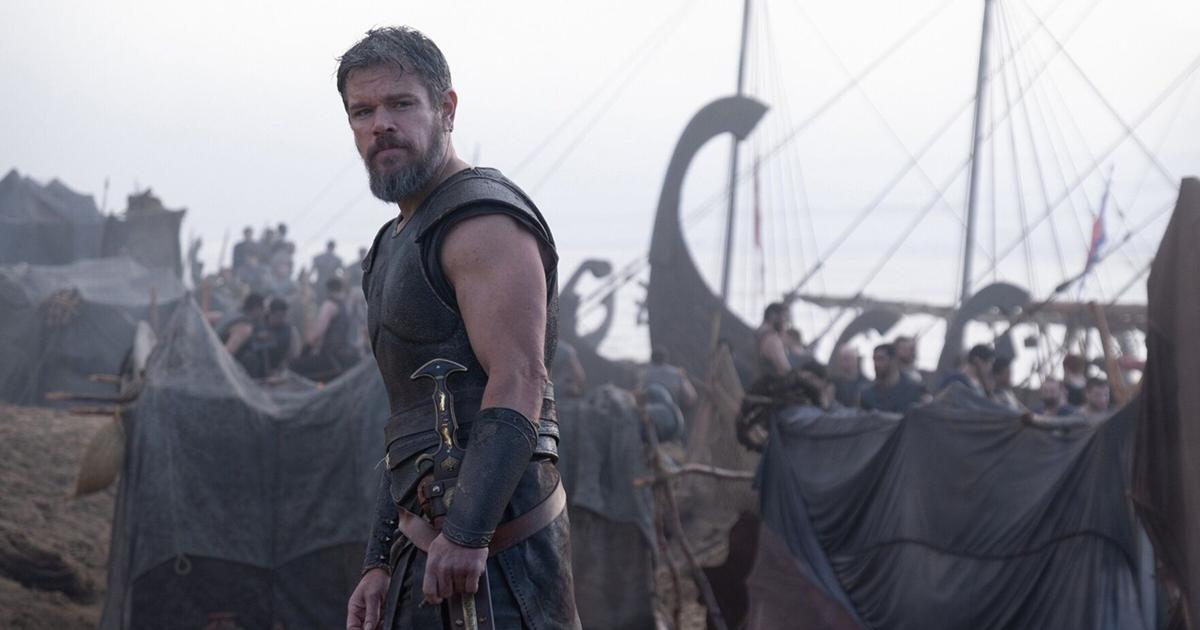
Watching Christopher Nolan’s “The Odyssey” is something of an odyssey in itself. Like Odysseus’ postwar journey home to Penelope, the film is vast, eventful, loud, dramatic, stressful, exhausting and seemingly endless. But as he showed us in “Oppenheimer,” Nolan has an uncanny way of making nearly three hours fly, even as you’re starting to wonder just how many travails poor Odysseus (a sturdy Matt Damon), not to mention the audience, can endure. Much of his “Odyssey” is mesmerizing — both massive action epic and intimate story of one man losing his way.
Nolan, of course, has never shied away from enormous stories, and “The Odyssey” has a bold confidence to it; you can see, in every scene, the filmmaker’s relish in knowing that he’d taken on a nearly impossible task. Homer’s “Odyssey,” an epic poem dating from approximately the eighth century B.C. and containing more than 12,000 lines, has faced countless translations and transformations over the centuries (my own favorite: James Joyce’s “Ulysses”); this one, filmed entirely on large-format IMAX cameras in six different countries, has the feel of a nearly impossible quest.
This is of course Nolan’s “Odyssey,” not just Homer’s (indeed, he incorporates work from other ancient Greek sources, particularly for flashback scenes involving the Trojan War), and the language has a casual, contemporary intimacy: Telemachus (Tom Holland) refers to his parents as Mom and Dad, more than one person uses the phrase “It’s OK,” and Odysseus at one point drops an F-bomb.
And while that informality may well be debated by Greek scholars, I think it’s part of what makes the movie work. Odysseus and his wife, Penelope (Anne Hathaway), are separated for most of the film, but in a brief flashback scene of the two together, they talk like lovers, not like Greek poets. “Promise me you’ll come back,” she says to him, her voice deep as the sea, and those words echo throughout the film — Damon and Hathaway create an electric connection that doesn’t fade. Hathaway doesn’t get a lot of camera time — few of the actors do, except Damon — and much of the time she’s filmed through a screen as she isolates herself from her suitors, but her Penelope is the film’s quiet soul.
As Odysseus makes his journey home from the Trojan War, he makes familiar stops along the way with his men: trapped in a cave with the one-eyed giant Polyphemus (a cyclops given haunting humanity by actor Bill Irwin); lured by the Sirens (who we can barely see and hear; their song is, as Odysseus says, “all the things you want it to be”); transformed into swine by the enchantress Circe (Samantha Morton, in a scene that’s uncannily creepy); waylaid on the island of the sea nymph Calypso (a lovely, yearning Charlize Theron) who holds Odysseus there for years, wanting him to be in love with her. The goddess Athena (Zendaya) makes occasional quiet appearances; she seems to embody hope.
All of this is gorgeously filmed by cinematographer Hoyte van Hoytema, a frequent Nolan collaborator (“Oppenheimer,” “Dunkirk,” “Interstellar”) who finds the impossible blue of the sea, the uncanny hugeness of the Trojan horse washed up on a beach (it’s like an enormous surrealist seashell), the harrowing shadow of a monster in the dark. (For the record: The screening made available for advance review was in a handsome 70mm print, but not in IMAX, the format in which it was filmed. Check listings carefully if you venture out to see “The Odyssey,” which is screening in multiple large-screen formats.)
The film occasionally loses its way a bit, just as Odysseus did; a final battle scene, in particular, feels needlessly chaotic and unfocused, and some of the actors (particularly Lupita Nyong’o, as Helen of Troy and her twin sister, Clytemnestra) barely get enough time to register. But if you lean back and surrender yourself to this “Odyssey,” it’s a remarkable journey, and Damon’s performance finds some welcome transcendence at the end. “It’s not always an easy thing,” Odysseus says quietly, overwhelmed, “a homecoming.”
‘ The preceding article may include information circulated by third parties ’
‘ Some details of this article were extracted from the following source www.yakimaherald.com ’