By
·
November 03, 2025
At the end of 2018, Aboriginal Australian rapper, dancer, artist, and actor Neil Morris, aka DRMNGNOW, was the first person ever to fill the role of First People’s Business Manager at the Victorian Music Development Office. For him, his goal there was simple: “I was trying to break down barriers around Indigenous artists,” he says. “[Labels] are not going to get an economic benefit from them—they’re multi-million dollar businesses that want to make 200k per year for every single artist. Instead, I wanted to make a space for them to create an intrinsic cultural value.”
Even the quickest look into the history of Indigenous acts in the Australian Billboard charts reveal how great that need was. From the 1980s until the serious rise of First Nations hip-hop in the 2010s, First Nations artists seem to only get an industry push once every five years or so—Yothu Yindi’s breakthrough 1991 dance hit “Treaty”; Christine Anu in 1995; Shakaya and Stiff Gins in the early ‘00s; Jessica Mauboy’s platforming on Australian Idol in 2006. And that’s just mainstream pop music. Given this fleeting support for accessible music, how could Aboriginal artists in the fields of punk, lo-fi, avant-garde music, or noise hope to gain traction?
“There was quite a bit of work around that,” says Morris. “I did an artist development program that [sought to answer] questions like, ‘How do you take an artist who, before 2015 couldn’t even get a gig in Melbourne, and set them up with the best [press] photographers? How do you get some of the top-of-the town PR firms to work with them? How do you make sure that Melbourne Music Week programs these kinds of artists? I was speaking with [Australia’s youth-focused radio station] Triple J about why they should have a First Nations-dedicated show, and they’ve gone on to do that.”
In the last few years, these kinds of positive steps have helped shine a spotlight on the wealth of Indigenous voices working in new music genres. In 2022, Kaldor Public Art Projects, in collaboration with the Art Gallery of New South Wales, hosted an event celebrating American artist Sol LeWitt’s admiration for Central Australian Anmatyerr artists Emily Kame Kngwarreye and Gloria Tamerre Petyarre. The exhibition fostered three separate collaborations between Aboriginal Australian musicians and American musicians—JWPATON with Chuck Johnson, Tahlia Palmer—aka amby downs—with Steve Gunn, and e fishpool with Claire Rousay. This series was released on legendary, (now-defunct label) Longform Editions to critical success.
Several other Australian labels and institutions have also dedicated resources to platforming new Aboriginal and Torres Strait artists—significantly, Sydney label Trackwork, Lawrence English’s Room 40, and Stu Buchanan, tastemaker behind the pioneering experimental music initiative New Weird Australia. Upon his promotion to Head of Screen for Sydney Opera House, Buchanan has used his position to elevate many Indigenous artists, like dubby field remixer Salllvage and anticolonial ambient-noise audiovisual artist amby downs, who presented the sound and film collage work Look Intruder (2024), which confronted Australian national identity from the viewpoint of a First Nations person. That it was broadcast directly from one of Australia’s most prominent tourism landmarks would have been unthinkable in the political climate of previous years.
Before diving into this incredible sample of noise, punk, lo-fi, and hip-hop from the new generation of Australian First Nations musicians, it’s important to heed these words from Morris: “It’s still a very Western way, to just include one Indigenous voice [in our cultural activities]. We need to always think about the cultural fabric and make sure that all voices are represented. We can include First Peoples in these spaces till the cows come home, but it’s not going to lead to a decolonized and healed future. We need to build new spaces from the ground up.”
For these artists, merely being invited to play is just the beginning. The end goal is spaces and platforms that are owned, promoted, and controlled by First Nations people. What follows is a selection of new music by musicians who fuse their own politics, history, and desires into the music they make.
Backhand
“Nothing Ever Changes”
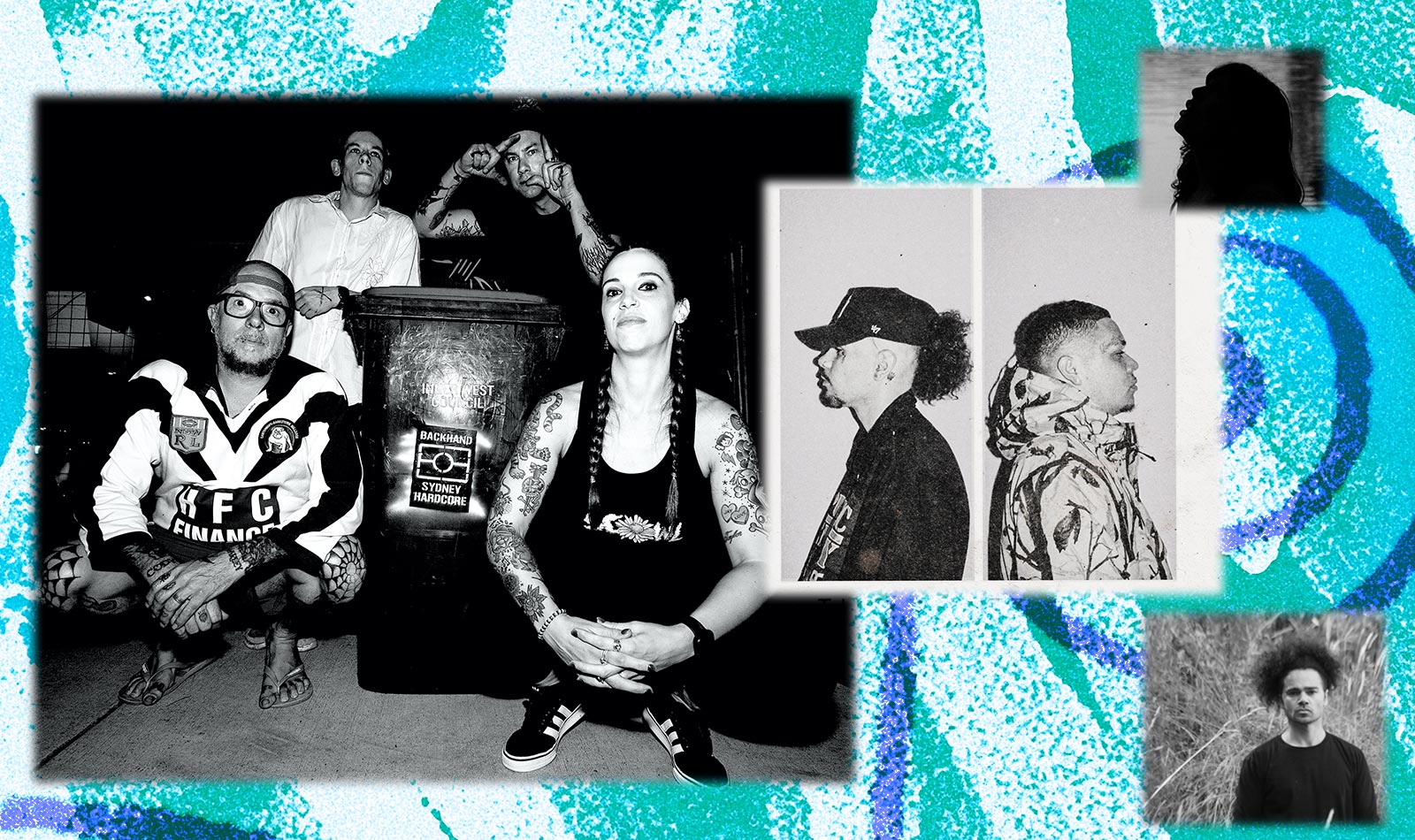
Sludgy, aggressive punks Backhand are part of a strong contingent of hardcore bands hailing from Eora Nation/Sydney, a movement that also includes Curses and Homesick. “Through all the despair and war in the world, I find myself clinging onto small bouts of hope,” says vocalist Kristy Preston. “Not just through the lens of someone in the punk scene, but as a mother, a partner, and a human. I enjoy being in a band—that creativity alone takes me away from my own day-to-day struggles—but it’s nice when someone comes up and tells me they got goosebumps from our set, or when some big, bald, badass old-school punk guy says they were nearly in tears during one of our songs.” “Nothing Ever Changes” is a desperate anthem, diverting punk’s trademark anger from suburban boredom to First Nations causes.
Local Woman
“Moving to Melbourne”
“For any artist trying to lead with cultural integrity at the heart of their work,” says Local Woman, aka Murwillumbah, New South Wale’s Kalyani Ellis, “it’s tough in this industry. It’s tough to be in a world that doesn’t inherently recognize the sacredness of music. But if you can protect your music, which is your heart and your spirituality and your story—that’s the most rewarding thing.” She explores the emotional ramifications of that statement on “Moving to Melbourne,” her first single and a bedroom punk masterpiece. “The song is an electronic emo anthem for chasing your dreams, and what you have to leave behind in the process,” Ellis says. “The girl you fell in love with that no one knew about, ‘cause you weren’t out yet. All the pieces of your heart that break when you’re someone who wants to achieve ‘bigger things.’”
e fishpool
“mothgirl1”
E fishpool’s compositions sound like chopped and screwed versions of early DIY industrial bands like SMERSH—harsh, but with something tender on the inside. “I guess the way my music sounds ultimately has always reflected what’s around me,” she says. “I am pretty vocal, and am usually making up random songs to soundtrack what I’m doing. I have no professional training and can’t read music, so it is all very interpretive. Everything comes from the sounds in my head.” Her new album, MothGirl, was written during a period of mourning over a close friend, “I had a lot of pent-up energy and emotion, and lots of time alone at a really special place in Gariwerd. Everything kinda came out at once—joy and grief and anger.”
amby downs
“campfire_______”
Palmer’s work is intentionally confrontational—even when it’s an acoustic track, as “campfire_______” is. The haunting and violent piece was composed alongside a VR animation which, in her own words, is intended to “invoke a sense of home-base during a time of early European invasion on this continent, a moment experienced by women, a moment that came before the chaotic violence of the men around them.”
“For me, ambient/collage work is one of the better ways to communicate the complexities of knowing our histories, our past, and our stories,” she continues, “as well as the difficulties of not knowing those things. Experimenting with non-linear, non-speaking based storytelling was fundamental in my personal journey of unlearning white Western thinking and re-connecting to Indigenous ways of thinking and being.”
Salllvage
“Autochthonic Sensory Meridian Response”
Salllvage cut his teeth in Warrang’s ballroom scenes—as a dancer, DJ, and producer under the name Guy Ruin—before wandering into a space known as “Indigenous futurism.” His electronic pieces, which are partly composed with AI, are thumping and challenging, yet organic and trance-like, dipping a toe into folktronica waters. “‘Autochthonic Sensory Meridian Response’ sums up a lot of what I’m about,” he explains. “As an artist, a lot of my work has a haunted or melancholy feel, which I think is basically about living in the ‘after colonial.’ I think there’s something about the sadness and the trauma of that that bleeds into a lot of the music that I make, even as that music itself is reparative.”
JWPaton
“West Sydney Sunset”
JWPaton’s musical career was preceded by work in graphic design, which makes sense when you hear his sunburnt soundscapes. Of the track “West Sydney Sunset,” he says, “It makes me think of driving home after work. I’m heading towards the Blue Mountains, the sun kind of breaks over the top and has this crazy red, pink sky. It’s super beautiful, but West Sydney is not so glamorous. I love that tension, between a place that has so much trouble and beauty.”
Sumn Conduit
“Effervesce”
Sumn Conduit is an incredibly tense, dynamically evolving, improvisational duo consisting of vocalist Sonya Holowell and modular synth player Ben Carey. Their fully improvised work glides between jazz and new classical, with “Effervesce” being a particularly phenomenal display of Sonya’s vocal talents. As an improviser, Sonya is committed to the importance of deep listening for First Nations Australian people. “Each performance is imbued with the information of the space that you’re in, and that includes all of the living entities that are there sharing that moment with you. [Deep listening] helps to constitute the sense of who you are and who you’re accountable to and connected to. It helps to form your identity.”
T Breezy x Walkerboy
“Clap”
Trackwork label head Utility’s editing and mixing on this T Breezy x Walkerboy album traverses the full range of hip-hop sounds, from immaculate early grime to the best ‘00s Dirty South. It’s is kept fresh with the incorporation of local twists and turns in the lyrics, and by the delivery of the two Gamilaraay men, who were born and raised in semi-rural Inverell and bonded through music. The result is lyrical structures that are incredibly distinct. According to the album notes, the tune “CLAP” is “channeling a similar ‘Dirt Off Your Shoulder’ stance to the naysayers as [the track of the same name on] Jay-Z’s triumphant The Black Album”—which is a very complicated way of saying: This song slaps hard!
DRMNGNOW
“Pray”
“Pray” is the final work from DRMNGNOW’s project Ngarwu, which consists of five audiovisual pieces released over the span of a year. These heavily lyrical rap songs, ambitious and poetic, explore themes of resilience, healing, and global injustice through Neil’s charismatic storytelling. The confrontational tone of his first hit, “Australia Does Not Exist,” takes a backseat here as he sings in his Yorta Yorta dialect, with “an intention of giving people something that’s connected to thousands of years of culture.” His earlier career as an R&B crooner gives way to a spoken-word style, designed to help “[non-Native Australians] be nourished by the awareness of the sacredness of the land on which they stand.”
‘ The preceding article may include information circulated by third parties ’
‘ Some details of this article were extracted from the following source daily.bandcamp.com ’