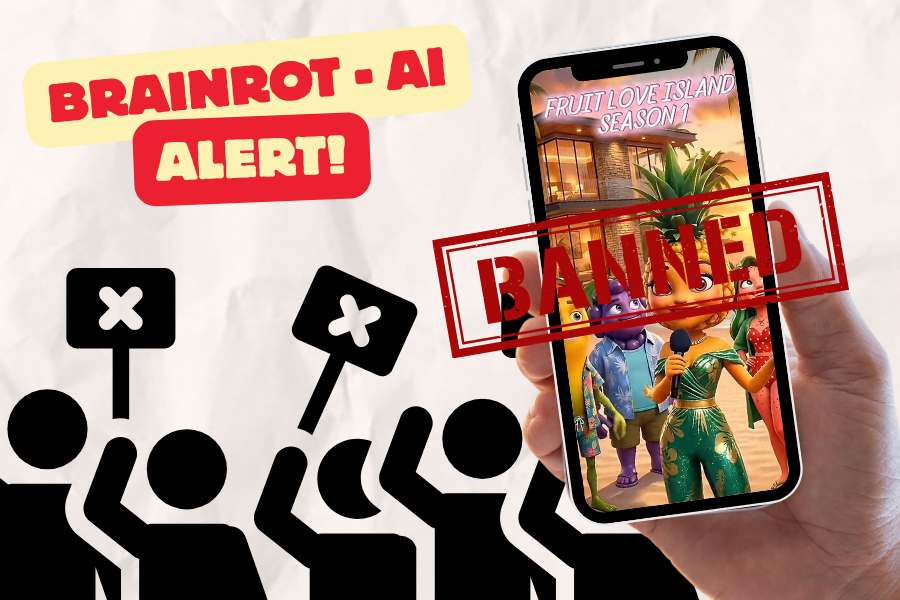
Over the past year, one thing has become impossible to avoid on social media, AI. AI-generated content. This content has become one of the most prominent methods of content creation, taking over platforms like TikTok, Instagram and Twitter. Recently, an AI-generated short TV series on TikTok has become popular, gaining over three million followers in nine days.
AI Fruit Love Island is a short-form AI spin-off of the reality TV show, Love Island. The series takes fruit and morphs them into men and women. These generated characters then follow the plot of Love Island and go on a fake reality TV show to find love. The AI mini-series has nearly no plot and is filled with what people, including myself, call AI slop. The show became impossible to avoid, even for me, a person with nearly zero social media.
The creator, ai.cinema021, posted two to four minute videos every day, keeping viewers hooked, and disclosed the series as fully AI-generated. People eventually turned against the AI series, spam reporting the account, which is now removed from the platform.
The creator had a loud response after the backlash and reporting. After being banned, the creator responded with harsh messages on social media, claiming “each episode takes hours” and mocking people for wanting to preserve the environment, saying “I’m so glad y’all got what y’all wanted! Saving the environment three gallons of water at a time… truly inspirational.”
It feels so odd how many people refuse to understand the effect of AI on the environment. No matter how much people speak up, spread awareness and desperately beg people to stop using AI, it never stops. People refuse to understand. They have every opportunity to help conserve the environment, but instead stare at the soulless, fake fruit on their screens and call it entertainment. Is that really better than the environment, than drinkable water?
According to the United Nations, 0.5 percent of the Earth’s water is drinkable, and with the rapid increase of AI, it’s guaranteed to take a toll on that supply. Many people complain about how AI hurts the environment, but most people don’t know how AI uses water.
When you decide you want to cheat on your quiz with AI, or you want to post a fake video of a bear dancing or singing, do you know what you’re doing? Do you care?
When you AI-Generate something, the machines process data, learn your patterns and spit out whatever you ask for. But that’s not all. When the machine is finished, it’s steaming and overheating, and it needs to cool down. So to cool down, the machines don’t use coolant; they use the cheap option, water. To cool down these machines, water is used at a rapid pace constantly. Every homework question, every meme or deepfake wastes massive amounts of water.
But this may be the first time you’ve heard this, because nobody mentions the effects of AI. AI could take over the art industry one day. Taking opportunities away from the passionate artists who work hard for what they love and replace them with art with no soul or story. AI is already being used for deepfakes and bullying, making students feel unsafe at school and on social media.
In so many situations, yes, AI could benefit you. It could make your lesson plans for a teacher. It could fix grammar for a student or writer. But it could also waste water, use up electricity, and generate fake information and pictures; it could replace you.
Is a silly fruit series really worth that? Is this what people consider entertainment? Before you use AI, stop to think of the consequences. Everyone using AI is contributing to the issue, no matter what you use it for. So take time to ask yourself how you feel about it. Use your voice; you could have a bigger impact than you think.
‘ The preceding article may include information circulated by third parties ’
‘ Some details of this article were extracted from the following source kennedytorch.org ’