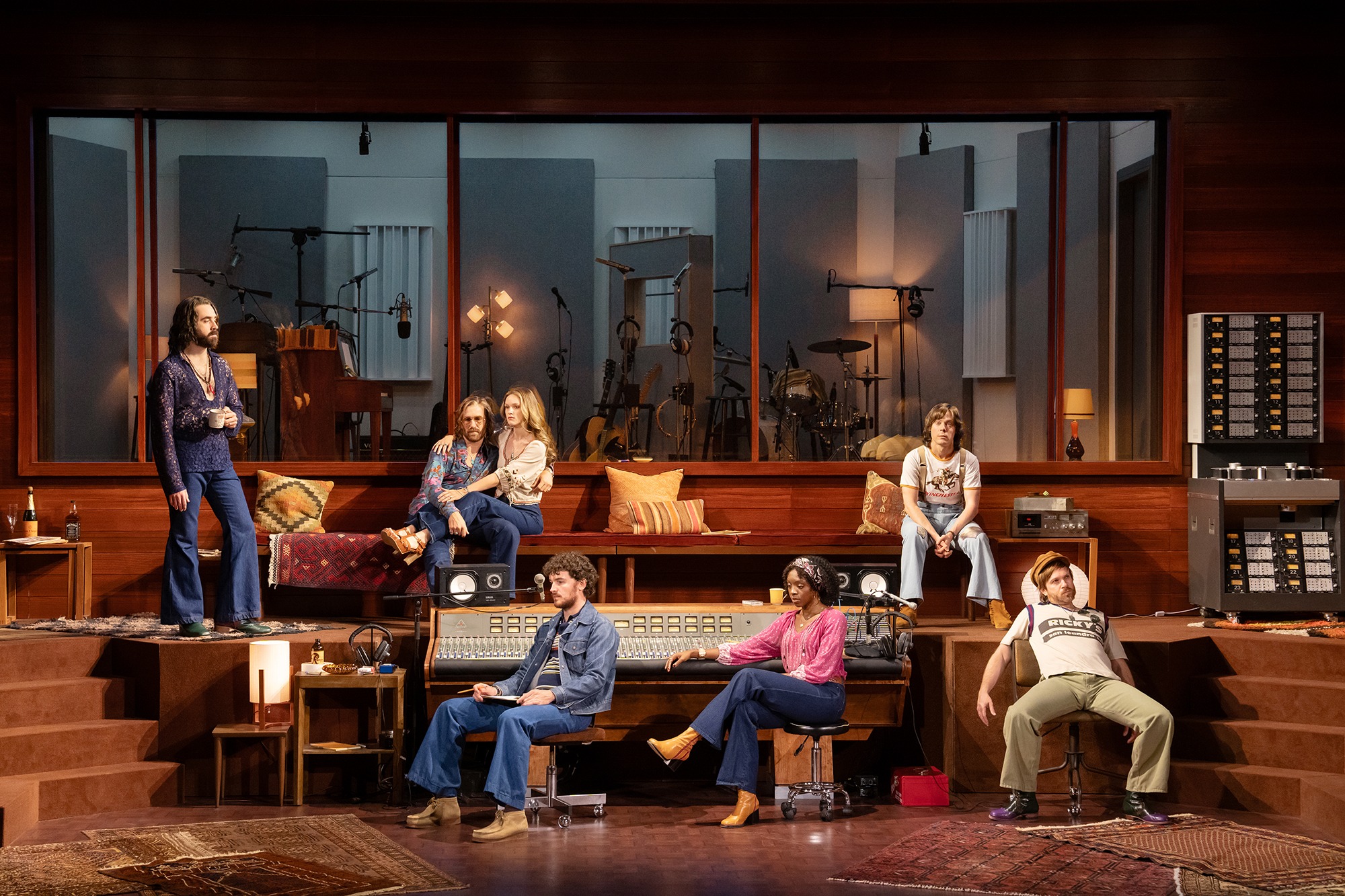
Stereophonic arrives at the Pantages Theatre with sky-high expectations—after all, it’s the most Tony-nominated play of all time. Set in 1976, the show follows a rock band sequestered inside a California recording studio as they attempt to make the album that will define their careers. The group – singer-songwriter Diana (Claire Dejean), her charismatic but troubled partner Peter (Denver Milord), guitarist Reg (Christopher Mowod), keyboardist Holly (Emilie Kouatchou), and drummer Simon (Cornelius McMoyler) – cycles through creative breakthroughs, emotional implosions, and long nights of second-guessing themselves. Working alongside them are Grover (Jack Barrett), the steady recording engineer, and his eager assistant Charlie (Steven Lee Johnson), the only two consistently grounded presences in a sea of ego and unraveling relationships.
On Broadway, the show famously ran over three hours; for the tour, David Adjmi has lovingly trimmed it to two hours and 50 minutes with a single 15-minute intermission, a version affectionately dubbed “The Radio Edit.”
The story has long been suggested to mirror the tumultuous Fleetwood Mac era—the Rumours-era trials, tribulations, and romantic entanglements—and there are definite arcs that mimic their journey. With so many Tony nominations under its belt, I expected something heavier, deeper, more revelatory: an intimate look at what it takes to make a record while juggling careers, personal crises, cultural shifts, and industry pressures. Instead, at least as this touring cast is directed, the production feels surprisingly simplified and superficial.
There’s nothing here we haven’t seen in countless plays, movies, and prestige TV series about musicians, especially those set in the 70s and 80s. Daniel Aukin directs the characters to perform with a broadness that leans hammy, full of mugging poses and exaggerated delivery. It’s not that the actors aren’t good – they are – but the way the show is presented often feels artificial, more like an impression of rock-and-roll dysfunction than a lived-in portrait of artists on the brink.
What doesn’t help is that most of the band is written and directed as self-involved, enabling, clingy, or narcissistic. The only two bright spots in the mix are Grover and Charlie, who come across as genuinely likable and perhaps the only characters you truly root for. That imbalance could have been fascinating if the script delved deeper into why these personalities survive or combust in the recording industry, or how the industry itself shapes and warps them. But David Adjmi’s book stays mainly on the surface, sketching archetypes without fully exploring them.

The moments when the show shines and feels most authentic are during its musical sequences. Will Butler’s original songs are intense, atmospheric, and perfectly tuned to the 70s rock aesthetic. They evoke the Fleetwood Mac vibe without imitation, and when the music takes center stage, the production finally taps into something real.
But those moments are too few. Ultimately, Stereophonic feels like a concept with enormous potential that never fully coalesces into a dramatically satisfying whole. What’s the message? What’s the theme? Beyond watching a band grapple with sudden fame and their oversized personalities, the show doesn’t seem to have much to say. For a play about music, identity, ego, and creation, it all sounds a bit… mono.
“Stereophonic” runs through Jan 2, 2026, at the Pantages Theatre Hollywood.
For tickets, visit BroadwayinHollywood.com.

‘ The preceding article may include information circulated by third parties ’
‘ Some details of this article were extracted from the following source weliveentertainment.com ’