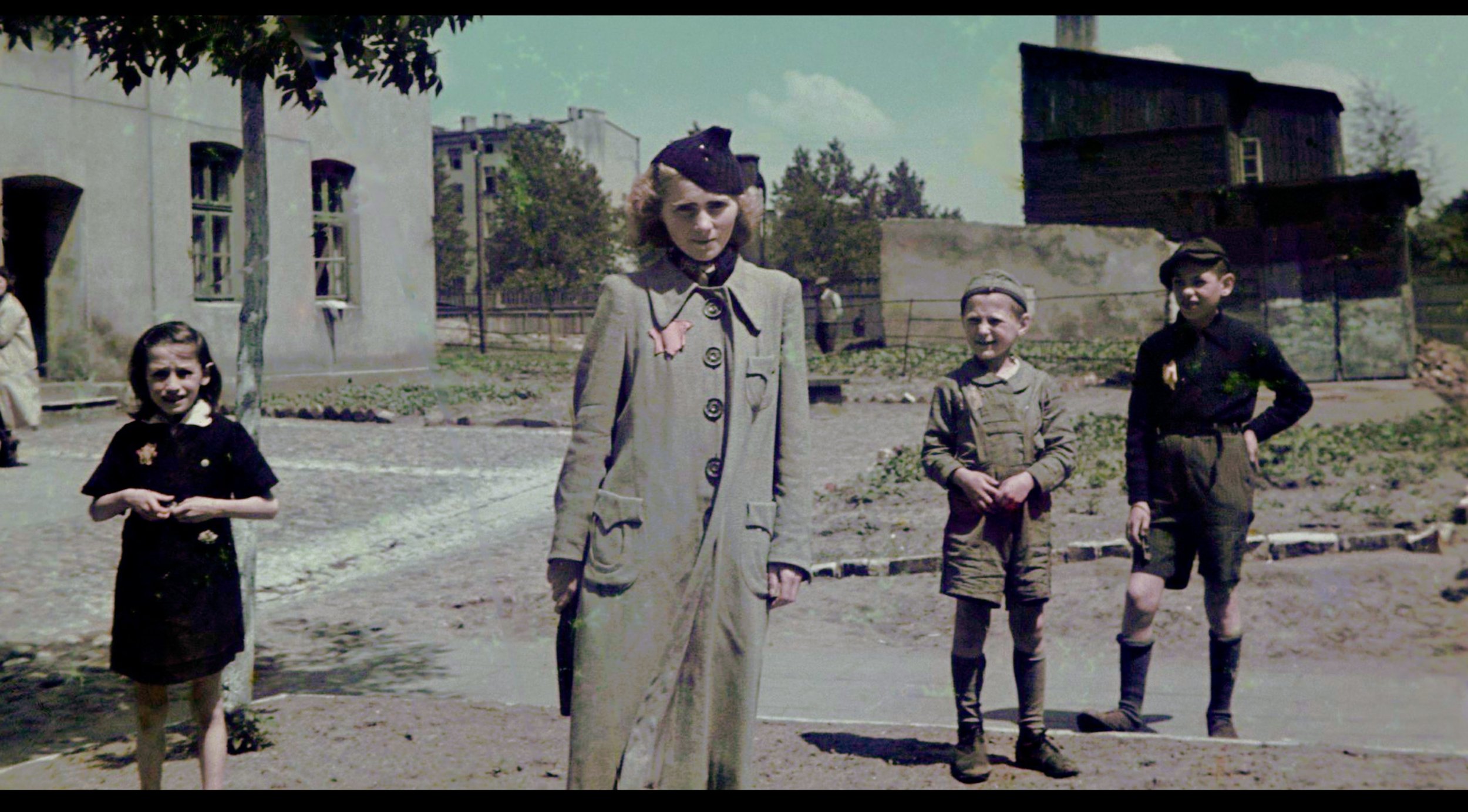
He has weaved together the stories of the rescuers in a chronological progression from the rise of the Nazi party in the 1920s through to the liberation of the concentration camps, using both colourized and black and white archival footage. The images are grimly familiar: SS soldiers in the streets, starving children in the ghettos, parades of Jews wearing stars marched through the streets, bodies hanged in the public street.
As the images flash by, we listen to the personal accounts of individuals who hid Jews in their walls and furniture, and raised orphan Jewish children as their own. In one case, a woman exchanged sex with an officer to ensure the protection of Jewish guests. Several of the people who co-habited became close. There are a couple of marriages recorded here, and one rescuer who converted to Judaism, getting circumcised at 68.
The musical score by Adam Guette is subdued and moving, and at 62 minutes, the film is mercifully concise and pointed. An anachronistic sequence reminds us of the recent rise of antisemitism, with footage of the 2017 Unite the Right rally in Charlottesville, Virginia, with torch-carrying men chanting “Jews will not replace us.”
The film concludes with the overlapping voices repeating a phrase of universal empathy from the Talmud: “Whoever saves one life saves the entire world.”
At risk of seeming crudely insensitive to this collective celebration of goodness, I’m not convinced the lustre of the celebrity voice cast brings us closer to the experiences of the real-life subjects. As well, the collective narrative technique can be distractingly fragmentary.
There are 31 actors, some doing double duty, voicing 45 recurring characters, who are identified only by name and country of origin. They all speak English, sometimes with various European accents, sometimes not.
For example, the American actor David Straitharn is instantly identifiable by his voice, even if he is speaking the part of the Polish diplomat Jan Karski, who first warned Western leaders about the Holocaust in Poland.
Jeremy Irons, voicing another Polish subject, Alexander Roslan, adds a guttural quality to his natural English accent while Bill Camp, as his compatriot Stefan Raczynski, sounds like a guy you would meet at a New England diner. The French woman, Ermine Orsi, speaks in the startling Scottish lilt of Kelly Macdonald.
Thematically, there are scholarly questions about the concept of the Righteous Among the Nations paradigm which celebrates exceptionally altruistic individuals at the risk of obscuring broader historical and national context. The survival rates of Jewish people in different parts of Europe varied widely and the Holocaust in the Netherlands was different than in Belgium, Poland or Denmark.
‘ The preceding article may include information circulated by third parties ’
‘ Some details of this article were extracted from the following source www.original-cin.ca ’