Television is littered with complex protagonists, and that has led to a problem: namely, countless fanboys idolizing characters that we were never meant to look up to. Walter White, Don Draper, and even Homelander are all characters that fans glom onto because they don’t realize they were written to be cautionary tales. Weirdly enough, Rick and Morty is slowly undoing this trend by portraying the slow growth of Rick Sanchez, one of the most toxic protagonists in television history.
If you’ve somehow never seen Rick and Morty, the premise is that Rick Sanchez is an aging genius who teams up with his grandson, Morty Smith, to go on increasingly surreal adventures through time and space. Rick has mastered multiversal travel, which allows him to experience the universe in a way that almost nobody else can. But this has effectively turned him into a nihilistic jerk because he believes nothing matters, an easy belief for someone who can always hop into different universes to see every possible outcome of every possible event.

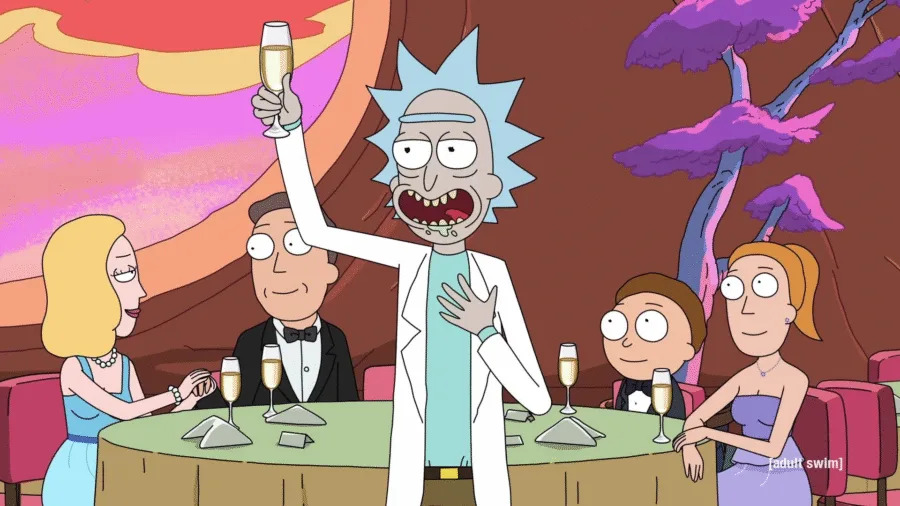
Rick Sanchez and his family on Rick & Morty
When the show begins, Rick is effectively worse than every other terrible TV protagonist put together. In the very first episode, Morty has to convince Rick to disarm a bomb that would destroy the planet, something we later find out is a fairly frequent occurrence. Eventually, he does effectively destroy the world when he creates a botched love potion that turns the entire planet into monsters straight out of a Cronenberg movie. Rick simply transports himself and Morty to another dimension rather than fixing the problem.
There are countless other examples of bad Rick behavior: he manipulates his daughter, arms hitmen, turns his grandson into a drug mule, and so on. Early on, it seemed like Rick would forever be an evil TV protagonist, especially because the worst fans of the show loved to compare themselves to him. But then (after infamously–and hilariously–turning himself into a pickle man), everything changed when Rick started going to therapy.

Rick attends therapy
Even though he became Pickle Rick to avoid a family therapy session, Rick began regularly seeing therapist Helen Wong. For fans closely watching the show, it was clear that therapy had a very positive effect on Rick. This was evident in small moments (like when he apologizes for mocking a Scientologist’s beliefs) and larger moments (like when he insists on saving the Bird Person he has always known rather than just fetching a different copy from another universe).
All of this culminated in Season 8, which gave us a tender moment in “The Curicksous Case of Bethjamin Button” where an aged-up Rick admits to his two de-aged daughters (one is a clone) that he wasn’t the Rick who abandoned them and that he is proud of them both. And in the show-stopping Season 8 finale “Hot Rick,” he removes the last memory of his dead wife so that he can be emotionally open. By the end, he sends that memory and a memory of his younger self (it’s a long story) into space so they can have the happily ever after he will never be able to have.

Rick and two Beths in “The Curicksous Case of Bethjamin Button”
It was a powerful and tear-jerking conclusion to the most recent season, but it was also definitive proof of how much therapy had transformed Rick for the better. He eventually realized that his decades-long grief was sabotaging his current relationships and used his wacky sci-fi technology to remove the trauma. He decided to stay the course even after getting several painful reminders that this choice would bring him closure but may never bring him happiness.
This proves that Rick is a more dynamic character than most of his TV brethren. Breaking Bad’s Walter White didn’t change his way, dying proud of what he had accomplished and how he had taken care of his family. Don Draper doesn’t change, either: in the Mad Men series finale, he takes the emotional insights he received from a spiritual retreat and turns them into one last, iconic ad, effectively trading enlightenment for another paycheck.

In this way, Rick and Morty is slowly undoing TV’s worst trend by showing its flawed main character continuously working on himself. This evolution has been fascinating to watch, and fans who have always emulated his worst behavior must now contend with the fact that Rick himself has acknowledged his flaws and taken steps (often drastic ones) in the name of self-improvement. He began this journey in the last way Season 1 fans would have expected: by going to therapy
Transforming TV and destigmatizing therapy? Not bad for a character that started out as a raunchy, one-dimensional parody of Doc Brown.
‘ The preceding article may include information circulated by third parties ’
‘ Some details of this article were extracted from the following source www.yahoo.com ’