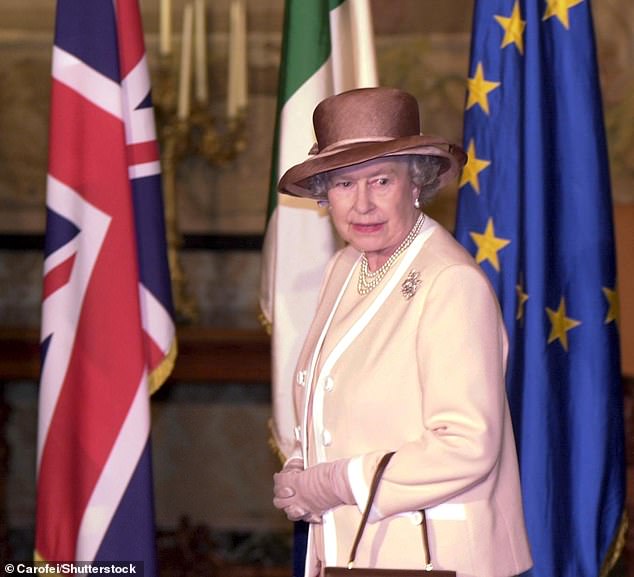
The first duty of a constitutional monarchy is to be politically impartial –or, rather, to be seen to be so. The late Queen, over her uniquely long reign, was a model in this respect.
This only made it more sensational when she appeared to weigh in on one side or the other in a contentious national debate, even when she never intended her views to be made public.
Never was this more explosive than during the 2016 referendum on whether or not the United Kingdom – her realm – should leave the European Union.
During that campaign, the Sun produced a front page declaring ‘The Queen Backs Brexit‘. It was based on leaks of comments Her Majesty was alleged to have made at a Windsor Castle lunch in 2011, attended by the then Deputy Prime Minister, Nick Clegg (a man passionately attached to the institutions of the EU).
The Queen is supposed to have said ‘with venom and emotion’ that ‘I don’t understand Europe’.
This, of course, is not the same as saying: ‘If there is a referendum in five years’ time, I’d be delighted if it reversed the decision my government made in 1973.’
But the problem for the Palace was it couldn’t categorically deny The Sun’s headline claim, because that would be as much as to say that the Queen was in favour of Remain – and infuriate her pro-Leave subjects.
Now, however, we have newspaper headlines saying exactly that – ‘The Queen was a Remainer’.
In 2016, The Sun reported that Queen Elizabeth backed Brexit, which put the monarchy in a difficult position over its political neutrality

Royal Correspondent of The Times, Valentine Low, says in his new book the late Queen did not want Britain to leave the EU
They stem from a new book, Power And The Palace: The Inside Story Of The Monarchy And 10 Downing Street.
Its highly regarded author, the former Royal Correspondent of The Times, Valentine Low, reports a senior minister, who had spoken with the monarch about this just three months before the 2016 vote, and the Queen saying: ‘We shouldn’t leave the EU.’
She had apparently added: ‘It’s better to stick with the devil you know.’ This chimes with what someone who had written the occasional speech for the Queen told me a couple of years after the row over the story in The Sun.
He shook his head and said: ‘Her Majesty was not a supporter of Brexit.’ This was not ideological, or even political. As a friend, who for some years worked at the heart of the nexus between Westminster and Buckingham Palace, explained when I asked him about Low’s claims: ‘Yes, she would have been in favour of remaining in the EU, but simply because she feared instability and constitutional tumult and would have seen such a rupture as having the potential to cause that.’
He added, slightly mischievously: ‘The late Queen, and indeed the House of Windsor historically, had a sort of personal reason for such fears. It is based on the sense that, if the constitutional tree is shaken, the glittering bauble at the top of it might also wobble perilously.’
In fact, it was the unreconciled Remainers within the parliamentary system who came close to taking this country to a revolutionary moment when they attempted to block the then Conservative government’s attempt to honour the result of the 2016 plebiscite.
In 2019, my father, the former Chancellor Nigel Lawson, warned the Lords: ‘I am deeply concerned at the growing rift between Parliament and the people, with the refusal to accept the people’s judgment… there is a real danger that undesirable but very often understandable insurrectionary forces will feel that they cannot trust the British Parliament or the British constitution, and a very ugly situation could well arise.’
This primordial fear, within the House of Windsor, of national disorder was a factor behind the most astonishing attack from Buckingham Palace on an elected Prime Minister – Mrs Thatcher. This was in July 1986, when The Sunday Times ran the electrifying front-page headline ‘Queen dismayed by ‘uncaring’ Thatcher’.

The Queen feared Thatcher’s tough stance against the coal miners was damaging ‘the country’s social fabric’

Police and demonstrators clash at miner’s rally in Trafalgar Square in 1985
The story, reporting that the Royal Family thought Margaret Thatcher was ‘uncaring, confrontational and socially divisive’, and that the Queen feared her tough stance against the coal miners was damaging ‘the country’s social fabric’, had been given to the paper by the Queen’s press secretary, Michael Shea.
In the ensuing uproar, a panicking Palace issued a statement declaring that ‘reports purporting to be the Queen’s opinion of the government’s policies are entirely without foundation’.
But in his authorised Thatcher biography, Charles Moore noted: ‘Mrs Thatcher had a sense that the story would never have reached a newspaper if he [Shea] had not felt emboldened by those he worked for to put it out.’
This was corroborated by Andrew Neil, who as Sunday Times editor had overseen the story: ‘There is no evidence to indicate that Shea leaked at Her Majesty’s behest, [but] I’m in no doubt that he was broadly reflecting the views of the Queen and other senior members of the Royal Family (yes, you, Charles).’
The charitable view of this episode is that the House of Windsor is primarily concerned to act as a unifier for the nation, and that this sense of national harmony was being made more difficult by Mrs Thatcher’s ‘confrontational’ approach. A less charitable interpretation is that the Queen and her wider family had little feeling for the aspirant middle-class whom Thatcher saw as ‘our people’, since they had never needed to strive to achieve prosperity themselves. Still less charitably, it might be they feared some revolutionary ferment might be the result of Thatcher’s policies – and who knows what that might mean for the occupants of palaces?
The most shocking example of this visceral royal unease comes from the revolutionary year of 1917, and the late Queen’s grandfather, George V. In March that year, after Nicholas II of Russia was deposed, the British Cabinet offered sanctuary to Nicholas and his family. This had followed discussions with King George.
Not only did the cousins, Nicholas and George, look extraordinarily alike, they were personally close. But by April, George had become seized with the fear that if the rejected Russian royal family came to the UK, it would cause the revolutionary virus to spread here and threaten the monarchy.
When the Foreign Secretary, Lord Balfour, rebuffed this, noting that the government didn’t think it ‘now possible to withdraw the invitation which has been sent’, the King got his private secretary to write: ‘He must beg you to represent to the Prime Minister that the residence in this country of the ex-Emperor and Empress would be strongly resented by the public and would undoubtedly compromise the position of the King and Queen.’
Only then did the Cabinet agree to retract the offer of asylum. The following year, Lenin ordered the slaughter of the now captured Nicholas and his family.
Obviously, nothing like this would have happened in any tumult in the wake of the Brexit vote. But the late Queen’s anxieties about constitutional stability in this country were deep-rooted – and most definitely inherited.
‘ The preceding article may include information circulated by third parties ’
‘ Some details of this article were extracted from the following source www.celebrity.land.co.uk ’