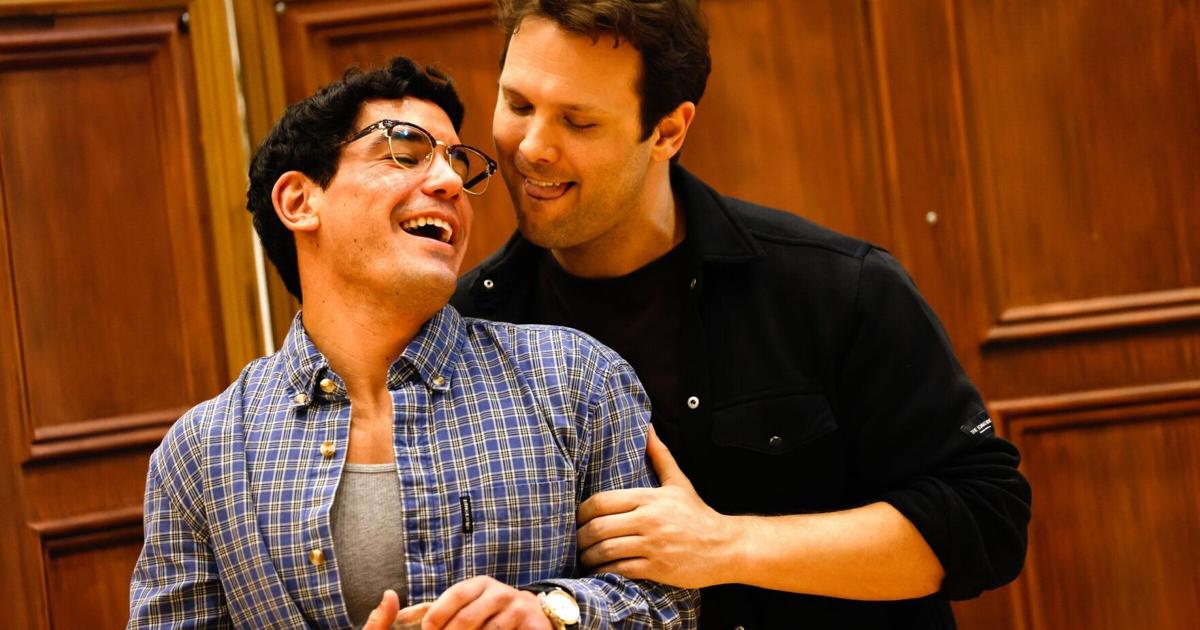
On a park bench in Dupont Circle, two men get acquainted over small talk: The health properties of milk, the guests at Sen. Joe McCarthy’s wedding, the spelling of Roy Cohn’s name. It’s 1953, and the idealistic young Timothy Laughlin has only recently arrived in Washington, D.C., when he meets with Hawkins Fuller, a handsome State Department official, on that fateful bench.
Flirtation bubbles within this early scene of “Fellow Travelers,” a 2016 opera based on Thomas Mallon’s 2007 novel of the same name.
Through Gregory Spears’ lush, idiosyncratic music and Greg Pierce’s waggish, pinpoint libretto, Timothy and Hawk’s playful banter blooms into a pulse-raising, gut-wrenching love story, fraught and forbidden in midcentury American politics.
This month, as “Fellow Travelers” turns 10 (and enjoys an exposure boost from the critically acclaimed 2023 “Fellow Travelers” Showtime miniseries starring Matt Bomer and Jonathan Bailey), a national tour launches at Seattle Opera and will travel to more than 10 U.S. cities in 2026 and 2027.
Its potential impact, both onstage and off, seems particularly resonant now.
Behind-the-scenes, its touring model (uncommon in the opera world) could offer an alternative to companies still grappling with pandemic-era setbacks, and success here could influence the production of contemporary operas moving forward.
Onstage, its powerful queer love story shares an important, undersung and distressingly relevant slice of American history at a time when LGBTQ+ rights are again under fire.
“Fellow Travelers” “gets straight to the heart of what it means to love somebody and be betrayed by somebody you love,” said director Kevin Newbury. “And to be oppressed by the system in which you live and work.”
Transformational art
In 2008, producer G. Sterling Zinsmeyer reached out to Newbury with the idea of adapting the novel “Fellow Travelers” into an opera — one that Newbury should direct.
“I fell in love with these characters, and I could see, on first read, how many of the scenes could come to life onstage,” Newbury said.
Timothy and Hawk begin their relationship during the Lavender Scare, a tentacle of the anti-communist, McCarthy-era political inquisition that purged LGBTQ+ people from government jobs. As such, the scenes weave together the micro and macro of both human emotion and global politics.
“A lot of my work has focused on telling stories about our shared queer history,” Newbury said. “‘Fellow Travelers’ is, first and foremost, a powerful love story.”
“But,” he added, “it’s also hot and steamy, and it’s important for me as an artist to portray queer intimacy on stage.”
Newbury, who describes himself as an artistic omnivore, brings an eclectic, modern energy to his opera productions, fueled by his work in theater, film and television, as well as directing projects like rocker Liz Phair’s 2023 “Exile in Guyville” tour.
“I like to direct an opera like a movie and a movie like an opera,” he said.
Newbury and Zinsmeyer approached Spears and Pierce about the adaptation, and the first-time collaborators began transforming “Fellow Travelers.”
Spears relished the chance to take conventions of traditional opera — the love duet, the aria, the leitmotif (a recurring musical theme that represents a character, emotion or idea) — and use them to tell a story that these techniques weren’t originally designed to tell, he said, “at least not in this way.”
“Back then, it was actually very dangerous to speak directly about (taboo subjects),” he said. “So opera works in counterpoint: You have what the characters are saying or singing, and then you have this whole psychology machine sitting in the pit, an orchestra that’s saying something else — it’s the atmosphere, the nuance, the contradiction. It’s, ‘I’m saying one thing but clearly feeling something different.’ Opera is very good at this.”
Spears’ wide-ranging yet cohesive score blends sounds and styles from classic 19th-century opera, medieval troubadours and minimalist, 20th-century opera. It meets a strong counterpart in acclaimed playwright Pierce’s libretto, full of playful witticisms and lyrics that feel accurate to human speech (which opera doesn’t always prioritize).
“Fellow Travelers” was Pierce’s first foray into opera, and he savored the form’s unique opportunities, like harmonies that allow multiple characters to speak at the same time.
The fast-moving piece, Pierce said, echoes the page-turner nature of the novel, with its many twists and turns. It also takes advantage of opera’s unique ability to burrow deep inside a character’s psyche and lay bare a soul, exposing the inner tumult and longing that many art forms relegate, necessarily, to subtext.
In the aria “Last Night,” he said, a giddy Timothy (a devout Catholic) sings in St. Peter’s Church the day after his first night with Hawk. “How many kisses?” he asks, overwhelmed and conflicted. “How many sins?”
“Giving the text to Greg Spears, I felt like I knew the story really well — I knew the moment, I knew the character. I thought I knew everything. And then I heard the music and thought. ‘Oh, that is what’s happening here, that’s what he’s feeling.’”
Liftoff
After a 2013 workshop at Cincinnati Opera’s Opera Fusion program, a new-works collaboration with the University of Cincinnati College-Conservatory of Music, the “Fellow Travelers” team suspected they were onto something.
“All these Cincinnati Opera company members would stop into rehearsal, and they wouldn’t leave,” Newbury said. “Everyone was so engaged, moved to tears and laughing at Greg Pierce’s wonderful jokes. And they offered us the world premiere.”
“Fellow Travelers” debuted at Cincinnati Opera in 2016 and elicited rapturous reviews. Subsequent productions around the country had similarly glowing receptions, which laid the groundwork for the 10th anniversary tour.
Newbury expanded that groundwork at the height of the COVID pandemic, when he co-founded the Up Until Now Collective, a development and production group for supporting interdisciplinary work and rethinking artistic production models. The collective, which owns the physical production of “Fellow Travelers” (sets, costumes, etc.), serves as co-producer of the tour.
Coproductions, in which opera companies usually split production costs and share expenses and any resultant rental revenue, are pretty standard in the opera business, said Seattle Opera General and Artistic Director James Robinson.
But a tour, in which an outside producer brings a more-or-less intact opera, including the cast, to a company that functions more as a presenter, is relatively rare. (Though Robinson pointed out that, unlike national tours of, say, a Broadway musical, opera companies are still responsible for artistic infrastructure like an orchestra.)
“It’s an interesting model, I hope more of it is done,” he said, though he clarified that a tour’s viability will depend on the piece in question — “Fellow Travelers,” crucially, doesn’t have a chorus, which would add to the logistics and cost.
Feels riskier today
Throughout his career, Robinson has commissioned and nurtured many new operas, his dedication to expanding the operatic genre a bedrock principle.
Audiences still flock to marquee titles — “La Bohème,” “Carmen,” “Madama Butterfly” — but over the years, Robinson said, he’s noticed them gravitate more and more to new works and stories with timely resonance.
Seattle Opera has worked hard in recent years to be as community-facing as possible, he said. Shortly after arriving in town (he joined Seattle Opera in 2024), Robinson learned that our city has a large LGBTQ+ population, and that the Opera had never done anything on its mainstage with a strong gay story, which he thought was overdue.
“It just so happens that ‘Fellow Travelers’ is a really good opera,” Robinson said. “And it also gets the word out that this is the type of work that we do.”
Doing this type of work, bringing exciting voices and expansive ideas to our country’s major stages, provides immense creative and cultural value at any time — but doing so now feels distinctly crucial.
“I feel especially honored to have a platform at this particular time,” Newbury said. “I can get very emotional talking about this — history is repeating itself, and our current administration is actively and systematically erasing our history and demonizing our community.”
When he and Spears started writing the piece with Newbury during the Obama years, Pierce said, none of this was on their minds, but now, sadly, it feels more relevant. “You read the paper now, and it feels like we’re living in that time again,” he said. “The disregard for facts, the fearmongering, the idea of creating enemies for political purposes when there are no enemies there.”
While “Fellow Travelers” remains largely unchanged from its 2016 premiere, one addition for this 10th-anniversary production is the Lavender Names Project, which turns the work of fiction into a historical document.
The project, created by Up Until Now Collective and the forthcoming American LGBTQ+ Museum in New York, is a growing national archive, created through community outreach, that honors the stories of LGBTQ+ people targeted by government discrimination. Images of these people, both collected from archives and submitted by affected individuals, will appear on stage at the end of the opera.
Robinson, who first saw “Fellow Travelers” some eight years ago, remarked on how strange it is that the piece feels riskier today.
“That’s a troubling conclusion,” he said. Even though “Heated Rivalry” is among the most-watched TV series these days, “politically, it feels like we’re in a dangerous time in the United States. This isn’t a nostalgia piece.”
‘ The preceding article may include information circulated by third parties ’
‘ Some details of this article were extracted from the following source www.yakimaherald.com ’