I once spent an afternoon in Calvary Cemetery looking for Tennessee Williams’ hard-to-find burial site in St. Louis, Missouri, his hometown.
The annual Tennessee Williams and New Orleans Literary Festival is this weekend, March 25-29, marking its 40th anniversary. It brings that day in St. Louis to mind because of a fiery debate that once ricocheted at the festival.
Since the festival started (full disclosure, I have been on the board) some of Williams’ contemporaries have participated in the popular “I Remember Tennessee” panel, where a frequent comment was how much they disliked the playwright’s brother, Dakin.
Chief among the grievances was Dakin’s decision to bury his brother in St. Louis. Tennessee Williams had not been shy about his opinion of the town where he grew up. “Loathe” was one of the common phrases.
There were many places that Williams relished. New Orleans, where he bought property in the French Quarter, was one of them. Also, Key West and New York City but not strait-laced, industrial, uncolorful St. Louis.
Yet as the surviving sibling, it would be Dakin’s decision. The brother was also a frequent attendee at the festival and appeared on panels. His presence gave legitimacy to the event. It also added drama. He was the ultimate antagonist, made more dramatic by his flashy gold jackets, loud pants and entourage which included a security guard because he believed that he was the target of a plot.
(Another member of the group was a friend of Dakin’s whose dad once operated an insurance business in Memphis. His clientele included Elvis. Over dinner one night, the friend recalled wrestling, as a kid, with Presley in the business’ front yard while his dad filled out the necessary insurance forms.)
After several years of Dakin-bashing, the festival dared to put together a “I Remember Tennessee” panel which included Dakin and some of his critics. As the audience took its place, the tension was building.
It did not take long for the question to be raised: “Dakin, why did you bury your brother in St. Louis?”
His answer was quick and to the point: “Because that’s where his family is buried.” His parents were there and so was his beloved sister, Rose. “It was the appropriate place.”
There was a pause, then an unscripted dramatic moment. One of Dakin’s harshest critics leaned into the microphone and said, “You know he’s right.”
Festivals come and go. Competitors enter the fray. But it was a rare scene on stage at Le Petite Theatre that day, when an artist’s lingering family crisis reached an unrehearsed moment of resolution. All on the panel agreed. Dakin was vindicated.
It must have been a year or so later when we visited St. Louis and were shown around by someone from the local tourist commission. Calvary is a beautiful hilly burial ground which includes monuments to many famous people, including Civil War Union General William Tecumseh Sherman who had once lived and worked in St. Louis.
Our driver took us throughout the grounds, but she could just not find the Williams family spot. Then she saw a cemetery employee. Certainly, he would know: Where is Tennessee Williams buried?” she asked. “Who?” he replied.
Early the next morning she phoned. She had spoken to a friend of a friend and now knew the location. She was on the way to take us back to the cemetery.
Even with knowing the directions, it still took us a while to find the location. Then we had to walk partially up a hill. But there it was, a family of plain tombstones, most notably one that simply read:
“TENNESSEE
WILLIAMS
1911-1983
POET
PLAYWRIGHT
The Violets in the Mountains
Have Broken the Rocks
Camino Real”
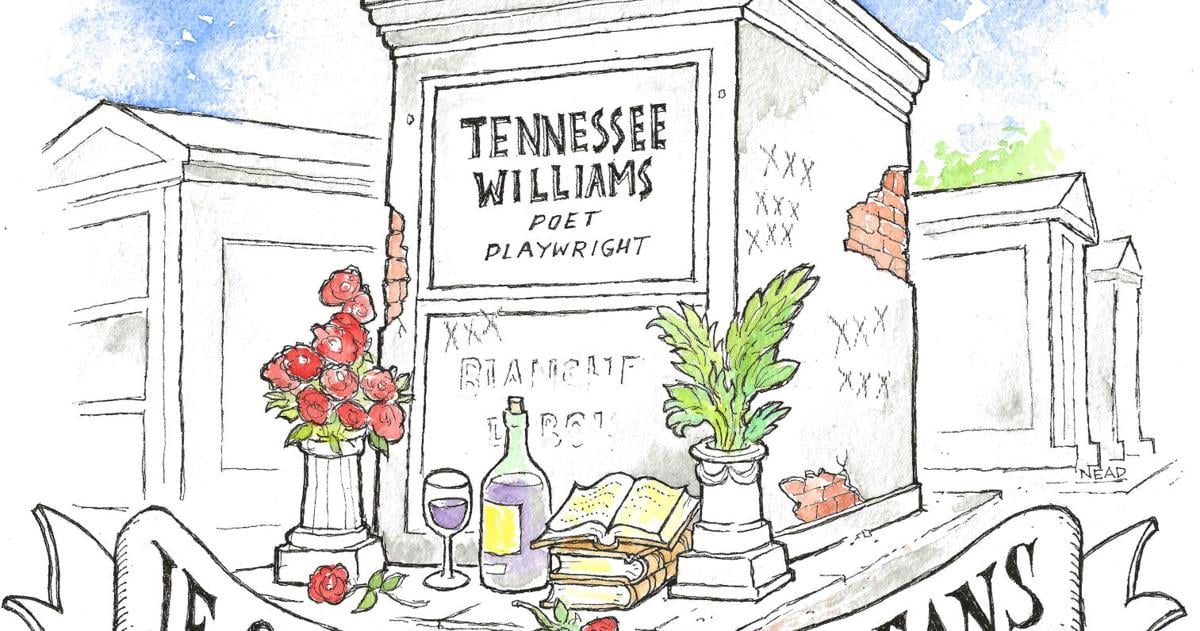
So, Tennessee Williams spends eternity with his family, not far from Gen. Sherman looking over. I have often thought, with due respect to Dakin, how different in would be had the playwright been entombed in New Orleans; perhaps in St. Louis Cemetery No. 1 where he would have had a Voodoo Queen as a neighbor.
Everyone would know where the Williams tomb was located, and it would perhaps be embellished by mysterious painted Xs.
Some might say that would be too touristy, but the playwright’s life was a tour of the souls. He would not have been in the same city as Rose, though the New Orleans cemetery is also named after St. Louis.
At least he would be away from Gen. Sherman, and Marie Laveau would always be nearby.
Contact Errol Laborde at [email protected].
‘ The preceding article may include information circulated by third parties ’
‘ Some details of this article were extracted from the following source www.nola.com ’