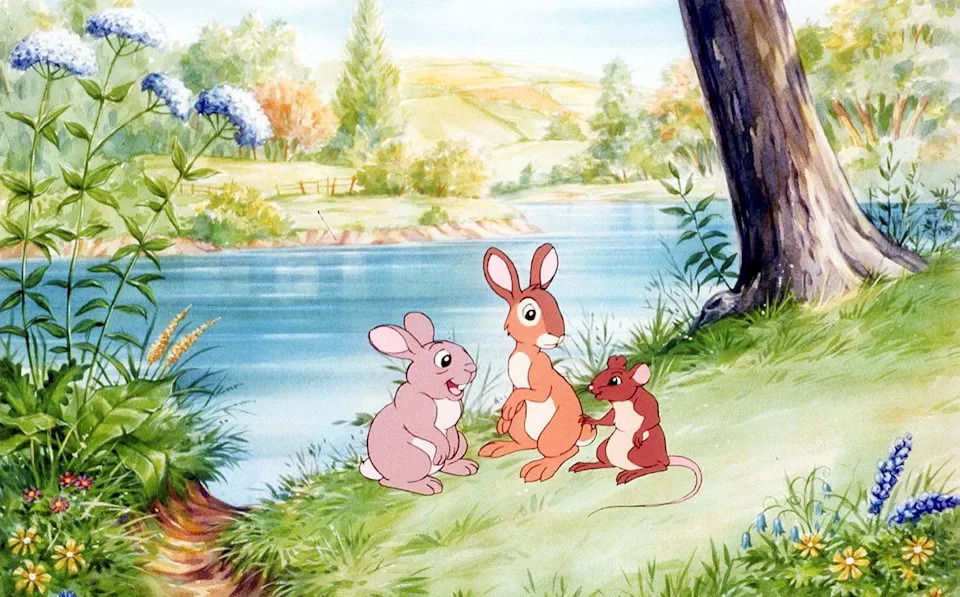
Watership Down is, famously, one of the most emotionally scarring films for younger viewers ever made and, according to a number of Telegraph readers, one of the very best, too. Yet, Martin Rosen’s harrowing 1978 adaptation of Richard Adams’s tale did not appear on my recent list of the 50 greatest animated features ever made – an omission which some readers found baffling or scandalous.
“Where is Watership Down?” wondered Angela Hartland. “To not have Coco(!), Watership Down or Ratatouille is unforgivable,” wrote Joseph Squire. “Where’s The Plague Dogs? Watership Down? Animal Farm? Sheesh…” asked Stephen Scott. “W A T E R S H I P D O W N” boomed M Moolenaar, in the voice of Sylvester Stallone yelling at Adrian at the end of Rocky II (or at least that’s how I read it).

Nostalgic affection was not enough to convince me that Watership Down deserved a place in the pantheon of greatest animations – PA
Truth be told, W A T E R S H…sorry, Watership Down, was one of the last films I whittled out of my final selection, along with the gorgeously knobbly 1983 Cosgrove-Hall adaptation of Kenneth Grahame’s The Wind in the Willows and 1986’s When the Wind Blows, from Raymond Briggs’s beloved post-apocalyptic graphic novel. The rationale behind dropping all three was the same: while I had not revisited any in their entirety since childhood, the parts I did rewatch didn’t persuade me that my nostalgic affection for (and, in two cases, terror of) them then was quite sufficient to secure them a place. (I had The Jungle Book at 27, as opposed to any higher, for the same reason. Great memories; also heavily rose-tinted.)
Meanwhile, with The Wrong Trousers, Song of the Sea, Chicken Run, Fantastic Mr Fox and Yellow Submarine all in the top 50, British and Irish animations already made up ten percent of the list: next to the two giants of world animation, America and Japan, we were already punching above our comparatively slight weight.
Then again, two other films whose absence was also lamented by readers I did end up cutting after rewatching in full. One was the Halas and Batchelor Animal Farm (1954), which felt less imposing now than it had when screened from a VHS on my school English department’s audiovisual trolley in 1993. The other was Up, the opening act of which I agree is up there with Pixar’s very finest work – though the remainder, being merely very decent, is (for me) not quite strong enough to earn the film a place in my pantheon.

Upon re-watching, Halas and Batchelor’s Animal Farm left a less imposing impression than I remembered 32 years ago – BBC/The Halas & Batchelor Collection
Whither Fritz the Cat? My omission of Ralph Bakshi’s landmark 1972 counter-culture toon – the first animation to receive an X rating in the US, and still certified 18 by the BBFC today – was also the cause of a surprising degree of dismay. Surprising to me, anyway, as Bakshi’s lewd and crude style has fallen out of fashion somewhat in the past 15 years; I’m delighted to see it is still cherished.
But the trouble with ranking Bakshi, and other mature-skewing animation auteurs such as Belleville Rendezvous director Sylvain Chomet, Bill Plympton and the Brothers Quay, is that their oeuvres are considerably more than the sum of their sometimes imperfect parts. It’s hard to argue that a single Bakshi film is more impressive than Moana (for instance) even while recognising the singularity of his voice and vision – but I dare say both Fritz and the triplets of Belleville would have been welcomed into my top 75.
As for Who Framed Roger Rabbit, I ruled it out on the grounds that it is a live-action hybrid; including it would have theoretically opened the door to other modern-day chimeras such as Avatar. Flesh and blood and pen and ink (and mouse and pixel) aren’t as separate as they used to be. Had it qualified, though, Roger Rabbit would certainly have made my top 10.

I disqualified Who Framed Roger Rabbit as it is a live-action hybrid – otherwise it would have made the top 10 – Allstar/Cinetext/Warner Bros
Despite, or rather because of, our differences of opinion, this sort of feedback is a critic’s dream: I crave readers who share my passion for film, and have as many pet causes to champion as I do. (To the bold handful who would have had me choose even more Studio Ghibli titles, I salute you.)
What I found a little more perplexing were the cries of horror over my omission of one of the Minions films, or the original Shrek. Yes, those were commercial behemoths which altered the course of their medium considerably more than, say, The Wrong Trousers ever did. But popularity and influence don’t always equate with greatness, and if enormous audiences love those blockbusters – and they do, quite reasonably so – that feels like a right and adequate sort of recognition. There’s not much more a critic can add.
‘ The preceding article may include information circulated by third parties ’
‘ Some details of this article were extracted from the following source www.yahoo.com ’