
Facts about iconic American brand The Walt Disney Company
From 1923 to present, here are five surprising facts about iconic American brand The Walt Disney Company.
This story is part of the Iconic Brands series, a USA TODAY network project showcasing the companies and brands that helped shape the nation’s identity, economy and culture. The series celebrates American ingenuity with a deeply reported examination of how brands intersect with history, community and everyday life in celebration of the nation’s 250th anniversary. Find more at https://usatoday.com/usa250/iconic-brands
In 1928, the cartoon short “Steamboat Willie” hit theaters. It was a black-and-white, 7-minute cartoon that wowed audiences with sound — no talking, but whistles, squeaks and the song “Turkey in the Straw.” It starred a pair of mice, one with two buttons on the front of his pants and the other with a daisy flower atop her hat.
Nothing anyone would recognize as the beginnings of a global entertainment empire.
The cartoon short’s director, Walt Disney, had some significant commercial failures close behind him. His Laugh-O-Gram Studio went bankrupt, and he suffered the humiliating reversal of having one of his earlier creations, Oswald the Lucky Rabbit, snatched out from under him. But this new cartoon and its elastic and slaphappy star, Mickey Mouse, represented a dramatic turnaround for the 5-year-old company.
After the unlucky rabbit incident, Walt Disney Co. would forever be fiercely protective about keeping close control of all its creations. It successfully lobbied Congress in 1998 to increase the national copyright term to 95 years, up from 75 years, in defense of Mickey and “Steamboat Willie.”
Even so, “Steamboat Willie” fell into the public domain in 2024. When powerhouse Orlando attorney John Morgan used a Willie-like character in a commercial, he sued in federal court to preempt a possible Disney lawsuit. Morgan later dropped the suit and said that Disney agreed to let him run the ads.
“Disney remains committed to guarding against unlawful copyright and trademark infringement to avoid consumer confusion caused by unauthorized uses of Mickey Mouse and our other iconic characters,” the company said in a statement. Mickey may be old enough to fall out of copyright, but trademark rights are different and forever.
Disney cast grows from Steamboat Willie to Spider-Man, Miss Piggy, Luke Skywalker
Add to Mickey and Minnie Mouse a rich cartoon cast of fictional beings also under Disney’s protective legal arm —Pluto, Goofy, Donald Duck and all his friends and relations. In recent years, Disney scooped up rights to characters created elsewhere, like Spider-Man and the X-Men, when it acquired Marvel Comics for $4 billion in 2009. Like Kermit the Frog and Miss Piggy, when it acquired rights to the Muppets for $75 million in 2004. Like Luke Skywalker and Darth Vader, when it acquired Lucasfilm in 2012 for $4 billion.
Then there’s streaming service, Disney+ (which also includes Hulu), which was launched in 2019.
According to Senal News, as of late 2025, Disney+ totaled nearly 200 million subscribers. In the third quarter of 2025 alone, Disney+ added 3.8 million subscribers.
In 2024, the streaming service generated $10.4 billion in revenue, a 21.4% year over year increase, according to the Business of Apps website.
Quite the cultural juggernaut. (Not be confused with Juggernaut, the comic book villain, which Disney also owns the right to.) License Global listed Disney as the No. 1 licensor of consumer products in the world in 2025.
Disney theme parks have $67 billion impact on U.S. economy
And that’s only part of the company’s economic and entertainment reach. Disney says it employed some 160,000 people in the U.S. and spent $2 billion on film and television last fiscal year.
And then there are the theme parks. A study released last year by Tourism Economics, an Oxford Economics company, estimated that in 2024, Disney’s U.S. theme parks had a $67 billion annual national economic impact. To put that number in context, the report noted, it’s a little less than the $71 billion consumers spent on the Halloween, Valentine’s Day and Mother’s Day holidays combined.
The parks began with an idea that had been percolating for Disney since the 1930s to create an amusement park near Disney studios. Not the typical tacky amusement park with cigarette-smoking carnies indifferently pulling the levers on rides battered from being hauled from place to place. No, something far bigger ‒ more polished, immersive and under tight company control.
Disneyland opens in 1955, offering new ‘experiences’
The result was Disneyland, which opened in 1955. A $17-million project built on former orange groves in Anaheim, California.
“To all who come to this happy place: Welcome. Disneyland is your land,” Disney proclaimed at the park’s dedication.
The new amusement park proved a happy place for the company. Like “Steamboat Willie,” it signaled a dramatic new phase of operations. It shifted from a mostly movie and television company to a broader family entertainment brand offering experiences.
Disneyland was an immediate success. After only 53 days, Disneyland welcomed its millionth visitor, 4-year-old Elsa Marquez. Even Soviet Premier Nikita Khrushchev demanded to see this amazing place during his 1959 U.S. visit. (Permission was denied by the State Department. Security concerns were cited.)
But going into the theme park’s second decade of success — it welcomed its 50,000,000th guest, Mary Adams, in 1965 — Disney nevertheless itched to create something on an even grander scale.
Next on deck: Walt Disney World in Central Florida, then global theme parks
Disney was irked at the lack of expansion possibilities and especially at tacky tourist development popping up nearby. So from 1963 to 1964, Disney Co., operating with extreme secrecy and using five dummy corporations, bought a swath of rural Florida land a little less than twice the size of Manhattan.
“We are starting from scratch,” Disney declared at the Nov. 15, 1965, Orlando press conference where he announced ambitious plans for the yet unnamed Walt Disney World. As with Disneyland, the claims for the undertaking seemed scarcely believable.
Walt Disney World would profoundly impact Central Florida. Florida historian Gary R. Mormino of the University of South Florida described the attraction’s effects as “the Big Bang that set in motion so much of modern Florida.”
“If Disney stayed just in California, what would be different? We’d still be a Sunbelt star, but maybe, say, a million less people,” he speculated.
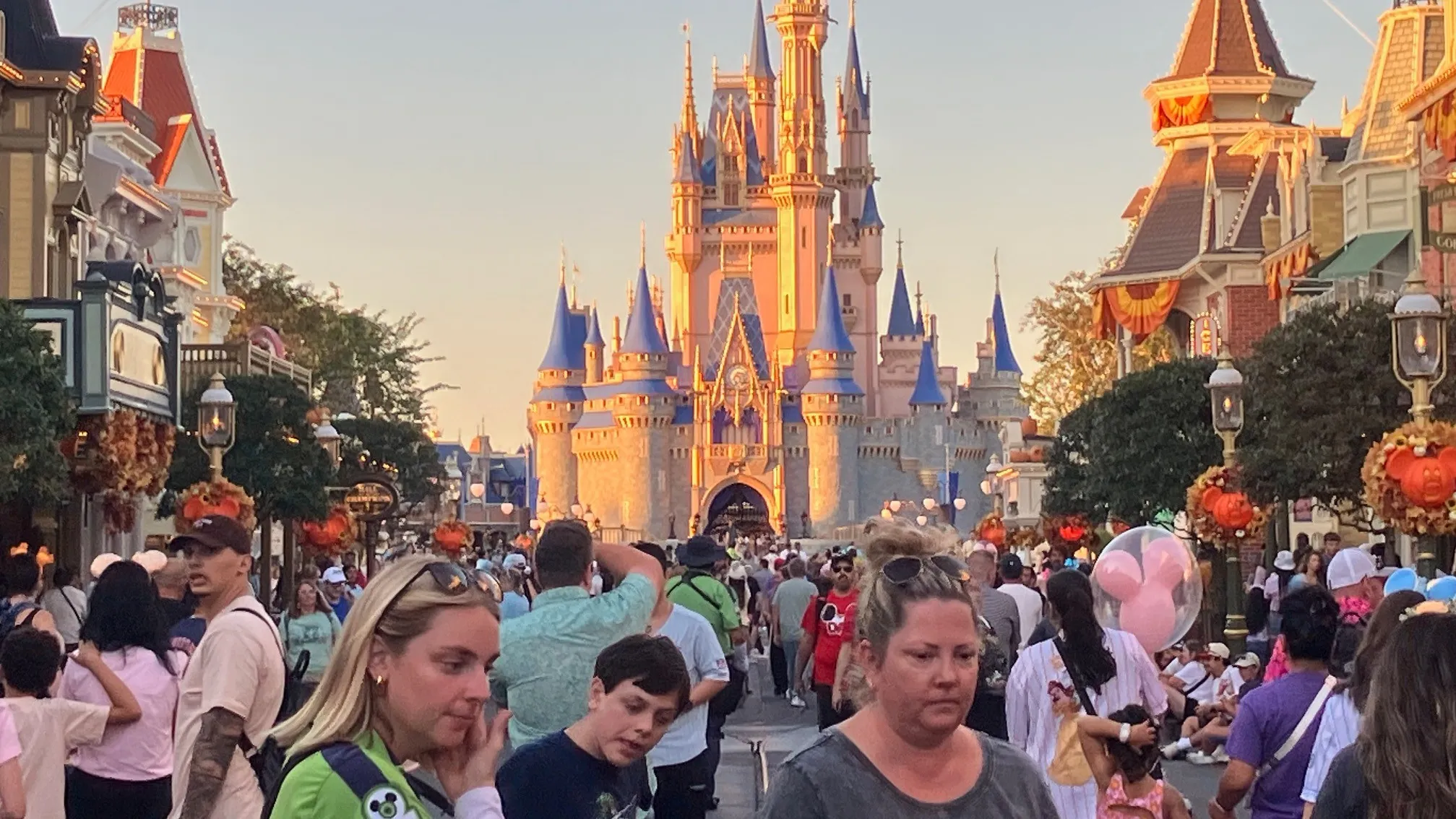
The Magic Kingdom park at Walt Disney World drew 17,836,000 visitors in 2024, making it the most visited theme park in the world, according to tallies by the Themed Entertainment Association. No. 2 was Disneyland Park, California. No. 4 was Tokyo Disneyland, the most visited of Disney’s parks outside the United States. Other international Disney parks include locations in Paris, Hong Kong and Shanghai. And last year, the company announced plans for a park in Abu Dhabi, United Arab Emirates.
Disney Co. ‘not just a business, it’s a cultural icon’
The parks, the movies, the merchandise all reinforced each other ‒ not just in the United States but globally. The park allow visitors to experience the movie stories; the movies remind you of the park rides; the whole reminds you of beloved childhood entertainments.
“A lot more people are growing up with Disney on repeat, a whole generation that saw “Frozen” over and over again … and are seeking the safety of revisiting a bit of their childhood,” observed A.J. Wolf who runs the Disney Food Blog which counts millions of readers in the vast Disney-fan blogosphere. Her book, “Disney Adults: Exploring (And Falling In Love With) A Magical Subculture,” looked at the theme-park experience as a lifelong fascination for many enthusiasts.
In a last quarterly earnings report released in February 2026, Disney Co. (DIS) reported revenue of about $26 billion, a 5% increase over the earlier report. It said $10 billion came from parks and cruises, what Disney Co. calls its “experiences” division.
Some companies sell computer chips. Some sell potato chips. But the core of Disney Co. still lies in selling something immaterial ‒ a thing it calls “experiences.”
The company has been able to keep up with the often-fickle tastes and wants of audiences, fans and children for more than a century, making Disney Co. not just been a business success but a true shaper of American and world culture.
As Mormino observed, Disney Co. “is not just a business; it’s a cultural icon.”
How the list was chosen
The Iconic Brands 50 identifies American companies that most profoundly shaped the nation’s identity, economy and culture. Selection emphasized historical significance, industry-building innovation, measurable economic influence and lasting cultural impact. Brands were chosen for transforming daily life or becoming enduring symbols of American values. Long-term relevance and sustained national influence carried greater weight than short-term financial performance or recent popularity.
Mark Lane is a News-Journal columnist. His email is [email protected].
‘ The preceding article may include information circulated by third parties ’
‘ Some details of this article were extracted from the following source www.usatoday.com ’