
(Louise Pomeroy / For The Times)
Martin Scorsese is one of our greatest directors, but he’s rarely celebrated for his talent in front of the camera. At long last, though, he’s received recognition for his acting, earning a guest acting Emmy nomination for his work on the satirical Apple TV+ show “The Studio.” It’s a fitting acknowledgment of his underrated chops, which he has wielded infrequently but skillfully across his long career. Below is a brief timeline of his most memorable acting moments, which also doubles as a guide to his evolving onscreen persona, whether he’s playing himself or not.
“Taxi Driver” (1976)
From the beginning, Scorsese made brief cameos in his films. But it wasn’t until his haunting portrait of troubled New York cab driver Travis Bickle (Robert De Niro) that the director gave a truly arresting performance, despite appearing for just four minutes.
Playing a racist, quietly unhinged passenger, Scorsese’s unnamed, well-dressed character calmly explains to Bickle that he’s planning to kill his cheating wife, laying out in disturbing detail what his .44 Magnum will do to her. This mesmerizing turn saw Scorsese embody the city’s spiritual sickness that’s poisoning Bickle’s mind.
“Quiz Show” (1994)
When Robert Redford cast Scorsese as corrupt Geritol boss Martin Rittenhome for his quiz-show-scandal drama, he explained to The Times, “I found it interesting to have him play a tough character gently. And given his delivery style, in which he talks real fast, I thought it would make the character extremely menacing.”
Scorsese proved him right, his composed character’s every smirk as lethal as a gunshot. While Rittenhome casually declaws Rob Morrow’s crusading attorney, Scorsese slyly plays off the audience’s familiarity with his dark, violent crime films. Rittenhome never lifts a finger, but Scorsese’s coiled performance drives home the point that corporate executives can be as ruthless as mobsters.
American Express commercial (2003)
By the 1990s, Scorsese was widely regarded as the American auteur. So, naturally, he was frequently courted for roles that sent up his elevated image, which set the stage for this very funny American Express commercial.
The premise is simple — Scorsese, perfectionist filmmaker, mercilessly ridicules the photos he took of his nephew’s birthday party — but it’s his deadpan performance that really sells the joke. Lambasting his creative choices, and silently judging the one-hour-photo employee who calls his shots “pretty,” Scorsese good-naturedly mocked the zealous dedication he brought to his movies. “It was very easy to do,” he later said of his self-deprecating portrayal, before admitting, “You know, the damn thing is, you got to be serious about making a picture.”
TikTok (2022-)
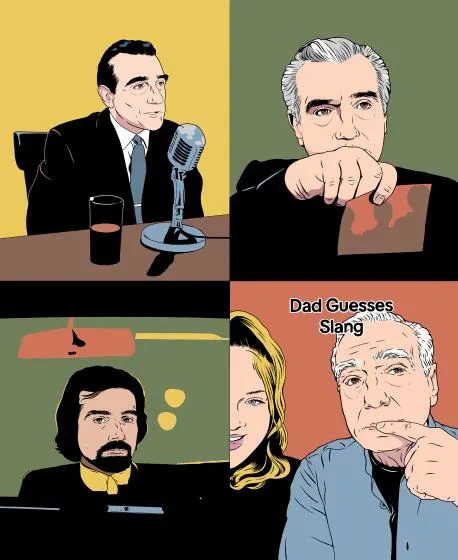
The intense young man responsible for searing dramas such as “Raging Bull” didn’t seem likely to become Cinema’s Lovable Grandpa. But Scorsese has successfully made the leap thanks to his adoring daughter Francesca, who recruited him to star in her TikToks, quizzing him on contemporary slang or scripting a bit in which he informs the family dog Oscar that he wants him for his next picture.
The videos quickly became a sensation, showing off Scorsese’s more private side — he’s never been so cuddly or endearing. “I was tricked into that. … I didn’t know those things go viral,” he told The Times in 2023, amused, about his TikTok celebrity.
“Killers of the Flower Moon” (2023)
Scorsese’s examination of the 1920s Osage murders — a grim study of greed and corruption — felt like a definitive statement on themes that have long consumed the director. That feeling was driven home by the movie’s striking epilogue, set during a radio show dramatizing “Killers’” events, which ended with Scorsese’s narrator solemnly standing onstage relating the sad fate that befell Lily Gladstone’s Mollie Burkhart.
“Marty realized that he needed to have somebody come in as a moderator to explain stuff,” “Killers” production designer Jack Fisk told Vulture in 2024, “but he said he didn’t understand exactly how to direct that person. How could he impart so much of the four years or five years of research he’d done into an actor? He decided to try it once himself.” The result was one of Scorsese’s simplest, most powerful performances — a moving eulogy not just for the slain Osage but also all the innocent characters victimized by his films’ litany of bad men.
“The Studio” (2025)
Scorsese had played himself in comedies like “Entourage” and “Curb Your Enthusiasm,” but his meta turn in the Emmy-nominated Hollywood takedown crystallizes everything that’s made him so good in front of the camera: It’s focused, edgy and never, ever winking. He’s playing a character but also subverting our impression of him as an uncompromising, ultra-serious auteur.
In “The Studio,” Scorsese is hilarious as an avatar of artistic integrity who, of course, gets screwed over by Seth Rogen’s spineless studio head. But there’s a whiff of bitter truth to his character’s dilemma. We can easily imagine the real Scorsese has had to face similar ordeals with facile Hollywood suits. How many world-class filmmakers are also such convincing Method actors?
This story originally appeared in Los Angeles Times.
‘ The preceding article may include information circulated by third parties ’
‘ Some details of this article were extracted from the following source www.yahoo.com ’