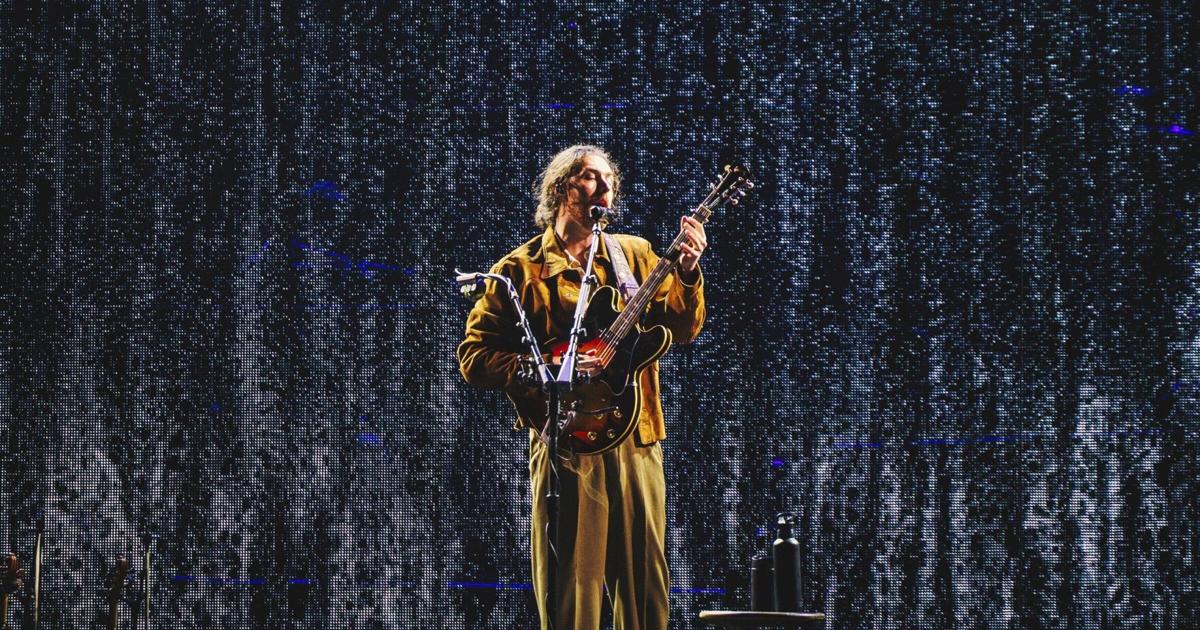
The overcast Seattle skies remind Hozier of Ireland, his home country, where it rains up to 250 days each year. Coincidentally, rare August showers came during the County Wicklow-born artist’s T-Mobile Park debut Thursday.
“It’s always in wet, cold climates where people have a cool, dry sense of humor,” the Irish songwriter relayed to the packed crowd.
Hozier — known offstage as Andrew Hozier-Byrne — started the initial leg of his Unreal Unearth Tour in 2023, last performing in Seattle that October at WAMU Theater across the street. Now in front of an audience about four times as big, the singer-guitarist of folk, blues and soul delivered a dynamic 128-minute set supported by a 10-member band. This third leg of the tour follows the release of the deluxe version of “Unreal Unearth: Unending” in December 2024.
Under faint blue beams of light, Hozier, wearing a dandy striped vest and trousers with a dress shirt, soothed the stadium into tranquility with “De Selby (Part 1),” his 2023 “Unreal Unearth” album opener. “At last,” he sang in a wispy falsetto, “when all of the world is asleep, you take in the blackness of air, the likes of a darkness so deep.” Transitioning into the grittier “De Selby (Part 2),” Hozier bellowed a longing declaration to become one with a lover. From the first two songs alone, even a new listener could reap the fruits of his resonant voice and poetry.
Hozier’s set evoked the sights and sounds of nature, from “Like Real People Do,” which elicited the crowd to shine a sea of phone lights, to the swinging, hurricane-like fretwork in “Francesca.” The literary savant’s 22 songs brought to mind mercurial seasons and terrains, with its mix of dramatic and mellow music — something his mountainous vocals weathered with ease.
A standout, “To Someone From A Warm Climate (Uiscefhuarithe),” melded soft vintage keys and rippling strings, embraced by Hozier’s soulful belts through a cavernous reverb. “Uiscefhuarithe,” an Irish word, means “something that has been made cool by water,” explained Hozier, who wanted to relay the comfort of sleeping in a warm bed to someone who had never experienced it.
Hozier managed to seamlessly fit his old and new hits into the set list, with nine of the songs from his debut album “Hozier.” “We need your help on this one, Seattle,” the Irish artist said before playing his 2024 chart-topping track “Too Sweet,” a slow, seductive commentary on overindulgence, which induced an entranced audience to serenade him back. In the brighter, more carefree “Someone New,” those in the pit raised their hands and swayed along as they sang, “Love with every stranger, the stranger, the better.”
Hozier consistently speaks out on human rights and social and political issues during his shows. At T-Mobile, at the end of his 2014 breakout song “Take Me to Church,” Hozier took one intersectional LGBTQ+ pride flag and a transgender flag from the pit to hang on his mic stand. He pounded his chest as he roared, “I’ll tell you my sins, and you can sharpen your knife.” Over 40,000 people joined layers of thick harmonies and yelled a round of reverberating “Amen”s.
After the lights went out, the front section of the floor flocked to another faint blue beam that shone on the lower right side of the stadium, where Hozier played a quick encore set on a riser with his acoustic guitar. Walking back to the main stage for “Nina Cried Power,” an anthemic track he recorded with civil rights activist and gospel singer Mavis Staples, Hozier pointed to intersections between struggles in the U.S. and Northern Ireland, which used the American civil rights movement as a model for its own resistance, and honored other musicians — Nina Simone, Marvin Gaye, Bruce Springsteen and more — who’ve made music for social change. Hozier also called attention to reproductive, labor, trans and gay rights; denounced antisemitism and Islamophobia; and supported the safety and self-determination of Palestinian people, which received cheers from the stadium.
“It’s so easy to forget that these are things that had to be worked for, that had to be pushed for and to be fought for,” he said.
The stadium mellowed once more with the lovely devotions of “Work Song,” the closing song, with a projected background of pink and purple clouds that ended in a nearly two-minute standing ovation. It was well-deserved praise for a singer who surely took Seattle to church.
‘ The preceding article may include information circulated by third parties ’
‘ Some details of this article were extracted from the following source www.yakimaherald.com ’