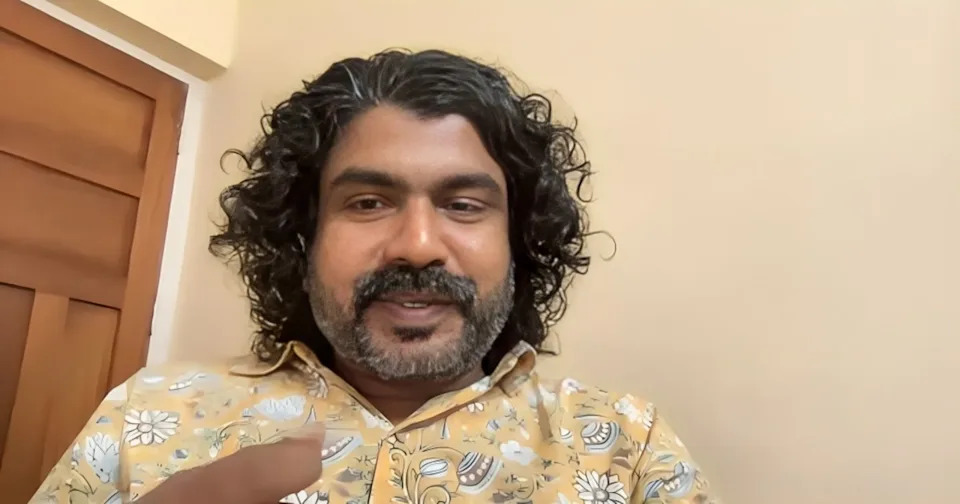
Sanju Surendran is one of those filmmakers who quietly reshape the way we look at the world. His latest film, If on a Winter’s Night, moves with a calm, almost fragile rhythm, yet it holds within it the weight of everyday struggle, young love, and the uncertain lives people build in a city that never stops shifting. What struck me most while speaking with him was the honesty with which he approaches his craft. Nothing is exaggerated, nothing is romanticised. The tenderness in his film—those small moments of singing, laughter, and silence—sits right beside the reality of precarity, and he lets both exist without forcing meaning.
In an exclusive conversation with TV SQUAD, Sanju spoke openly about the challenges of shaping the film in the edit, the trust he built with his actors, and the thoughtful guidance he received from Payal Kapadia. He also reflected on the excitement of winning at Busan and the ongoing struggle of bringing independent cinema to audiences. Above all, he talked about filmmaking as an exploration—one that stays alive only when he dares to take risks.

The film beautifully captures moments of resilience — like the couple singing in Malayalam or laughing in their tiny room. How did you balance these tender moments with the broader narrative of precarity without romanticising poverty or struggle?
Sanju: I didn’t want to because when I see some films about Delhi—or certain films—we can see that poverty was used as a kind of a narrative, you know, I would say a powerful sort of thing. But I… but there were ways to navigate it. I would say I thought that, like when it’s a young couple in Delhi, they would actually have access to Sarojini Market, where they would get cheap, yet fashionable, clothes. So with a little bit of design and so they could actually get to, you know, look nice. In the sense that I like digressions in cinema, you know. So along with the broad narrative, these digressions, this actually, I like it very much, but it’s very difficult to balance the whole thing—the main narrative and the digressions—to get the two to move seamlessly.
So, like at the editing table, we did a lot of work. I would say we took a lot of time to edit the film. While shooting, we… we had a tremendous amount of footage. It was very difficult for the editor to get this form of the film, you know, because I feel that subtraction is creation, you know. So I was a very merciless editor. I had to chop down a lot of things to get that correct rhythm. With Gopika’s character, we had about three or four instances where she got online dates, and they came to a place, and they had a date. So, all of these we had to take out. We have to balance it, and on the editing table, we could actually find out a nice rhythm for it. Editing was very tough. This actually seems like a very simple film to make, to watch, but actually, it was very difficult. First of all, shooting in Delhi was very difficult, you know. Delhi is very difficult to shoot, get the permissions, or deal with things, but luckily, we got a very nice space at Niv Art, and all of us were there, and you know, the team was very strong, very supportive. So we could pull it off.
You know, it took a long time to get the edit, the correct rhythm, because we had too much footage and everything was looking very good. So we don’t know where to cut, like that.
With so much high-quality material, the decision of what to cut must be agonizing. What is your specific process for filtering that footage? Do you prioritize narrative momentum over visual beauty, or is it a more intuitive rhythm you are chasing?
Sanju: So, Praveen M.K. was the editor of the film. Um, so we have, I would say, a nice rapport, you know. So he would actually bring about a first cut or things like that, and I would actually look at it and see how to work on it or, you know, try to see which works or which doesn’t work. I feel that, say, sequencing is power—the way sequences are arranged. It’s just like colors, you know. In the sense that if you have red with green, it would give one a feeling. At the same time, red with white would give a different feel. So this is the same as sequencing, you know. So you have to get that sequencing in the correct order, so that all sequences ought to be there. So I was just… I was mainly looking at the broad structure of the film, how to structure it. Also, these shots, the duration of the shots, how to go about it, what to, you know, plan. Because some shots, even though beautiful, might not go with the narrative, and we had to mercilessly take them down, you know.

Your actors, Bhanu Priyamvada and Roshan Abdul Rahoof, operate in a very naturalistic register. What was your process in preparing them for performances that rely so heavily on silence, pauses, and unspoken emotional weight?
Sanju: It was a very interesting process. After the institute, for a long time, I didn’t work with actors; I was mainly making signature films, animations, or documentaries. Later, I returned to the institute to make a short film called Garass, where we were asked to work with a beautiful batch of five actors. I translated a Malayalam story into English, and we rehearsed with them to get to know the film. This gave me deep insight into working with actors. Usually, filmmakers are obsessed with the image and the composition, so we tend to forget that actors are very important. You have to win their confidence and give them a platform to perform. Roshan came aboard early, so we had a small workshop just to get to know the character. With Bhanu, it was different. We auditioned many actresses, but most would drop out—some got web series, others felt the intimacy scenes were too much. Bhanu came in at the last minute, but she was very quick to grasp the script.
Roshan and Bhanu had nice chemistry. We shot the exteriors first—it was more of a guerrilla kind of shoot, which I think helped them build a friendship. By the time we reached the interior scenes, which were much more difficult due to the intimacy, they were very mature and delivered fantastic results. I wanted the camera to be non-intrusive, very tactile and fluid, capturing it on the go. Then there was Aarathi, who played Gopika. She studied sound design at Whistling Woods. She is a very interesting character. Sometimes you don’t know the power of the actor while shooting, but later you see this enigma or presence they permit on screen. A lot of people said she was just fantastic. And finally, Jithesh. His segment is very subtle, underplayed, and beautiful. He was my student at the K.R. Narayanan Institute, so he was there throughout the shoot. That helped create a general friendship between all these characters who came from different backgrounds, and that connection translated onto the screen.
With Payal Kapadia joining as a producer, you added a heavyweight of independent cinema to your team. In what ways did her mentorship or feedback tangibly alter the film? Were there specific moments where her advice steered the narrative in a new direction?
Sanju: Yes, exactly. Once the rough cut of the film was done, we showed a screener to Payal Kapadia and had a long online meeting. She just loved the film and gave a lot of suggestions; it was a very interesting talk. We were finding ways of collaborating, and Payal suggested coming on board as an Executive Producer. It was very gracious of her, and it gave the whole film a different kind of energy. Paayal’s suggestions are very keen—she has very clinical observations on cinema.

The final knock on the door is one of the most unsettling images in the film. It refuses closure. How did you arrive at this ending, and what emotions or ideas did you hope this open-ended moment would leave with the audience?
Sanju: I find that this world is a very mad, mad world. There isn’t a proper closure to a lot of things. Especially in today’s contemporary life, everything is very haphazard, chaotic, unpredictable, and mad. I wanted to bring a little bit of that madness into the film. I was wondering how to end it. At one point, we considered a proper resolution, but this idea was always in my mind even while scripting—not just letting it go, but showing it as a kind of cycle, as if it were happening all over again. During the main shoot, we couldn’t film this last sequence. We had another schedule in Kerala later, where we shot that portion. Ultimately, I think it was just to bring a little bit of the madness of life into the film. That is all I intended.
Winning at Busan is a massive validation, but the reality of the market is often disconnected from critical acclaim. Did you feel an immediate shift in how distributors or the industry perceived the film after the award, or has the struggle to secure a theatrical release remained an uphill battle?
Sanju: I am trying to find a distributor for the film, but it is very difficult. The main challenge is finding an audience or the proper channel for distribution. I am currently trying to figure out a way to connect with the correct people. That said, the Busan Film Festival hugely supports independent cinema. We received the Asian Cinema Fund for post-production, so we could actually complete the film in Seoul. It was a beautiful experience. Our color grader works with the likes of Christopher Doyle, and they think very differently—they focus heavily on the texture and color of the frame. The wintry feel of the film is all thanks to him. We also did the final sound mixing there. It ended up being about 3 decibels lower than a normal mix. We didn’t realize it at the beginning, but that soft mix turned out to be very effective. Collaborating with different people through this fund helped the film a lot. Even though distribution is a challenge, a lot of independent films are being released nowadays, which is quite good.

Finally, what do you hope young filmmakers and film students take from If on a Winter’s Night, especially in terms of how cinema can represent precarity, intimacy, and the everyday without leaning on spectacle or conventional dramatic structure?
Sanju: For me, every film is an adventure because we are constantly trying to explore new things. My first film, Aedan, had a different feeling altogether—it was shot in Kerala. This film was shot in Delhi; it is more urban and deals with contemporary relationships. With each film, I try not to imitate myself. I want to explore something new and take risks within the narrative so that a new kind of cinema is produced. These are the ideas that drive my filmmaking. I just hope people receive the film in its correct spirit.
‘ The preceding article may include information circulated by third parties ’
‘ Some details of this article were extracted from the following source www.yahoo.com ’