For New Orleans native Chanice Holmes, dancing is more than exercise, sport or art. Dancing is a method of expression and healing.
Through her position as program director of Dancing Grounds, Holmes works to ensure dance is accessible for children and adults in New Orleans. The 501 (c) 3 nonprofit organization develops young leaders, promotes health and wellness, and advocates for social change through inclusive and accessible dance programs reaching New Orleans residents of all ages.
Holmes, who has worked with Dancing Grounds for eight years, is a winner of the 2025 Inspirit Award for her commitment to accessible dance programming in her community. Audrey Stewart, a mother of a Dancing Ground student, says that the studio is a place of safety. She nominated Holmes for the award because she believes Holmes has the spirit and compassion to assist students and families however she can.
“Dancing Grounds means home,” Holmes said. “It feels very important to have a space like this that allows folks to come as they are, be authentic to who they are, and create a space that we want to be echoed out into the world.”
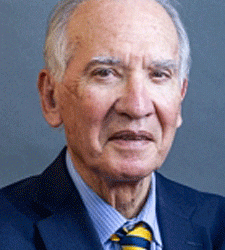
Chanice Holmes, programs director at Dancing Grounds in New Orleans.
Holmes was born and raised in New Orleans and attended The Willow School, which was formerly Lusher Charter School. She danced from a young age, and through her school’s art program, she was recruited to attend Hollins University in Roanoke, Virginia, where she graduated with a bachelor’s degree in fine arts, dance and arts management.
She began her journey with Dancing Grounds as an in-school dance teacher for elementary to high school youth, then progressed to the Dance for Social Change coordinator and then co-director.
“I just fell in love with working with the kids,” Holmes said. “I wanted to do so much in terms of how youth are supported.”
Holmes imbued Dancing Grounds’ youth programming with her belief that young people are change makers ready to build healthy, thriving communities, who only need supportive spaces that allow them to thrive and be heard.
Emerging artists
Laura Stein and Jessi Donley founded Dancing Grounds in March 2012. They shared a common vision for bringing the local dance community together and providing more quality, accessible dance programming. Dancing Grounds started in Stein’s Bywater home. The organization grew over time and moved to a larger studio at 3705 St. Claude Ave.
Dance for Social Change, the organization’s flagship initiative, inspires New Orleans youth to use their artistic talents to enact positive social change. The organization also supports dance artists in the city with rehearsal space, workshops and artist-in-residency opportunities.
Since 2012, Dancing Grounds has reached over 3,500 young people, 8,000 adults and 12,000 audience members.

An adult movement class at Dancing Grounds give participants a freedom to express themselves.
“Folks who come into our space as adults, or who start in our space as young people, grow and evolve with us,” Holmes said. “We’re emerging artists. We are growing, full people. We hope that every time a person comes to Dancing Grounds, they experience that feeling of home.”
A safe space
Children can dance with Dance for Social Change from preschool to high school. Stewart says that this continuity of relationship through the years allows kids the freedom to be who they are.
Her son, Zay, 11, joined Dancing Grounds when he was 5 years old. Stewart says she has witnessed how Holmes has cultivated a culture of artistic excellence while providing a safe space for students to be their whole selves.
Holmes and Stewart agree that New Orleans can be a tough place for affordable arts programming, but having a consistent place to build friendships and gain skills goes a long way. With Holmes at the helm, the Dance for Social Change program improved students’ academic outcomes, their wellness through healing movement and their connections to mental health care.

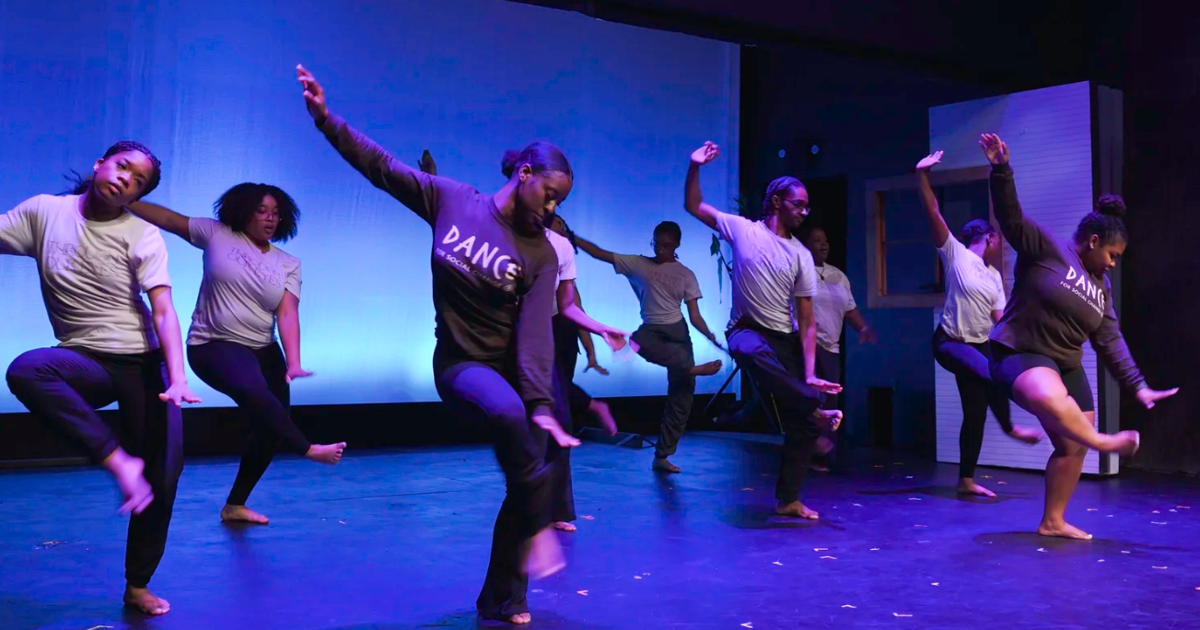
A group of dancers perform at one of Dancing Grounds’ shows they put on twice a year.
Holmes adjusts the program to ensure it provides the right support.
After learning that many young people struggled to access clinical mental health care, she formed a partnership with Children’s Bureau of New Orleans to link the teenagers in need with clinical care via their enrollment in Dance for Social Change.
Holmes collaborates with other city youth service organizations to build a network of support. Partnerships with the New Orleans Health Department and Mayor’s Office of Youth & Families help young people make key connections across citywide programs, services and resources.
‘I’m fed every time I teach’
Since the first graduating class in 2019, 100% of Dancing Grounds participants have matriculated to college upon high school graduation. In the past three years, more than 30 participants ages 16 to 18 at high risk of disconnection from work and school have participated in paid internships.
Dance for Social Change also allowed more than 250 participants to gain college and job readiness skills through designing, producing and performing a multidisciplinary original performance and film.
The majority of Dancing Grounds participants are New Orleans public school students, between the ages of 6 and 18. At least 80% of participants are Black, and 70% are girls. A significant majority are eligible for free and reduced-price lunch and come from historically disenfranchised New Orleans neighborhoods, including the 9th Ward, 7th Ward and New Orleans East.
“I heard a student the other day just raving about a class like, ‘Oh my gosh, I had the worst day. But coming in, I feel so great after class. I feel like I was pushed and challenged, and then I also feel like I got what I need. It was like medicine,'” Holmes said.
“And then I’m thinking about a teacher who also came in heavy. I was recording class, and I saw the smile on her face. I was like, ‘How you doing?’ And she said, ‘You know, I’m fed every time I teach.’ This space is a transformative space.”
Fuel the movement
In January, Holmes got word that Dancing Grounds lost its National Endowment of the Arts funding, which totals $120,000 of their budget. This cut meant loss of some staff members and adjustments to class offerings. Now down to a staff of five, Dancing Grounds is stretching to make sure students aren’t impacted.
The organization is building reserve funds through a fundraising campaign called Fuel the Movement 2025. The campaign will secure affordable classes for its young people and adults. Stewart says Holmes’ faithful commitment to Dancing Grounds is inspiring to her. She will do anything to keep Dancing Grounds alive.
Holmes’ leadership style reflects her teaching practice, which she says is grounded in improvisation of feeling and spirit.
“Giving and receiving are intertwined in the culture of New Orleans — persevering through things that may be holding you back,” Holmes said. “Dance transforms and can shift the energy. It’s connected to spirit and grounding. And I think New Orleans is a very spiritual place.”
‘ The preceding article may include information circulated by third parties ’
‘ Some details of this article were extracted from the following source www.nola.com ’