Theater review
Massive, unanswerable questions writhe like a ball of snakes at the heart of Sam Holcroft’s play “A Mirror,” now running at 12th Avenue Arts in a production by Thalia’s Umbrella. Perhaps the phrase printed on the program — “this play is a lie” — clued you in.
Holcroft’s story, about theater artists working in a country where art is censored by the government, feels not like a static Gordian knot but something slippery and alive: a multiheaded ouroboros looping back on itself over and over again.
And it starts, of all places, at a wedding.
Welcome! Choose your seat: bride’s side or groom’s side? But before Joel and Leyla can finish reciting their vows (more legal oaths than professions of love), the proceedings are halted.
After this brief interruption, things can get started. We’re really here to see a play — at our own risk.
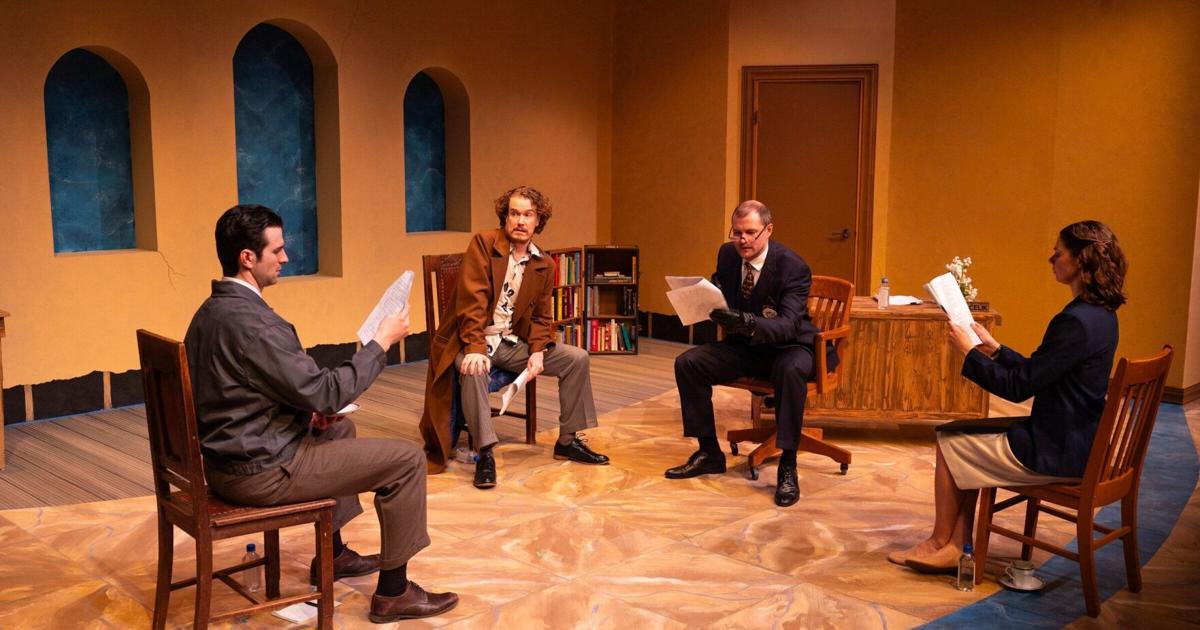
The play is about Mr. Čelik (Quinlan Corbett), a government official who fancies himself a die-hard supporter of the arts; his soldier-turned-ministry assistant Mei (Emily Verla); and a soldier-turned-mechanic-and-aspiring playwright Adem (Adam Tapp), who submits his first script for ministry review, per government policy, and ends up in the ministry’s crosshairs.
Adem’s habit of snatching dialogue, verbatim, from this lived experience rubs Čelik the wrong way. If Adem didn’t invent it, isn’t it a lie? Or is it the most true art there is?
To help answer that question, Čelik later ropes in the established playwright Bax (Jon Lutyens), who is used to sanding down his artistic edges for the sake of producibility. It’s cost him dearly.
But remember: This play is a lie.
“A Mirror” premiered at London’s Almeida Theatre in 2023 and quickly transferred to the West End in 2024 in a production starring Jonny Lee Miller.
Holcroft, whose other plays include the unexpectedly literal family drama “Rules for Living” and “Edgar & Annabel,” another authoritarian-centric piece recently produced in Seattle by Pony World Theatre, doesn’t try to untangle these knots so much as toss them at the audience like a ball of yarn to either snarl them further or start to tease apart as they see fit.
Without ruining any of the many twists and reveals in “A Mirror,” expect layers of reality to be stripped back over time. Don’t worry about keeping everything straight; as soon as you think you’ve got it figured out, the script knocks another narrative Jenga piece out of place.
While “A Mirror” is anchored by strong performances from Verla and Corbett, as directed by Terry Edward Moore and Daniel Wilson, its urgent rhythm never quite clicked into place, and that sluggishness meant that the rhythm couldn’t be interrupted, as it needs to be, many times over. Without screeching halts and sudden boiling points, the proceedings meld into a tonal sameness that doesn’t scream “art in a surveillance state.”
But the play’s exquisite discomfort remains, found amid questions of authoritarianism and censorship that feel particularly salient right now, as do questions about what art can or can’t (and should or shouldn’t) do. What it is and what it is not.
All plays are lies and all plays are truth, depending on how you think about it — but that’s the ballgame. Black-and-white thinking limits us all. The freedom of artists is the freedom of audiences, and “A Mirror” helps us appreciate how lucky we are to be asking these questions at all.
‘ The preceding article may include information circulated by third parties ’
‘ Some details of this article were extracted from the following source www.yakimaherald.com ’