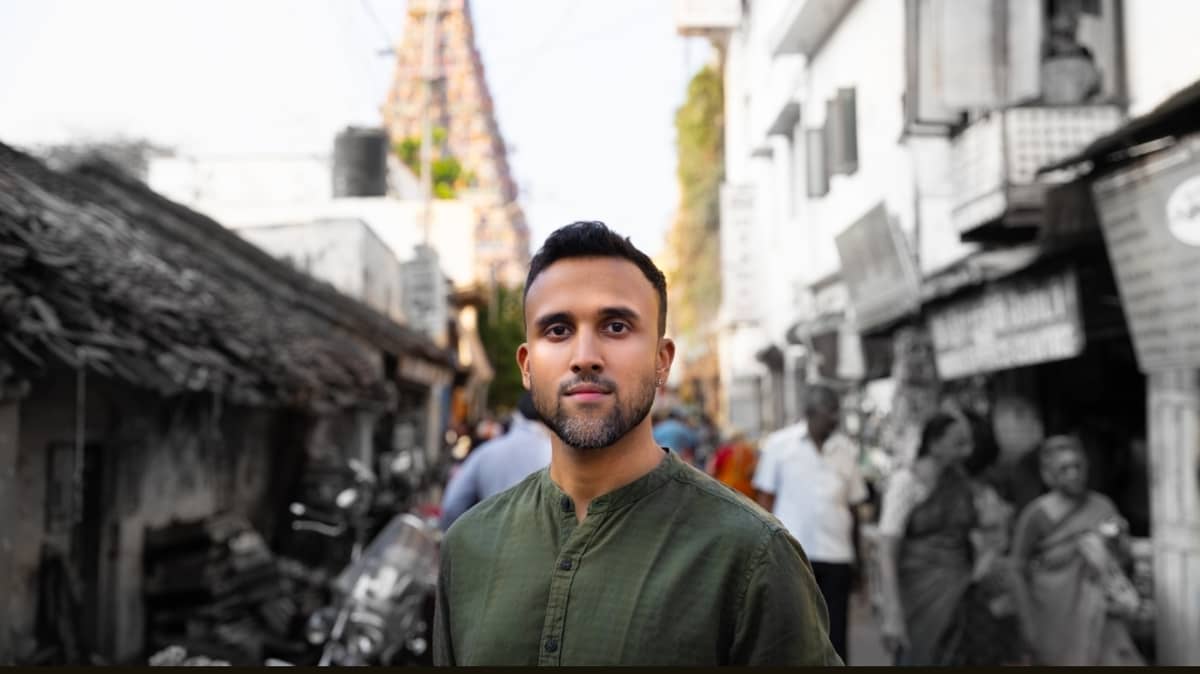
LA- and Chennai-based carnatic musician Aditya Prakash continues to push the boundaries of classical music through deeply personal, interdisciplinary storytelling. His latest solo gig-theatre project, Room-I-Nation, debuted at the Mumbai Lit Fest in November 2025 and the Mahindra Kabira Festival in Varanasi in December. The work will next be showcased at Hubba at The Sabha, Bengaluru, on January 16, 2026.
Co-written and directed by acclaimed dancer-choreographer Mythili Prakash, Room-I-Nation draws from Aditya’s 2023 album ISOLASHUN, weaving carnatic music with narratives of Asian immigration, identity and belonging. The project reflects on what it means to exist between cultures — to search for home not as a destination, but as an evolving emotional space. Having toured with Pandit Ravi Shankar at the age of 16, Aditya has since collaborated with artists such as Anoushka Shankar, Karsh Kale, Tigran Hamasyan, Mythili Prakash and Akram Khan.
In a hearty chat with t2ONLINE, Aditya reflected on discomfort as creative fuel, the politics embedded in classical traditions, and the lifelong process of finding home in the in-between.
ROOM-i-Nation blends carnatic music with themes of identity and immigration. What sparked the idea for this multidisciplinary format, and how did the concept evolve as you created it?
The starting point was Isolahsun, an album I created during the pandemic. It was a period of deep introspection, and the album became a way of questioning my own position within society — and within systems that I had largely taken for granted until then. For most of my training in Indian classical music, the focus was on mastery of form, repertoire and discipline, but not on the sociological history of the tradition.
That changed when I read a book by my mentor, T.M. Krishna, which examines the social and caste histories embedded within carnatic music. Reading it was unsettling. I began to feel complicit — complicit as someone who benefits from privilege within the tradition, and also as an Indian growing up in America, witnessing structural inequalities there. Isolahsun emerged from that tension: between privilege and marginalisation, inheritance and discomfort, belonging and alienation.
The album itself is political, but also deeply personal. It doesn’t begin in a conventional musical way — it begins with a search for identity, both personal and socio-political. As I was making it, I realised the music was inherently narrative-driven. I didn’t want to simply perform it live as a concert. I wanted to build a storytelling experience around it. That impulse led naturally to theatre, and that’s where Mythili’s vision became crucial. With her grounding in theatre as much as dance, the work evolved into a fully staged, interdisciplinary performance.
You co-wrote and developed the project with Mythili Prakash. How did your creative partnership shape the narrative language of the work?
Mythili is my elder sister, and we’ve been collaborating for most of our lives. I’ve composed music for many of her dance productions, and that long history has created a deep creative shorthand between us. At the same time, she is incredibly rigorous and demanding in her process. She questions relentlessly, moves through countless drafts, and keeps interrogating the work until every element earns its place.
I began this project by writing freely — putting down everything I wanted to say on a blank canvas, without worrying about structure. Mythili’s instinct was to shape that raw material into a conversational narrative. As we worked, a central thread kept returning: my father. He passed away ten years ago, long before this album or project came into being, yet his presence became unavoidable. He was instrumental in my artistic journey
He is the reason I am who I am today. He left his career in engineering so my mother could run her dance school, managed the business side of her work, and nurtured my musical journey with immense care. The performance ultimately became an imagined dialogue with him — what I want to tell him now, how my music has changed, whether he would agree with my choices.
Through that personal, imagined conversation, the work opens up much larger questions: immigration, diasporic identity, first-generation struggles, caste politics, and the historical frameworks of carnatic music. The intimacy of that dialogue is inseparable from our sibling relationship — Mythili directing me in a work that is both deeply personal and artistically demanding made that honesty possible.
The performance draws from your 2023 album Isolashun. What was it like transforming the album’s sonic themes of isolation and belonging into a theatrical experience?
It was both thrilling and deeply uncomfortable. I’m a musician first — my training is in singing and playing instruments. Acting, delivering monologues, embodying different roles on stage was unfamiliar territory. There were many moments when I wanted to retreat into the safety of a concert format.
But Mythili was firm. She held the vision and pushed me forward.She could see that the album demanded something more. Isolahsun isn’t structured like a typical collection of songs with verses and choruses — it is narrative-driven, not structured like conventional songs. To honour that, we needed visuals, a set, a sense of place, and a dramatic context.
That discomfort became productive. It forced me to break old habits and confront new artistic questions. Theatre allowed the music to exist differently — not just as sound, but as part of a lived, unfolding story. The challenge was precisely what made the work come alive. Discomfort is essential to growth.
ROOM-i-Nation premiered in India at the Mumbai Lit Fest to an overwhelming response. How did the audience reactions resonate with you, especially given the work’s personal themes?
What I’ve learnt over time is that the more specific I am about my story, the more universal it becomes. This is the most personal work I’ve ever made — whether it’s the father-son relationship, intergenerational disagreements, or the emotional weight of being a first-generation immigrant. People saw themselves in it.
When I performed the work in the US and the UK, much of the audience was diasporic — people born there to parents from elsewhere. India was the first time I performed it for a largely non-diasporic audience, and I wasn’t sure how it would land. But the response was incredibly deep. People connected to the emotional relationships at the heart of the work, and also walked away with a greater awareness of Asian immigration histories.
That dual response — emotional and intellectual — felt deeply affirming.
As an LA/Chennai-based artist, how have your bicultural experiences influenced your understanding of “home” — a central idea in ROOM-i-Nation?
Finding home has been one of the biggest challenges of my life. I’ve always existed in between.Growing up, I often felt I didn’t fully belong in either the US or India. Isolahsun— and by extension Room-I-Nation — is about carving out a space of my own, rather than trying to fit into predefined boxes.
LA, a true cultural melting pot, especially, shaped me profoundly, and I grew up surrounded by artists from wildly different traditions. My mother worked with hip hop dancers, gospel choirs, ballet performers; at home, musicians from across backgrounds would come to rehearse. Outside, my friends were jazz musicians. I was exposed to authentic practitioners across forms in a way I might not have experienced had I grown up solely in India.
All of that,the diversity, expanded my artistic palette. The more you converse with people unlike yourself, the more expansive you become — not just as an artist, but as a human being.
You’re regarded as one of the foremost young practitioners of carnatic music. How do you balance preserving tradition while pushing boundaries through contemporary storytelling?
For a long time, I felt split between identities — carnatic musician in one space, contemporary artist in another. That became exhausting. At some point, I asked myself: who am I really?
Now, I’m trying to bring everything into one integrated identity. Why can’t carnatic music be contemporary? What does “contemporary” even mean? I don’t have definitive answers yet, but I know that asking these questions is moving me forward.
I resist being boxed into categories. Music transcends beyond labels — whether traditional, fusion or contemporary. My mentor T.M. Krishna performs carnatic music in an uncompromisingly traditional way, yet his work feels deeply contemporary because of what he chooses to say through it. Ultimately, it’s always about the artist’s intent, not the label.
You’re touring key metros and festivals across India until January 2026. How does performing ROOM-i-Nation in different cities influence the way you deliver or interpret the work?
The work itself doesn’t change, but the energy does. Every city has its own rhythm, its own emotional temperature. As a performer, you respond instinctively to that energy on stage. No matter how much you plan, something shifts in the moment — and that’s where live performance becomes alive. The performance evolves in the moment.
Touring with Pandit Ravi Shankar at just 16 is extraordinary. What lessons from that experience continue to shape your musical journey today?
His humility and curiosity left a lasting impression on me. Even at his peak, he remained endlessly inquisitive — asking questions, discussing ragas, exploring similarities between carnatic and Hindustani traditions.
We spent long periods touring together, and he made the effort to include someone as young as I was. His deep understanding of rhythm, cross-rhythms, orchestration, and his use of harmony within raga structures have all shaped me profoundly as a composer. Above all, it was his openness — the sense that learning never ends.
You’ve worked with artists like Anoushka Shankar, Karsh Kale, Tigran Hamasyan, and Akram Khan. How have these collaborations expanded your artistic language?
Every collaboration expands your vocabulary. You absorb another artist’s language while also learning to articulate your own more clearly. Explaining your ideas forces you to understand them more deeply.
Working with Akram Khan, in particular, transformed my relationship with discomfort in art. He embraces the full spectrum of human emotion — anger, rage, unease — and believes those emotions must be present in artistic expression. Classical traditions often shy away from the uncomfortable, but humanity isn’t tidy. With artists like Akram and T.M. Krishna, I’ve learnt to allow the unpleasant into my work — and that’s where it becomes more honest.
With ROOM-i-Nation gaining momentum, what new directions or projects are you hoping to explore next in your musical and theatrical work?
I’m currently working on a highly collaborative album involving over 30 artists from classical backgrounds, all of whom are interested in pushing the boundaries of their forms. The project explores a wide emotional spectrum — from beauty to discomfort — much like ISOLASHUN.
I’ve also composed a section of music for an English film adaptation of Hamlet, featuring Riz Ahmed and directed by Aneil Karia. It’s the first time I’ll hear my music on a cinema screen, and it’s opened up exciting possibilities. I’m increasingly interested in cinematic composition, and this feels like the beginning of a new chapter.
‘ The preceding article may include information circulated by third parties ’
‘ Some details of this article were extracted from the following source t2online.in ’