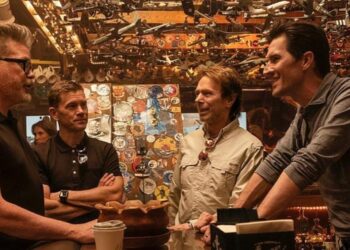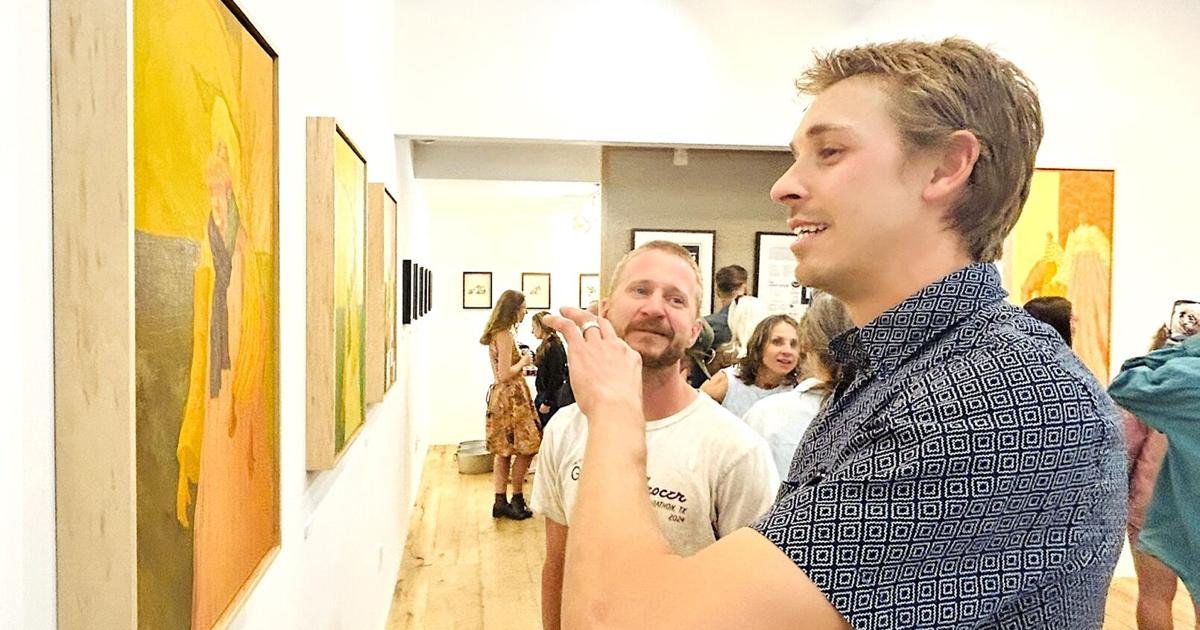
Carbondale artist Nicholas Ward discusses his work with a visitor during last Thursday’s opening of “Between the Real,” his exhibition at Aspen Collective.
Carbondale artist Nicholas Ward’s oil paintings depict simple moments from everyday life. He embeds them with significance from forces that are unseen in the canvases but are affecting the paintings themselves — technology and artificial intelligence.
His new exhibition,“Between the Real,” opened last week at Aspen Collective, 213 S. Mill St., and runs through July 15.
The show features two distinct sections. Upon entering the gallery, one is presented with seven colorful oil paintings; in the back part of the gallery, there is a series of eight charcoal drawings.
“This exhibition began as an exploration of memory, storytelling, and ritual but morphed into my own grappling with life amidst omnipresent and ever advancing technology,” Ward said.
In the paintings, reality gradually begins to fracture. Figures acquire extra arms; dresses dissolve into pixel-like fragments; individual stories unfold inside larger stories.
The progression mirrors what Ward imagines happens when AI repeatedly processes and reprocesses information and in so doing, gets further and further away from the original subject matter.
“You put a prompt into AI, and if you keep bouncing it off itself, it slowly devolves further and further away from this recognizable thing,” he said.
Ward’s concern is not so much the technology but the rituals themselves, such as how cell phones pull people’s attention away from the present moment and into some other distraction — and how that affects the way humans perceive reality and one another.
“There is almost this worship of the phone and AI,” Ward said. “I got to thinking about how technology draws us away from those rituals, the distraction and the fracturing of that time and intention.”
“Between the Real” is less a critique of technology and AI than a meditation on what remains uniquely human as technology becomes increasingly woven into daily life.
“The core concept was to explore human connection through rituals,” Ward said while walking through the exhibition before its opening last Thursday. “The intention behind doing something — giving it your full attention — is what makes it a ritual.”

Artist Nicholas Ward stands next to one of the oil paintings that make up his exhibition “Between the Real.” It runs through July 15 at Aspen Collective.
Ward isn’t interested in declaring technology as good or bad. Instead, he sees himself wrestling with two very different forms of connection. One is immediate, tactile and grounded in the physical world — gardening, dancing, caring for animals, sharing stories. The other exists in a digital space that often feels strangely real despite lacking humanity.
“There are studies now about lonely elderly people having AI companions,” Ward said. “Part of me thinks that’s dystopian. But another part thinks, ‘Well, that beats being lonely.’”
Ward traces the concept behind the show to science fiction writer Arthur C. Clarke’s observation that “any sufficiently advanced technology is indistinguishable from magic.”
“It seems like even the creators don’t fully understand what’s happening inside these AI systems,” he said. “I’m interested in that space between what feels real to us and this new world happening alongside our lives.”
One of Ward’s favorite paintings, “Gunning for Gold at the Tunbridge World’s Fair,” grew out of an oversized sunflower in his garden. After measuring the nearly 13-foot plant, his father-in-law jokingly replied that it resembled a winner at the Tunbridge World’s Fair (which is actually a tiny little fair in a small town).
Ward turned the family joke into one of the exhibition’s most joyful paintings.
“It’s really about humor and earnestness,” he said. “There’s a genuine pride hiding in that figure.”
The story also illustrates another thread running throughout Ward’s show: storytelling itself.
“I’ve never been a very good verbal storyteller,” he said. “Painting is my way of telling stories.”
Ward’s paintings intentionally leave room for viewers to participate in the narrative.
“A lot of my artistic vision is creating stories that are only partially complete,” he said. “The viewer finishes them. We all bring our own histories and moments and associations. The pieces in this show want to be talked to.”
The storytelling thread also is expressed in the back of the gallery through his series “En Masse,” which consists of eight charcoal drawings cut from a single large composition.
Unlike the oil paintings, Ward said the charcoals are not directly connected to the AI narrative. Instead, they explore movement, dance and what might exist just beyond the edge of the images.
“I wanted to explore what’s happening just off the frame,” he said.
Ward said he hopes visitors leave his show contemplating whether they are still making time for the small rituals that make them feel alive.
“I hope people find something they relate to in the show,” he said. “But I also hope they question their own use of technology and think about how they can have more intention in whatever their small ritual is — making coffee, watering sunflowers, dancing, whatever it is — because what still feels most real and meaningful is often the simplest human experiences.”
‘ The preceding article may include information circulated by third parties ’
‘ Some details of this article were extracted from the following source www.aspendailynews.com ’