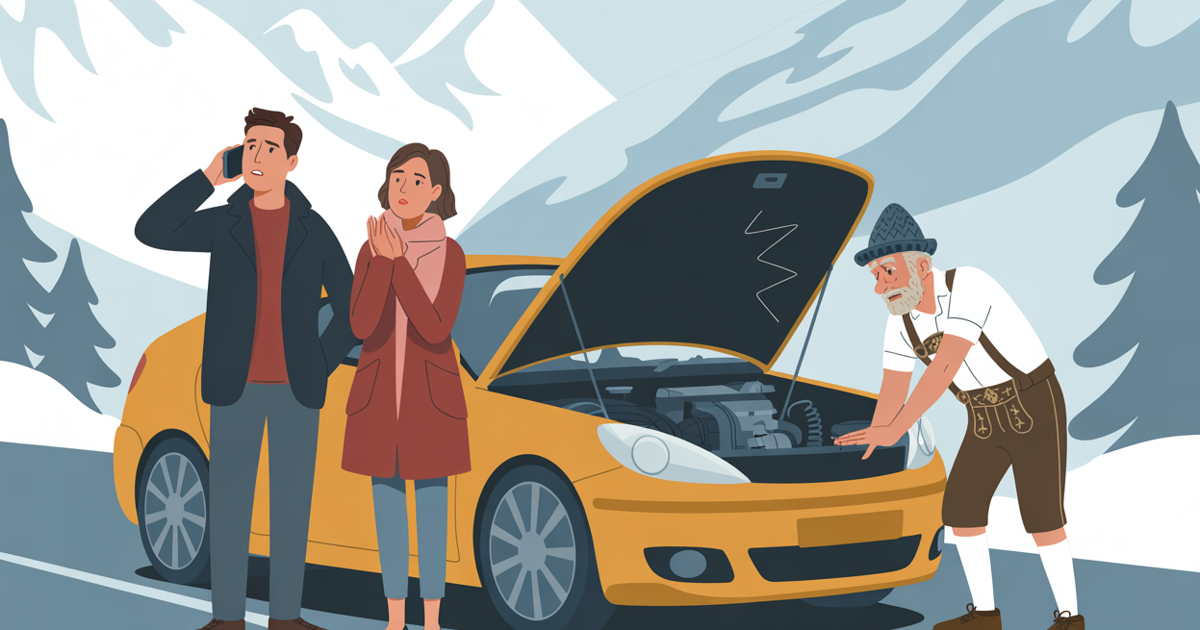
I rented a car from Alamo at Geneva Airport in April for a six-day trip through Switzerland. The car worked perfectly for the entire rental period until the last morning. We were staying in Champex-Lac in Valais, a mountain village at 1,500 meters elevation, and woke up to a cold, frosty morning. We needed to return the car and catch our flight from Geneva.
When we tried to start the car, nothing happened. No lights. No starter. Nothing. Four people tried to get it going, but the car was completely dead. We called Alamo’s emergency number, and they told us to leave the car where it was since we didn’t have time to wait for a technician. Three of us had flights to catch that morning, so we arranged alternate transportation to the airport at considerable expense.
Two months later, Alamo charged roughly $1,000 to my credit card without any prior agreement or warning. What’s worse, they sent me two different invoices with completely different totals: one for 395 Swiss francs and another for 489 Swiss francs. Neither amount corresponds to what they actually charged to my account.
I later learned that the garage checked the battery and had to replace it entirely. It wasn’t simply discharged from negligence — it needed full replacement because it was defective and couldn’t handle cold weather. When you rent a car, you expect it to function properly for the duration of the rental. This battery was clearly inadequate from the start.
I’ve read that rental companies don’t charge customers for mechanical or electrical breakdowns unless the breakdown is the customer’s fault. We didn’t leave lights on or doors open. The car simply wouldn’t start on a cold morning. How is that our responsibility?
When I contacted Alamo’s customer service in Switzerland, they refused to refund the charge. They said I should have purchased their Roadside Assistance Protection, which would have covered the towing costs. They also claimed that because I selected an insurance policy with a 1,500 franc deductible instead of the zero-deductible option, I was responsible for all these charges.
This feels completely wrong. We suffered a loss by not being able to use the rental car we paid for. Now they want us to pay an additional $1,000 for their faulty equipment. Can you help? This seems like Alamo is taking advantage of foreign customers who have difficulty defending themselves outside Switzerland. — Kjell-Erik Berggren, Oslo
You’re right, if the battery was defective, Alamo should never have charged you for it. Rental companies are typically responsible for mechanical breakdowns that aren’t caused by customer negligence or misuse. A battery that dies on a cold morning after functioning normally for five days suggests a preexisting problem with the vehicle, not customer fault.
Here’s what you should have done. First, document everything immediately. Take photos of the car, the dashboard, the surroundings — everything. Get the names of everyone who tried to help start the vehicle. Create a written timeline of events while the details are fresh.
As soon as you see an unexpected credit card charge, contact the company in writing. Email is fine, but keep copies of everything.
And third, appeal to a higher authority. When a customer service representative closes your case, escalate to the executive contacts. I publish a list of Alamo’s contacts on Elliott.org for exactly this purpose. A brief, polite email to a senior executive often produces better results than multiple exchanges with front-line customer service.
After I contacted Alamo on your behalf, the company conducted a thorough review of the case.
“After checking all previous rentals, we confirmed that no prior customer reported any issues or faults with this vehicle or its battery,” a representative told me.
The company suggested that repeated start attempts after the initial failure may have permanently damaged the battery. But what were you supposed to do? Not try to start the car? Leave for the airport on foot? The logic doesn’t work. When a rental car won’t start, most people will naturally try multiple times before calling for help. That’s not negligence. It’s common sense.
To Alamo’s credit, the company recognized this wasn’t a clear-cut case and agreed to cover the cost of the battery as a goodwill gesture.
Your case highlights an important issue with rental car breakdowns. Companies often have policies that seem reasonable on paper but become problematic in real-world situations. The lesson? Always purchase travel insurance that covers rental car mishaps, document everything obsessively, and dispute any suspicious charges to your credit card immediately.
Sometimes a dead battery is just a dead battery — and the car rental company should pick up the tab.
‘ The preceding article may include information circulated by third parties ’
‘ Some details of this article were extracted from the following source www.nola.com ’