In “Jurassic Park,” Jeff Goldblum’s famous line is, “Life finds a way.” It could just have easily been “art finds a way.”
When two artists get together to problem-solve, amazing things can happen.
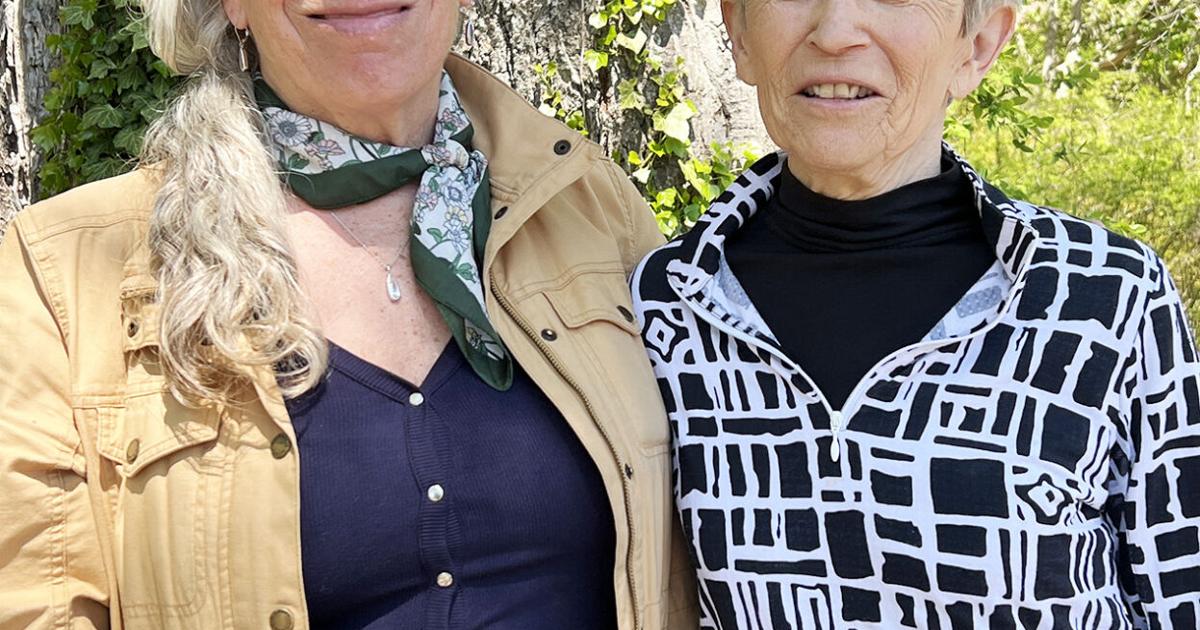
Dawna Hammers is a longtime singer-songwriter, music teacher and caregiver. Her music practice has led her to work one-on-one with dementia and Alzheimer’s patients as well as perform in group settings such as the Alzheimer’s Family Support Center’s Funday Mondays at the Cape Cod Museum of Art.
Susan Beardsley is a Falmouth artist, best known for her whimsical found-art sculptures that can be found in many outdoor locations around Falmouth. Beardsley is also a wood-turner, an art practice she enjoyed with her husband, Bob. In 2016, the couple collaborated for an exhibit at Falmouth Art Center titled “A Little of This, A Little of That.” In an interview about that show, Beardsley credited her husband with helping her with her found art pieces, especially when it came to attaching welded pieces or clamping pieces to glue together. Bob Beardsley died of complications from Alzheimer’s in December 2025.
Beardsley and Hammers first connected at a music event where Hammers was performing, with Hammers later visiting the Beardsleys at their home, where she would engage in music with Bob, which provided Susan the opportunity to Zoom with one of the support groups coordinated by the Alzheimer’s Family Support Center. “It gave her a break and he was busy and having fun,” said Hammers.
The pair is now teaming up to share their experiences and what they’ve learned in order to help other caregivers.
Hammers has created the 25-minute film, “Music Is Medicine: Using Music to help People Coping with Dementia & Alzheimer’s Disease,” while Beardsley has published a book titled “Comfort: A Daily Reader for Caregivers of Someone with Dementia.” Beginning in June, the two will be at venues across the Cape giving a presentation they are calling “Creative Ways of Coping with Dementia & Alzheimer’s.” Hammers’ film will open the presentation, followed by a talk by Beardsley about her book. Complimentary copies of “Comfort” will be available and attendees are invited to stay for an author signing and short sing-along. Caregivers and their loved ones, along with anyone else interested in the topic, are welcome to attend.
Music And Healing
Hammer’s video contains footage of her working with several clients. Giving them instruments to play by themselves, such as chimes, hand drums and harmonicas, and encouraging them to play in her soothing sing-song voice.
Clients who played instruments earlier in their lives are often able to tap into kinesthetic memory, or muscle memory, to play songs.
“Music acts as a distractor, focusing attention away from negative stimuli to something pleasant,” says Hammers, citing a variety of research on both listening and playing music. In one study, surgery patients who listened to music recovered faster and needed less painkillers than those who didn’t.
Through her long career, Hammers has worked in a variety of nursing homes, assisted care facilities and memory care units. Hammers got started in caregiving over 40 years ago. “I started in housekeeping,” she said, “then trained as a caregiver so I could do more on the medical side.” Hammers worked with Alzheimer’s patients as well as in an assisted living facility when she lived in Vermont. Hammers documents many of the things she’s experienced over that time in her film. Locally, she’s worked as a caregiver and also done entertainment and led activities in different facilities.
“Sometimes new patients can be angry or very shut down,” said Hammers. “If you start playing music with them, it helps a lot.”
In a segment of the film that features Beardsley’s husband, Bob, Hammers hands him a baritone horn, which he takes and immediately begins to play “America the Beautiful.”
“He played in the Falmouth Town Band for a long while,” said Beardsley. “There’s this concept called ‘cognitive reserve,’ where a person can’t do this or that and then they pop out with these remarkable things. The cognition is still there,” she added.
The physical act of singing or playing an instrument is also beneficial for dementia patients, encouraging them to be present and take deep breaths. “Singing engages both the brain and the lungs,” says Hammers.
While Hammers is a professional musician with a beautiful voice, any caregiver can sing with their loved one, regardless of musical ability. “Don’t judge yourself,” said Hammers.
“There are only 12 notes in the scale and it all gets recreated. But it’s powerful. People don’t realize how powerful it is.”
The video shows patients enjoying all genres of music from American songbook favorites like “I’ve Got Rhythm” and “Fly Me To The Moon” to R&B and classic rock ‘n’ roll.
“The genre doesn’t matter,” said Hammers. “I love all the old songs because my father taught them to me.”
Hammers had taken videos of her clients over the years and with permission from their families, some of the footage appears in the film. “I knew I needed to do something and put them together somehow—I couldn’t erase them, they were too precious and people needed to see them. That’s why I wrote for the grant and, thankfully, they were supportive of it.”
Hammers received a grant from the Arts Foundation of Cape Cod, which she used to create her film, working with musician and audio-video engineer Shaqed Druyan, who Hammers called “a wizard,” and Christine Lemay from Morningstar Design, who Hammers said was wonderful in helping with design and graphics for the film.
‘A Page Or Two At A Time’
Beardsley started writing her book in 2024, saying the project took her about six months to complete. She said the idea for the book and the book’s format were styled after some 12-step programs she’s been involved in.
The Alanon book, for example, has a similar set-up as a day-by-day reader and the idea came to Beardsley that caregivers needed a similar guide.
“I don’t know that people can sit down and read a whole handbook, especially when they are caring for someone; it’s just overwhelming, but a page or two at a time, people can do that.”
“It just came to me. This is what we need,” said Beardsley, who added that the book “poured out.”
“I was right in the middle of Bob’s illness and writing it helped me so much.”
Beardsley said the book is split between strategies caregivers can use with their loved one that are helpful and also strategies they can use to take care of themselves.
Divided into 365 short entries, each one opens with a statement from a caregiver that Beardsley then explores in more depth.
For this author, having seen my own mother through Alzheimer’s, the first entry immediately rang true—we can’t predict the future. The second entry was equally compelling: “Life as a caregiver is often not so fine,” writes Beardsley, suggesting that we shouldn’t feel guilty for not being positive all the time.
Beardsley said she paraphrased many of the quotes that begin each page from thoughts and ideas shared by her support group.
So far, the book is only available from Beardsley as she’s looking to give them out to caregivers rather than sell them in bookshops.
“It’s really heartfelt for me to be living this and knowing so many other caregivers in the struggle,” she said. “It’s a great satisfaction,” she added, “knowing that whatever experience you’ve had, you can share it with other people.”
“It can be very isolating when you’re taking care of someone,” said Hammers. “Some people just don’t know what to do, especially when it’s a loved one and you already have your patterns and routines. Caregivers are so busy and when people have dementia, sometimes they are just sitting all day and not being stimulated. Sue’s got a list in the book of different activities that you can do, which is so helpful.”
Part of Hammers’ grant proposal included making the video available to the community and so the idea of teaming up with Beardsley to present the film and the book seemed appropriate.
“If I were going to tour the film around, it made sense to combine the two,” said Hammers. “They are both creative ways of dealing with dementia.”
In a broader sense, Hammers hopes the talks shed light on an issue that’s important for the mid and Upper Cape where, according to the Cape Cod Commission, the region includes “more households with individuals aged 65 and older than the state.”
“We need these important services,” said Hammers.
Hammers said she also hopes younger people turn out for the presentation, “they are the ones who are going to have to deal with this in the future.”
In their flyer description, Hammers and Beardsley offer that their program will provide “insight, encouragement and a sense of community for caregivers, families and all who are drawn to the role of creativity in healing.”
Confirmed dates and locations when Beardsley and Hammers will give their presentation are: Highfield Hall in Falmouth on Tuesday, June 9, at 4:30 PM; Falmouth Public Library on Tuesday, June 16, at 1 PM; Woods Hole Public Library on Monday, June 22, at 3 PM; and The Alzheimer’s Community Center in Hyannis on Tuesday, June 23, at 1 PM. The program is free. All are welcome.
Hammers and Beardsley will be at the Cape Cod Museum of Art in Dennis on Friday, June 26, at 10:30 AM, where their talk will be included with the price of museum admission.
‘ The preceding article may include information circulated by third parties ’
‘ Some details of this article were extracted from the following source www.capenews.net ’